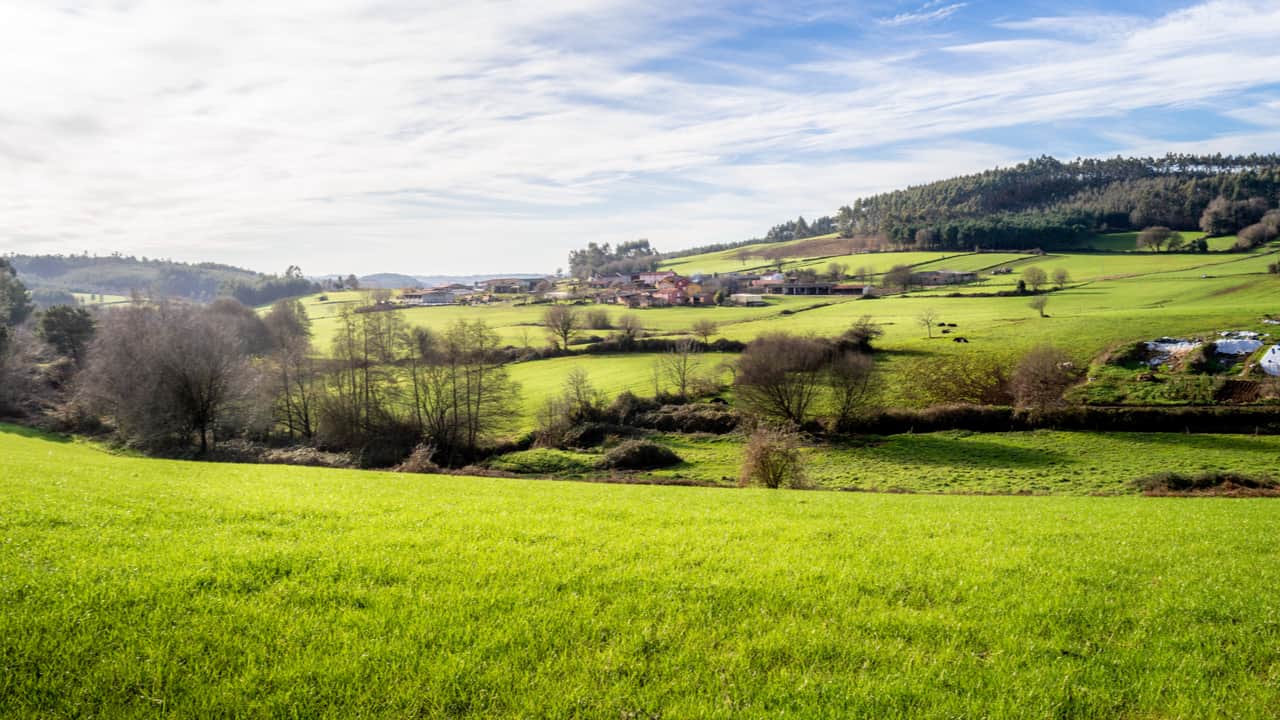
You will probably remember Arzúa for two things. The first is the cheese; Arzúa is the heart of one of Galicia's most respected dairy regions and the home of Arzúa-Ulloa, a soft cow's milk cheese with a Protected Designation of Origin. The second is the bittersweet feeling of standing in the main square knowing that Santiago de Compostela is only a long day's walk away. After weeks on the Camino de Santiago, even the dull last stretch feels precious. Arzúa is where most pilgrims start to slow down on purpose.
This is a practical guide to Arzúa for pilgrims walking the Camino Frances. It covers where the town sits on the route, what to see in the few hours you will probably spend awake there, what accommodation is realistic in peak season, and how to break the long final stage to Santiago into something the body actually wants to walk.
Where is Arzúa on the Camino Frances, and what is the town like?
Arzúa is the last sizable town on the Camino Frances before you arrive in Santiago. It sits in the province of A Coruña, in inland Galicia, with a population of roughly 7,000. It is also where the Camino del Norte (the northern coastal way) joins the Camino Francés, so from this point onwards both groups of pilgrims walk the same path into the city of Santiago.
Most pilgrims arrive in Arzúa from Palas de Rei or Melide. The walk in is through eucalyptus woods, dairy pastures, and a string of small hamlets. By the time you reach the town centre your legs know the rhythm; the cafés know what you want before you order. The high street is unromantic: a long, gently sloping road of pilgrim shops, supermercados, pharmacies, and bars. It is a working town with a guests' wing built in.
One small mercy of Arzúa: it is laid out along the Camino, not across it. You walk in, you walk out, and the albergues, hotels and restaurants are mostly within a hundred metres of the route. After a 28 kilometre day, that matters more than you think.
What is there to see in Arzúa?
Arzúa is not Santiago. Set your expectations accordingly and you will be quietly pleased. The historical sights are modest, manageable in an hour, and a useful counterweight to the lager-and-laundry afternoon that otherwise tends to fill the space between arrival and dinner.
The two stops worth making:
- Iglesia de Santiago (Parish Church of St James): a simple parish church with a calm interior, a quiet place to sit for ten minutes. The dedication to the apostle is, of course, the same one that pulls you down the route in the first place.
- Capilla de la Magdalena (the chapel and ruins of the old convent): the remains of an Augustinian convent and a small chapel founded in the medieval period to serve pilgrims. It is more atmospheric than grand. Five minutes is enough to take it in.
If you arrive in the first week of March, Arzúa's annual cheese festival takes over the town. The festival is a proper Galician celebration of Arzúa-Ulloa, with tastings, sausage stalls, and a market that draws people from across the province. Outside of that week, you can still buy excellent local cheese in the deli on the main street, often from the same farms that supply the festival.
None of this is the reason you came. The reason you came is one more day of walking. But for a couple of hours, it is a fair use of an afternoon.
Where should you stay in Arzúa? Albergues, pensions and hotels
Arzúa has more accommodation per capita than almost any other town on the Camino Frances. Public (Xunta) albergues, private albergues, pensions, small hotels and apartments line the route through the town centre. In summer, the volume of pilgrims grows quickly from Sarria onwards; in July and August, beds in Arzúa fill by mid-afternoon. Outside of those months a walk-in works most days.
The four main types of accommodation, and who each one suits:
- Xunta de Galicia public albergue: simple bunk-bed dormitories, around 10 euros a night, first-come first-served, no reservations. Best for budget-minded pilgrims who arrive early.
- Private albergues: typically 12 to 18 euros a night for a bunk, with reservations accepted. Often have laundry, a small kitchen, and a more sociable common room.
- Pension or guesthouse: small private rooms, often family-run, in the 35 to 65 euro range. Best for couples or those wanting a quiet night.
- Hotel: typically 60 to 110 euros for a double room. A hotel makes sense the night before your final push to Santiago, when sleep is more valuable than thrift.
The table below compares the typical features. Specific names and prices change year to year; use it as a planning sketch rather than a directory.
|
Type |
Typical price (per night) |
Beds / rooms |
Reservations |
Laundry / kitchen |
|
Public Xunta albergue |
10 euros |
~50 to 70 bunks |
Walk-in only |
Basic laundry, small kitchen |
|
Private albergue (basic) |
12 to 15 euros |
20 to 60 bunks |
Most accept |
Usually both |
|
Private albergue (premium) |
15 to 25 euros |
Mixed dorms and small rooms |
Recommended |
Usually both, plus breakfast |
|
Pension or small guesthouse |
35 to 65 euros |
5 to 15 private rooms |
Yes |
Sometimes; ask |
|
Hotel |
60 to 110 euros |
20 to 50 rooms |
Yes |
No kitchen; laundry on request |
Three practical points worth pinning above the door. First, the Xunta albergue does not accept reservations; if you want it, arrive before 3 pm in summer. Second, most private albergues will hold a bed if you call ahead by mid-morning. Third, if you walked from Melide or further today, your knees will thank you for a hotel or pension for the night before Santiago.
What amenities should you look for in an Arzúa albergue?
The boring questions are the ones that matter at 9 pm when your phone is on 12%, your socks need washing, and the kitchen is closed. Before you commit, check:
- Number of beds in the dormitory (smaller dorms sleep noticeably better).
- Hot showers and shower-to-bed ratio.
- Laundry: machine or just a sink and a line.
- Kitchen: full kitchen, microwave only, or none.
- Towel and linen policy: bring your own, hire, or included.
- Curfew and lights-out time.
- Distance to the start of the next morning's path.
A small private albergue with a real kitchen and a quiet dorm of 8 to 10 beds is, in my experience, the sweet spot in Arzúa. Marginally more expensive than the Xunta, much better sleep, and the breakfast next morning is usually serious.
How far is Arzúa from Santiago de Compostela?
The classic stage from Arzúa to Santiago is roughly 38.7 km. That is a long day at the best of times, and after a few weeks on the route it is a brutal one. Almost no one walks it in a single push. The two common splits are at Arca (also called O Pedrouzo), at about 19 km, or at Monte do Gozo, at about 33 km.
The table below sets out the practical numbers. Pick the split that suits your legs and your mood.
|
Stage |
Distance from Arzúa |
Distance remaining to Santiago |
What it gives you |
|
Arzúa to O Pedrouzo (Arca) |
19 km |
~19.5 km |
A balanced split with a normal final day |
|
Arzúa to Santa Irene |
15 km |
~24 km |
Quieter overnight, shorter today |
|
Arzúa to Amenal |
22 km |
~16 km |
Slightly longer today, shorter morning |
|
Arzúa to Monte do Gozo |
33 km |
~5 km |
Stage almost done, brief walk in next morning |
|
Arzúa to Santiago (one push) |
38.7 km |
0 |
A long day with a high reward |
Where should you split the final stage: O Pedrouzo or Monte do Gozo?
Most pilgrims overnight in O Pedrouzo. It is the obvious choice: roughly halfway, plenty of beds, three or four good cafés, and a tradition of pilgrim dinners that have been welcoming tired walkers for decades. From there, the final day into Santiago is around 19.5 km, which gives you time to arrive mid-morning, drop your pack, queue at the Pilgrim's Office, and still make the noon mass at the cathedral.
Monte do Gozo is the alternative. It is the first place on the route from which you can see the spires of Santiago Cathedral; the name itself means "Mount of Joy". There is a large modern pilgrim complex on the hill, with a Xunta albergue and several hundred beds. Staying here gives you a final morning walk of just 5 km, almost entirely downhill into the city. The trade-off is that the complex is functional rather than charming, and the moment of first seeing the cathedral, traditionally a hushed, slow moment, is undercut a little by the size of the building you sleep in.
If your knees are sound and you want a proper send-off to the route, O Pedrouzo is the conventional choice. If you are injured, in a hurry, or want the symbolic stop at Monte do Gozo, that is a perfectly good answer too. A few pilgrims split twice, with a short day to Santa Irene or Amenal first and a shorter morning into Santiago. The Camino does not care which you pick.
Where does Arzúa sit on the wider Camino Frances?
From Saint-Jean-Pied-de-Port on the French side of the Pyrenees to Santiago de Compostela, the Camino Frances runs roughly 780 km. The yellow concrete kilometer markers that count down through Galicia are some of the most photographed objects on the route, and you will pass the 40 kilometer mark just before Arzúa, the 30 kilometer mark a little after Salceda, and the 20 kilometer mark on the way into O Pedrouzo. By the time you arrive at Monte do Gozo the cathedral is 5 km away and the kilometer markers are nearly worn smooth by pilgrim hands.
For perspective, the table below sets out where Arzúa sits relative to the other meaningful waypoints on the Camino Frances. Most pilgrims will pass through several of these on their way; the last few rows show the final approach in detail.
|
Waypoint |
Approx. km from Saint-Jean-Pied-de-Port |
Approx. km remaining to Santiago |
|
Pamplona |
75 |
~705 |
|
Burgos |
282 |
~498 |
|
León |
491 |
~289 |
|
Sarria |
670 |
~110 |
|
Melide |
728 |
~52 |
|
Arzúa |
741 |
~39 |
|
O Pedrouzo |
760 |
~20 |
|
Monte do Gozo |
775 |
~5 |
|
Santiago de Compostela |
780 |
0 |
For pilgrims who started in Sarria to qualify for the Compostela (the Pilgrim's Office certificate requires the last 100 km on foot), Arzúa is the last full overnight before Santiago. For everyone else, it is one of the most welcoming places on the route to start letting the long walk close.
What to expect on the walk from Arzúa toward Santiago
The path from Arzúa is gentle. Eucalyptus woods, dairy farms, scattered hamlets, frequent cafés. You cross the village of Boente, the village of Salceda, and a string of smaller settlements with bars that pop open just early enough to catch the pre-dawn pilgrims. The Camino del Norte joined the Camino Frances back in Arzúa itself, so the path is busier than it was a few days ago.
Practical things to know about these last days:
- Start early. 6:30 am or earlier in summer gives you cool air and a quiet path for the first two hours.
- Carry a light snack. Most cafés open by 8 am, but a slice of empanada in the pack covers the gaps.
- Look after your feet. The eucalyptus path is gentle, but small downhill stretches at the end of the day finish off bad blisters.
- Save some energy for the cathedral. Arrival in Santiago is its own form of fatigue.
- If you are walking the Camino in summer, accept that the last 19 km from O Pedrouzo will be busier than anything you have walked so far.
Frequently asked questions about Arzúa on the Camino Frances
Is Arzúa on the Camino de Santiago?
Yes. Arzúa is a small town on the Camino Frances, the most walked of the Camino routes, around 39 km east of Santiago de Compostela. It is also where the Camino del Norte joins the Camino Frances for the last two days into Santiago.
Do I need to book an albergue in Arzúa in advance?
From late June through mid-September, yes for private albergues, hotels and pensions. The Xunta public albergue does not take reservations, but you can usually secure a bed if you arrive before 3 pm. Outside of peak summer, walk-in works most days. If your pilgrimage falls in the school holidays of July and August, book ahead and you will sleep easier.
How long does it take to walk from Arzúa to Santiago, and should I split the stage?
The full stage is roughly 38.7 km and takes 9 to 11 hours on foot for most walkers. Most pilgrims split it at Arca (O Pedrouzo) after 19 km. A smaller number stop at Monte do Gozo, around 5 km short of Santiago Cathedral. Walking it in a single push is possible but uncommon and rarely a happy choice for the body.
What is Monte do Gozo, and is it worth stopping there overnight?
Monte do Gozo is a small hill on the eastern edge of Santiago. Historically it is the first point on the Camino Frances where the spires of the cathedral come into view, which earned it its name (Mount of Joy). There is now a large modern pilgrim complex on the hill with a Xunta albergue and several hundred beds. It is worth stopping there overnight only if you want a very short final morning into the city. Most pilgrims pause for the view and walk on.
What is Arzúa known for besides the Camino?
Cheese. The town gives its name to Arzúa-Ulloa, a soft cow's milk Galician cheese with a Protected Designation of Origin, and to the annual cheese festival held in the first week of March. The pastures around Arzúa produce some of the best dairy in Galicia, and even outside of festival time the local cheese is widely available in shops and restaurants along the route.


