The first thing you notice is the smell. Not the eucalyptus, though that comes later, thick and medicinal in the forests south of Pontevedra. No, the first thing is the airport in Porto, the coffee, the particular warmth of Portuguese air even inside a terminal building, and then outside, the stone. Old stone, wet stone, stone that has been walked on for a thousand years and will be walked on for a thousand more. You stand there with your pack, wondering what exactly you’ve committed to, and whether your knees are up to the job.
The Camino Portugués is the second most popular route to Santiago de Compostela, and for good reason. It is shorter than the Camino Francés, less crowded (mostly), and it passes through two countries whose cultures overlap and diverge in ways that keep you curious for every kilometre. It is also, I should say at the outset, not a route to underestimate. Shorter does not mean easier. The Portuguese Way has its own particular challenges, its own rewards, and its own quiet beauty that reveals itself slowly, like a conversation with someone you’ve only just met but already trust.
This guide is everything I wish someone had told me before I walked it. The practical bits, the honest bits, the bits that guidebooks sometimes gloss over because they’re trying to sell you something. I’m not selling anything. I’m just a person who walked south to north with a blister on my left heel and a growing suspicion that I’d packed too many socks.
What is the Camino Portugués and why do people choose it?

The Camino Portugués is a pilgrimage route that runs from Lisbon (or, more commonly, Porto) north through Portugal and into Galicia, ending at the Cathedral of Santiago de Compostela. It follows, roughly, the path that Portuguese pilgrims have taken since the twelfth century, though the modern waymarked route diverges from the historical one in places where motorways and industrial estates have swallowed the old tracks.
People choose it for different reasons, and those reasons tend to shift as the walk progresses. Some want a shorter Camino than the Francés, which at roughly 800 kilometres is a serious commitment of time and annual leave. The Portuguese from Porto is around 240 kilometres, walkable in twelve to fourteen days. That’s manageable for people with jobs, families, and the kind of holiday allowance that doesn’t stretch to six weeks.
Others are drawn by Portugal itself. The country has a quality that’s hard to name precisely. A gentleness, perhaps. A slowness that isn’t lazy but deliberate. The tiles on the buildings, blue and white, cracked and beautiful. The pastéis de nata eaten standing at a counter at seven in the morning. The way old men sit outside cafés as if they have been placed there by a set designer who understands light.
Some choose it because they’ve already walked the Francés and want something different. Less infrastructure, fewer pilgrims, more solitude in sections, and a landscape that trades the Meseta’s vast openness for river valleys, vineyards, coastal paths, and the particular green of Galician countryside after rain.
Which Camino Portugués route should you take (Central vs Coastal vs Variante Espiritual)?

There are three main options, and each has a genuinely different character. This isn’t a case of one being better than the others. It’s a case of knowing what you want from the walk.
The Central Route is the traditional pilgrimage path. It runs inland from Porto through Barcelos, Ponte de Lima, Valença, and then across the border into Spain via Tui, continuing through Pontevedra and Padrón to Santiago. It passes through towns and villages with deep pilgrim history, Romanesque churches, and the kind of agricultural landscape where you walk between vineyards trained on granite pergolas. The path is well waymarked, infrastructure is solid, and you’re never far from a café or albergue.
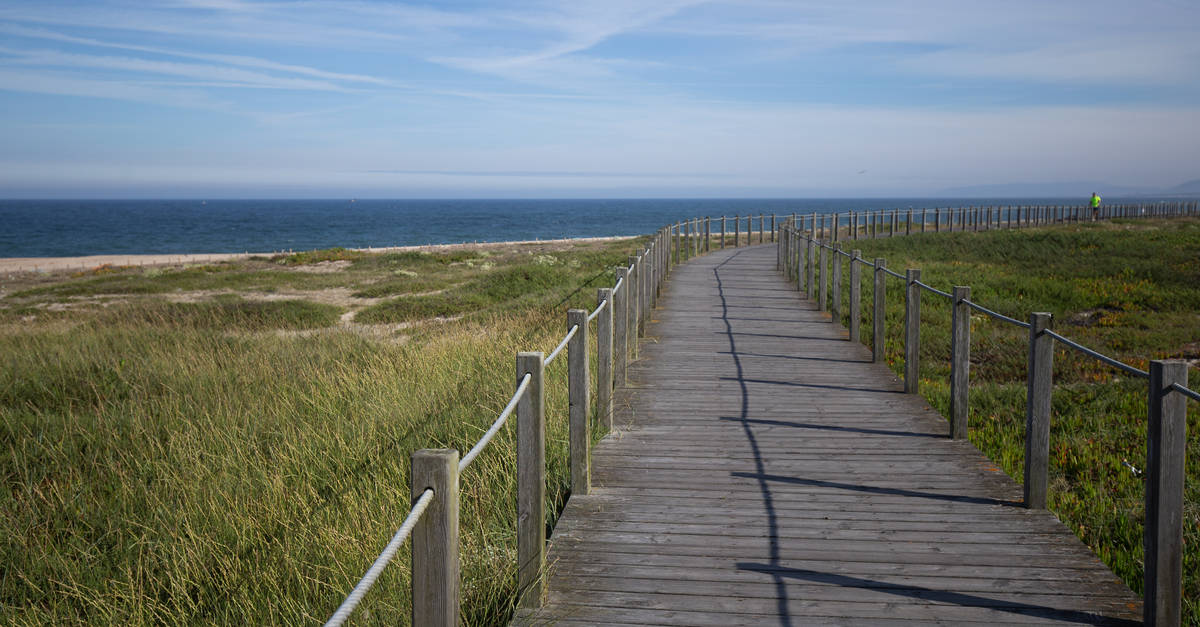
The Coastal Route (Caminho da Costa) follows the Atlantic coast north from Porto, through Matosinhos, Vila do Conde, Viana do Castelo, and then either cuts inland to rejoin the Central Route near Valença or crosses into Spain at the coast and continues through Baiona and Vigo. The obvious appeal is the sea. Long stretches of boardwalk over dunes, the sound of Atlantic surf, salt air, fishing villages, and some genuinely spectacular coastal scenery.
The Variante Espiritual is a detour rather than a separate route. It branches off from the Central Route at Pontevedra and takes you through the Ría de Arousa by boat, landing at Vilanova de Arousa before walking through Padrón to Santiago. The boat journey is meant to mirror the legendary arrival of Saint James’s remains by sea. It’s a beautiful and slightly strange experience, sitting in a boat with your pack and your boots, watching the Galician coastline slide past.
Here’s a rough comparison:
|
Feature |
Central Route |
Coastal Route |
Variante Espiritual |
|
Distance from Porto |
~240 km |
~260-280 km |
Adds ~25 km via detour |
|
Terrain |
Inland, mixed paths and roads |
Coastal, boardwalks and roads |
River and coastal, includes boat |
|
Difficulty |
Moderate |
Moderate |
Moderate (with logistics) |
|
Crowds |
More pilgrims |
Fewer in Portugal, more in Spain |
Fewer overall |
|
Scenery |
Vineyards, villages, churches |
Ocean, dunes, fishing towns |
Estuary, river, Padrón |
|
Infrastructure |
Excellent |
Good (improving) |
Adequate |
Which is better for first-timers: Central or Coastal?
If this is your first Camino and you want reliability, the Central Route. It has more albergues, better waymarking in some sections, and the rhythm of walking through villages with pilgrim history gives the experience a structure that feels intentional.
If you’re a confident walker who cares more about scenery than tradition, the Coastal Route is magnificent in sections. But be honest with yourself about how much tarmac-walking you’re willing to tolerate.
Many people combine the two: walking the Coastal Route through Portugal, then crossing to the Central Route in Spain. This gives you the best coastal scenery and the more established Spanish infrastructure.
Where should you start the Camino Portugués (Lisbon, Porto, or elsewhere)?

Lisbon is the traditional starting point, and walking the full route from the capital to Santiago is roughly 620 kilometres, requiring around four weeks. It’s a serious undertaking, but those who do it speak of the route’s gradual unfolding, the way Portugal reveals itself in layers as you move north.
Porto is where most people start. It’s accessible, beautiful, and the walk from here to Santiago is a comfortable two weeks. You get enough distance to feel like you’ve earned it, with enough variety of landscape and culture to stay interested.
Tui is the minimum starting point if you want to earn the Compostela certificate. It sits on the Spanish border, roughly 115 kilometres from Santiago. Tui itself is a lovely town with a fortress-cathedral perched above the river, and the walking through Galicia from here is consistently good.
How do the “last 100 km” rules work for the Compostela certificate?
To receive the Compostela, you need to walk at least the last 100 kilometres to Santiago (or cycle the last 200 kilometres). For the Camino Portugués, the 100-kilometre point falls roughly at Tui on the Central Route. Your credencial (pilgrim passport) must be stamped at least twice per day from the 100-kilometre mark onwards.
When is the best time to walk the Camino Portugués?

The honest answer: May, June, and September. April is possible but brings more rain and some albergues may still be closed. July and August are hot, genuinely hot, in inland Portugal and Galicia, with temperatures regularly exceeding 30°C.
Spring in northern Portugal is extraordinary. Wisteria drapes over stone walls, the vineyards are vivid green, wildflowers line the paths, and the air has that quality of being simultaneously warm and fresh. Late May and early June offer long days, manageable temperatures, and enough fellow pilgrims for company without the crush of peak summer.
September is my personal favourite. The light softens, the summer crowds thin, the wine harvest begins, and there’s a melancholy quality to the walk that suits pilgrimage.
How long does the Camino Portugués take and how do you plan daily stages?

From Porto, most people take between 12 and 16 days, depending on fitness, pace, and how many rest days they build in. The average daily stage is between 18 and 25 kilometres. Here’s a rough stage breakdown for the Central Route from Porto:
|
Stage |
From |
To |
Distance (approx.) |
|
1 |
Porto |
Vila do Conde/Rates |
26 km |
|
2 |
Rates |
Barcelos |
22 km |
|
3 |
Barcelos |
Ponte de Lima |
33 km (or split) |
|
4 |
Ponte de Lima |
Rubiães |
18 km |
|
5 |
Rubiães |
Valença/Tui |
20 km |
|
6 |
Tui |
O Porriño |
18 km |
|
7 |
O Porriño |
Redondela |
16 km |
|
8 |
Redondela |
Pontevedra |
20 km |
|
9 |
Pontevedra |
Caldas de Reis |
22 km |
|
10 |
Caldas de Reis |
Padrón |
19 km |
|
11 |
Padrón |
Santiago |
25 km |
These stages are conventional rather than fixed. The Barcelos to Ponte de Lima stage is long and many people split it. The first day out of Porto is also worth considering carefully; the urban walking through Matosinhos can be tiring and disorienting, and some people take a train or bus to skip this section.
Do you need to book accommodation in advance or can you be spontaneous?
For most of the year, you can walk without booking and find a bed. Municipal and private albergues operate on a first-come, first-served basis. The exception is the final two or three stages into Santiago, where pilgrim numbers increase significantly.
If you’re walking in peak summer (July/August) or during Easter week, booking ahead for at least some nights is sensible. Municipal albergues cannot be booked in advance.
One approach that works well: walk without bookings but carry a phone with accommodation apps (Booking.com, the Buen Camino app) and book one or two hours ahead if you’re worried about a particular stage.
How much does the Camino Portugués cost and what should you budget for?

This varies enormously depending on how you walk. The Camino can be done very cheaply or quite comfortably. Here’s a rough daily breakdown:
|
Category |
Budget |
Mid-range |
Comfortable |
|
Accommodation |
€6-12 (albergues) |
€15-30 (private albergues/pensiones) |
€40-80 (hotels/casas rurales) |
|
Food |
€15-20 (supermarket + pilgrim menu) |
€25-35 (cafés + restaurants) |
€40-60 (restaurants) |
|
Other |
€5 (stamps, water) |
€10 (coffee stops, small treats) |
€15-20 (wine, sightseeing) |
|
Daily total |
€26-37 |
€50-75 |
€95-160 |
Over two weeks from Porto, budget pilgrims spend roughly €400-550, mid-range walkers €700-1,050, and those preferring private rooms and restaurant meals €1,300-2,200. These figures exclude flights, gear, and travel insurance.
The pilgrim menu (menú del peregrino) in Spain is a fixed-price meal, typically three courses with bread, water, and sometimes wine, for roughly €10-13. In Portugal, the equivalent is the prato do dia (dish of the day), often equally generous and slightly cheaper.
What are the most important things to know before you go?

Navigation. The route is waymarked with yellow arrows and in some sections with blue and yellow azulejo tiles, which are specific to the Portuguese Way and rather beautiful. The waymarking varies in quality. In Spain, it’s generally excellent. In Portugal, there are occasional sections where arrows have faded or where urban sprawl has complicated the route. Carry a digital guide or app as backup.
Credencial. Your pilgrim passport. You can buy one in Porto at the Sé Cathedral or at the Portuguese Camino association office. You can also order one in advance from your national confraternity. Stamp it at albergues, churches, cafés, and tourist offices along the way.
Respect. You are walking through people’s villages, past their farms, along their streets. Keep noise down in the early morning. Close gates behind you. Don’t leave litter. Greet people. “Bom dia” in Portugal, “buenos días” in Spain.
Safety. The Camino Portugués is very safe. Violent crime is essentially unheard of on the route. The risks are practical: traffic on road sections, dehydration in summer, twisted ankles on cobblestones.
What apps and guidebooks are best for the Camino Portugués?
The Buen Camino app is excellent and widely used. It provides stage-by-stage navigation, elevation profiles, accommodation listings, and offline maps.
Gronze.com is a comprehensive Spanish-language resource with up-to-date accommodation listings and stage descriptions.
For physical guidebooks, the Cicerone guide to the Camino Portugués by Matthew Harms is practical and well-researched.
What should you pack and how should you train?

Pack less than you think you need. Then remove another item. The single most common mistake is overpacking.
Your pack, fully loaded with water, should weigh no more than 10% of your body weight. For most people, that means 7-9 kilograms.
Essentials:
- Backpack (35-40 litres)
- Two or three merino wool or synthetic t-shirts
- One pair of walking trousers
- Shorts
- Rain jacket (waterproof, breathable)
- Fleece or light insulating layer
- Underwear (2-3 pairs, quick-dry)
- Walking socks (2-3 pairs, wool blend)
- Trail shoes or lightweight boots (broken in, tested on long walks)
- Sandals or light shoes for evenings
- Sun hat
- Sleeping bag liner or ultralight sleeping bag
- Toiletries (small sizes)
- First aid kit (blister plasters, anti-chafing balm, painkillers, tape)
- Credencial and ID/passport
- Phone, charger, and portable battery
- Water bottle (1 litre minimum)
- Headlamp
- Earplugs (essential for albergue sleeping)
Training. Walk before you walk. In the two to three months before departure, build up to walking 20-25 kilometres in a day with your loaded pack. Walk on consecutive days. Pay attention to your feet. If a shoe pinches on a training walk, it will create a blister on the Camino.
How hard is the Camino Portugués compared to other Caminos?
The Portugués is generally considered one of the easier Caminos in terms of terrain. The Central Route from Porto has moderate elevation changes. Cobblestones, which are plentiful in Portuguese towns, are surprisingly hard on feet and ankles.
|
Route |
Difficulty |
Daily elevation |
Key challenges |
|
Camino Francés |
Moderate-Hard |
Variable, some big days |
Pyrenees, Meseta heat, length |
|
Camino Portugués (Central) |
Easy-Moderate |
Gentle |
Cobblestones, road sections, heat |
|
Camino del Norte |
Hard |
Significant coastal hills |
Elevation, weather, fewer services |
|
Camino Primitivo |
Hard |
Mountain terrain |
Steep climbs, remote sections |
How do you plan travel logistics from the United States?

There are no direct flights from the US to Porto as of the time I last checked, but connections through Lisbon, Madrid, London, Paris, and other European hubs are plentiful and generally affordable if booked in advance.
Getting to Porto. Fly into Porto’s Francisco Sá Carneiro Airport. From the airport, the metro runs directly to the city centre in about 30 minutes.
Leaving from Santiago. Santiago de Compostela has an airport with flights to Madrid, Barcelona, London, and other European cities. Alternatively, take the train from Santiago to Madrid (roughly 5 hours) or to Porto (about 4-5 hours) and fly home from either city.
Practical tips for transatlantic travellers:
– Arrive in Porto at least one day before you plan to start walking
– Consider spending two nights in Porto. The city deserves it, and you’ll start walking rested
– Travel insurance that covers trip interruption and medical evacuation is worth the cost
– Notify your bank and credit card companies of your travel dates
Frequently Asked Questions
Do I need to speak Portuguese or Spanish to walk the Camino Portugués?
No. You can walk the entire route speaking only English, particularly in the larger towns and on the well-trodden stages. That said, learning a few dozen words in each language will improve your experience enormously. “Bom dia,” “obrigado/obrigada,” “por favor,” and “onde é o albergue?” in Portuguese will carry you a long way. In Spain, the equivalents plus “una cerveza, por favor” will see you through.
Can I walk the Camino Portugués solo (and is it safe)?
Yes, and yes. Solo walking is one of the great pleasures of pilgrimage. You walk at your own pace, stop when you want, eat when you’re hungry, and sit in silence when silence is what you need. You will also find that solo walking on the Camino is a somewhat temporary condition; you’ll meet people at albergues, over dinner, on the path, and some of those meetings will become the highlights of your walk.
Women walking solo report feeling safe on the Camino Portugués, and the community of pilgrims provides an informal network of mutual awareness.
What’s the best way to avoid blisters and injuries on the Portuguese Way?
Blisters are the great democratic affliction of the Camino. The best prevention is broken-in footwear (never start a Camino in new shoes), good socks (merino wool, not cotton, never cotton), and early intervention. The moment you feel a hot spot, stop and address it. A piece of tape or a blister plaster applied at kilometre five can prevent a debilitating wound by kilometre fifteen.
Keep your feet dry. Change socks at lunch. Air your feet at rest stops.
How do I get a pilgrim passport (credencial) and where do I stamp it?
You can obtain a credencial from several sources:
- In Porto: The Sé Cathedral and the Portuguese Camino association office
- Before you leave home: Many national confraternities and Camino societies sell them online
- Along the route: Some albergues and churches can provide them
Stamp your credencial at every stop: albergues, churches, cafés, tourist offices, municipal buildings. In the final 100 kilometres, you need at least two stamps per day for the Compostela.
Should I choose Central or Coastal if I’m worried about crowds?
If crowds are your primary concern, the Coastal Route through Portugal will be quieter than the Central Route for most of the year. However, both routes converge as they approach Santiago, and the final stages are busy regardless of which path you’ve taken.
If you want the quietest possible experience, walk in shoulder season (April/May or late September/October) on the Coastal Route. If you want company and the pilgrim social experience, walk the Central Route in June or September.


