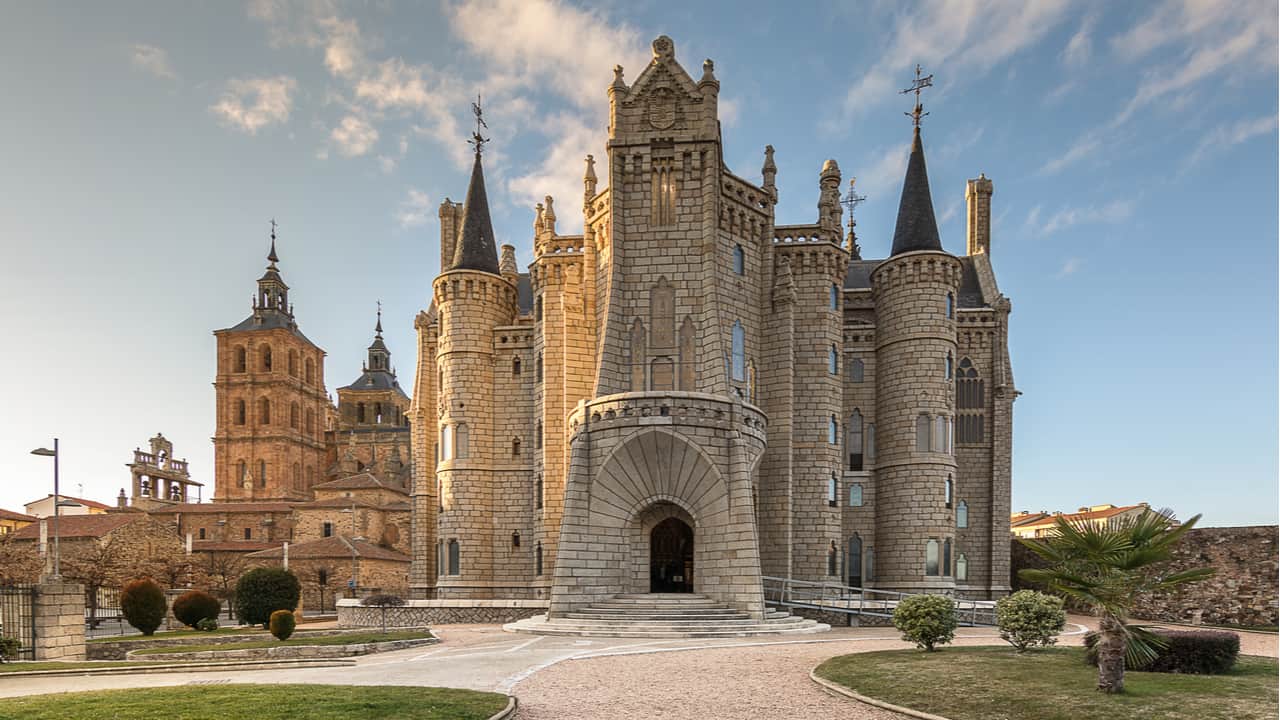
Astorga is the kind of town the Camino Francés trains you to appreciate. By the time you walk in, you have crossed the Pyrenees, traversed the Meseta, left León behind, and earned a slow afternoon in a city that has been welcoming pilgrims for longer than most of Europe has been Christian. Roman walls. A cathedral with a baroque façade and a quieter Gothic heart. A Gaudí palace, the strangest building on the entire pilgrimage route. And cocido maragato, a meal so heavy that you should not attempt it the day before a long stage.
This city guide is for pilgrims who walk the Camino de Santiago, particularly the route of the Camino de Santiago known as the Camino Frances, and arrive in Astorga on foot. It covers what the city is, what to see, where to sleep, what to eat, and how the next stretch of the Camino route climbs into the mountains toward Foncebadón, the Cruz de Ferro, and O Cebreiro. If you only have a few hours in Astorga, the guide tells you how to spend them. If you have a rest day, all the better.
Where is Astorga on the Camino Frances, and which stages connect to it?
Astorga sits at roughly 480 km from Saint Jean Pied de Port and around 260 km from Santiago de Compostela. On the Camino Frances, also called the French Way, it is the gateway to the León mountains and the last sizable city before the route climbs through Rabanal del Camino, past the Cruz de Ferro, and down into Ponferrada and El Bierzo. Pilgrims walking the entire Camino arrive in Astorga between days 20 and 25, depending on pace; those who started in Sarria for the last 100 km of the Camino do not reach Astorga at all, which is one of the small tragedies of the Sarria-only approach. If you have walked from Saint Jean Pied de Port or even from León, Astorga is a city you will remember; if you started in Sarria, you will hear other pilgrims talking about it and quietly wonder.
Three classic stages around Astorga:
- León to Astorga (roughly 50 km). Most pilgrims split this in two with a short overnight in Villadangos del Páramo or San Martín del Camino.
- Astorga to Rabanal del Camino (roughly 21 km). A gentle morning’s walk through quiet hamlets, the start of the climb into the León mountains.
- Rabanal del Camino to Ponferrada (roughly 33 km). Over the Cruz de Ferro and down through Foncebadón, El Acebo, and Molinaseca. A long descent that demands good footwear and a slower-than-usual pace.
If you are using a guidebook organised in 33 stages, Astorga is usually stage 22 or 23. The waymarking through the town itself is straightforward; the Camino route enters from the Puente de Hierro and leaves through the Plaza San Francisco. You will not have to look hard for the yellow arrows.
Why has Astorga been a crossroads since Roman times?
Astorga was founded as Asturica Augusta around 14 BC, on the orders of Emperor Augustus, as a base for the Roman conquest of the Asturian and Cantabrian tribes of northern Spain. From the start it was a Roman city of consequence: a junction of major roads connecting the gold-mining region of Las Médulas, the Atlantic ports, and the broader network of Iberian highways. The historian Pliny the Elder called it a magnificent city. The Roman walls, parts of which still stand at the eastern edge of the old town, give a small sense of the scale.
It is fair to say that the city has been knocked down and rebuilt more often than most. After the fall of Rome, Astorga passed under Visigoth rule. In the early 8th century it was sacked during the Muslim expansion across Iberia, then partially abandoned, then resettled. By around the year 850 it had become a Christian stronghold under the Kingdom of Asturias, with a new cathedral, a bishop’s seat, and a fresh population. From the 11th century onwards, as the Camino de Santiago grew into the most walked pilgrimage route in Christian Europe, Astorga’s position on the road made it one of the most important cities on the way.
Most of this history is still visible if you know where to look. The Roman walls and a small but well-curated Roman museum. The medieval street pattern around the cathedral. The old hospital and pilgrim-care buildings near the cathedral square. Even the cathedral itself, with stones from several centuries layered into a single façade. Astorga wears its past lightly, but it is everywhere.
How did Astorga become famous for helping pilgrims?
At the height of the medieval pilgrimage, Astorga housed twenty one hospices for pilgrims, a number second only to Burgos on the entire Camino Frances. A hospice (in the medieval sense) was a small religious or charitable institution that gave travelers a bed, a meal, basic medical care, and a blessing for the road ahead. Most were run by religious orders, others by lay confraternities, a few by the cathedral chapter itself. Together they made Astorga one of the most reliably hospitable cities on the route.
What makes Astorga unusual is that even as the pilgrimage to Santiago dwindled after the Reformation, the city continued to use some of these buildings to shelter the homeless and the poor. Most other former pilgrim cities along the Camino de Santiago repurposed or demolished their hospices once the Camino traffic dried up. Astorga kept theirs in service. A small fact, but it tells you something about the city’s character.
Today the legacy survives in two ways. First, in the practical: there is a generous municipal albergue, several private albergues, and a community of local volunteers who keep the network running through the busy summer months. Second, in the symbolic: the cathedral and the city museum both display pilgrim-care artefacts, and the famous Bishop’s Palace next to the cathedral now houses the excellent Museo de los Caminos, a museum dedicated to the history of the pilgrimage routes.
What are the best things to see in Astorga?
For a city of fewer than 11,000 residents, Astorga has a long list of sights. In a half day, three are essential: the cathedral, the Gaudí Bishop’s Palace, and the Roman walls. With a full rest day you can also add the Chocolate Museum (Astorga has been a chocolate town since the 17th century), the Roman museum, and a slow circuit of the old town.
|
Sight |
Typical visit time |
Why pilgrims stop |
|
Astorga Cathedral |
45 to 60 minutes |
The spiritual heart of the city, a working pilgrim cathedral on the Camino route |
|
Gaudí Bishop’s Palace (Museo de los Caminos) |
60 to 90 minutes |
One of only a handful of Gaudí buildings outside Catalonia; houses the museum of the pilgrimage routes |
|
Roman walls and Roman museum |
45 minutes |
Two thousand years of city history in walking distance from the cathedral square |
|
Plaza Mayor and old town loop |
30 minutes |
A walkable medieval street pattern with cafés and ironwork |
|
Museum of Chocolate |
30 to 45 minutes |
Astorga has been a chocolate town since the 17th century; the museum sets out the story |
|
Convento de San Francisco |
20 minutes |
Quiet medieval convent on the western edge of town, where the Camino exits |
Astorga Cathedral
Astorga Cathedral was built between the 15th and 18th centuries on the site of an earlier Romanesque cathedral. The result is a building that mixes late Gothic interior arches with a baroque main façade and a Renaissance retablo behind the altar. It is not the most architecturally consistent cathedral on the Camino, but it is one of the more atmospheric. A small admission fee, around 6 euros, includes the small diocesan museum next door, which has medieval pilgrim relics and a fragment of a 12th century pilgrim staff.
The cathedral hosts the pilgrim mass on most evenings around 7 pm, with the daily blessing of pilgrims passing through. Even if you are not religious, the blessing is a small, quiet ritual worth sitting through. The acoustics of the nave amplify the priest’s voice in a way that always sounds a little ancient.
The Gaudí Bishop’s Palace (Palacio Episcopal)
This is the strangest building on the entire Camino de Santiago. Antoni Gaudí, the Catalan architect best known for the Sagrada Família in Barcelona, designed the Bishop’s Palace between 1889 and 1913 at the invitation of the bishop of Astorga (who happened to be Catalan). The result is a neo-Gothic stone fantasy of turrets, ribbed vaults, stained glass, and angular stairwells; one of only a handful of Gaudí buildings outside Catalonia.
The palace now houses the Museo de los Caminos, a museum dedicated to the history of the pilgrimage routes that converge on Santiago. The collection includes medieval pilgrim relics, route maps, hospice artefacts, and a thoughtful exhibition on the spiritual and economic role of the Camino through the centuries. Admission is around 6 euros. Plan 60 to 90 minutes; longer if the museum holds your attention.
The Roman walls
The visible Roman walls of Asturica Augusta wrap the eastern edge of the old town. Most of what stands today is the lower courses of the original 3rd century structure, with later medieval rebuilding on top. There is no charge to walk along the wall path, which gives a quiet, residential view of the city. The Roman museum, a few minutes’ walk away, fills in the rest of the story with mosaics, inscriptions, and the foundations of a Roman house excavated under what is now a city street.
Where should pilgrims sleep in Astorga? Albergues and accommodation
Astorga has good accommodation for every budget. The municipal albergue (Albergue de Peregrinos San Javier) is one of the friendliest on the Camino Frances and a popular choice for first-night-in-Astorga pilgrims. Several private albergues offer slightly more comfort, smaller dorms, and a usually quieter night. There are also pensions, small hotels, and one or two paradores within a half hour’s drive.
|
Type |
Typical price (per night) |
Reservations? |
Best for |
|
Municipal albergue |
10 euros (donativo at some) |
Walk-in only |
Pilgrim experience, sociable, central |
|
Private albergue |
12 to 18 euros |
Most accept |
Smaller dorms, kitchen, laundry |
|
Pension |
35 to 55 euros |
Yes |
Couples, light sleepers, rest day |
|
Hotel (3 to 4 star) |
60 to 110 euros |
Yes |
A proper bed before the mountain stages |
|
Boutique guesthouse |
80 to 130 euros |
Yes |
Rest day with a long bath and a real breakfast |
Three practical notes from experience. First, the municipal albergue and most private albergues are within five minutes walk of the cathedral square; you do not lose much time finding any of them. Second, if you arrive on a Friday or Saturday in July or August, book the private albergues by mid-morning; the walk-in queue at the municipal builds quickly. Third, the climb out of Astorga begins gently, so a slightly heavier breakfast at your accommodation will not slow your morning.
What should you eat in Astorga?
Astorga’s signature dish is cocido maragato, the heaviest plate on the Camino de Santiago. The local Maragato people serve their cocido in reverse order: meats first (seven or eight different cuts, with chickpeas), then the vegetables, then the soup last. The reasoning, depending on who you ask, is either practical (mule drivers ate the meat first in case bandits arrived mid-meal) or culinary (the soup as a settling end). The portion size is properly intimidating. Order one between two people unless you are walking nowhere tomorrow.
Three other Astorga staples worth tracking down:
- Mantecadas de Astorga: small, soft, almond-flecked sponge cakes baked in distinctive paper cases. A whole box weighs almost nothing and survives in a pack for a couple of days.
- Chocolate from Astorga’s old chocolate houses: the city has been making chocolate since the 17th century. The traditional bars are slightly grainy and intensely cocoa-forward; a good souvenir.
- Cecina: a cured beef from the León region, served in thin slices, often as a starter with bread and olive oil.
Most pilgrim menus in Astorga offer cocido maragato as one of the available mains, alongside more conventional starters of salad or soup. A pilgrim menu of three courses with wine and bread typically costs 12 to 18 euros. The chocolate is best bought at one of the smaller shops near the Plaza Mayor rather than the tourist outlets directly opposite the cathedral.
The next stages: Astorga, Rabanal del Camino, the Cruz de Ferro, and O Cebreiro
What gives Astorga part of its character is the mountain landscape that begins at its gates. From Astorga the Camino climbs steadily for two days, first to Rabanal del Camino, then up to Foncebadón and the Cruz de Ferro at around 1,500 metres, then down into the El Bierzo valley. A few days later the route climbs again to O Cebreiro in Galicia, the small mountain village where you cross into the final region of the route.
A rough sense of distances for the next several days along the Camino:
|
Stage |
Distance (km) |
Notes |
|
Astorga to Rabanal del Camino |
21 |
Gentle climb, quiet hamlets |
|
Rabanal to Ponferrada (via Cruz de Ferro) |
33 |
Highest point of the Camino Frances; long descent |
|
Ponferrada to Villafranca del Bierzo |
24 |
Vineyards and a beautiful arrival |
|
Villafranca to O Cebreiro |
28 |
A serious mountain climb into Galicia |
|
O Cebreiro to Sarria |
40 |
Usually split over two days; Sarria is the popular starting point for the last 100 km |
The Cruz de Ferro deserves a paragraph of its own. It is a small iron cross on top of a tall wooden pole at the highest point of the route. Tradition has it that pilgrims carry a small stone from home and lay it at the foot of the cross, as a way of leaving behind something they want to be free of. The pile is now several metres high. Whatever your views on ritual, it is one of the quieter and more affecting moments on the entire Camino Frances.
O Cebreiro, two days further on, is the small mountain village that marks the border into Galicia. Stone-walled, often misty, with thatched-roof pallozas (round Celtic-style houses) and the church where the medieval miracle of the host is said to have occurred. After the descent from O Cebreiro you have around 150 km of Galicia ahead, ending in the cathedral of Santiago de Compostela.
Quick orientation for first-time pilgrims arriving in Astorga
If you are walking the Camino for the first time and Astorga is your first night in León province, a small checklist for the afternoon:
- Arrive between 1 and 3 pm to give yourself the afternoon for the cathedral and the Gaudí palace.
- Drop your pack at your accommodation, shower, change, and eat something light before sightseeing.
- Visit the cathedral first; the museum and the palace second; the Roman walls third.
- Eat the cocido maragato only if tomorrow is a short stage or a rest day.
- Buy a small box of mantecadas for the morning.
- Read or look up the next stage to Rabanal del Camino so you know what to expect at dawn.
The Camino Francés is a UNESCO World Heritage site, and the route through Astorga’s old town has been walked, in some form, for over a thousand years. Walking it now is a small inheritance from those who walked it before you. Astorga is one of the better places along the route to feel that weight without being crushed by it.
Frequently asked questions about Astorga on the Camino Frances
How far is Astorga from Santiago de Compostela?
Astorga is roughly 260 km from Santiago de Compostela by the Camino Frances route, around 12 to 14 walking days for most pilgrims. The route from Astorga crosses the mountains of León, descends into El Bierzo, climbs again to O Cebreiro in Galicia, and finishes through the rolling green countryside of Galician dairy country.
Is Astorga worth a rest day on the Camino?
Yes, more so than most cities on the Camino Frances. Between the cathedral, the Gaudí Bishop’s Palace, the Roman walls, the chocolate museum, and the food, Astorga easily fills a full day. It is also a sensible place to rest before the mountain stages to the Cruz de Ferro and beyond. If your knees or feet have started to complain on the Meseta, a day off in Astorga is one of the wiser choices on the Camino de Santiago.
Where does the Camino Frances enter and leave Astorga?
The Camino Frances enters Astorga from the east via the Puente de Hierro and the railway crossing, then climbs gently into the old town along Calle de los Sitios. It leaves through the Plaza San Francisco on the western edge of town, past the Convento de San Francisco, and out into the open countryside toward Murias de Rechivaldo and Rabanal del Camino. The waymarking is excellent throughout, with yellow arrows and scallop shells along the entire route through the city.
Why is Astorga associated with Gaudí?
The bishop of Astorga in the late 19th century was Joan Baptista Grau i Vallespinós, a Catalan, who commissioned his fellow Catalan Antoni Gaudí to design a new Bishop’s Palace after the old one burned down in 1886. Gaudí worked on the building between 1889 and 1913, although the project was paused several times and was eventually finished by other architects. The result is one of only a handful of Gaudí buildings outside Catalonia and a startling neo-Gothic counterpoint to the more conventional cathedral next door.
What is cocido maragato and should I order it?
Cocido maragato is the signature dish of the Maragato people, the historic muleteer community of the Astorga region. It is a heavy three-part meal served in reverse: meats and chickpeas first, then vegetables, then a clear soup at the end. The portion is intimidating, the flavours are excellent, and a single serving is generous enough for two pilgrims to share. Order it on a rest day or the night before a short stage; never the night before a hard mountain morning toward the Cruz de Ferro.


