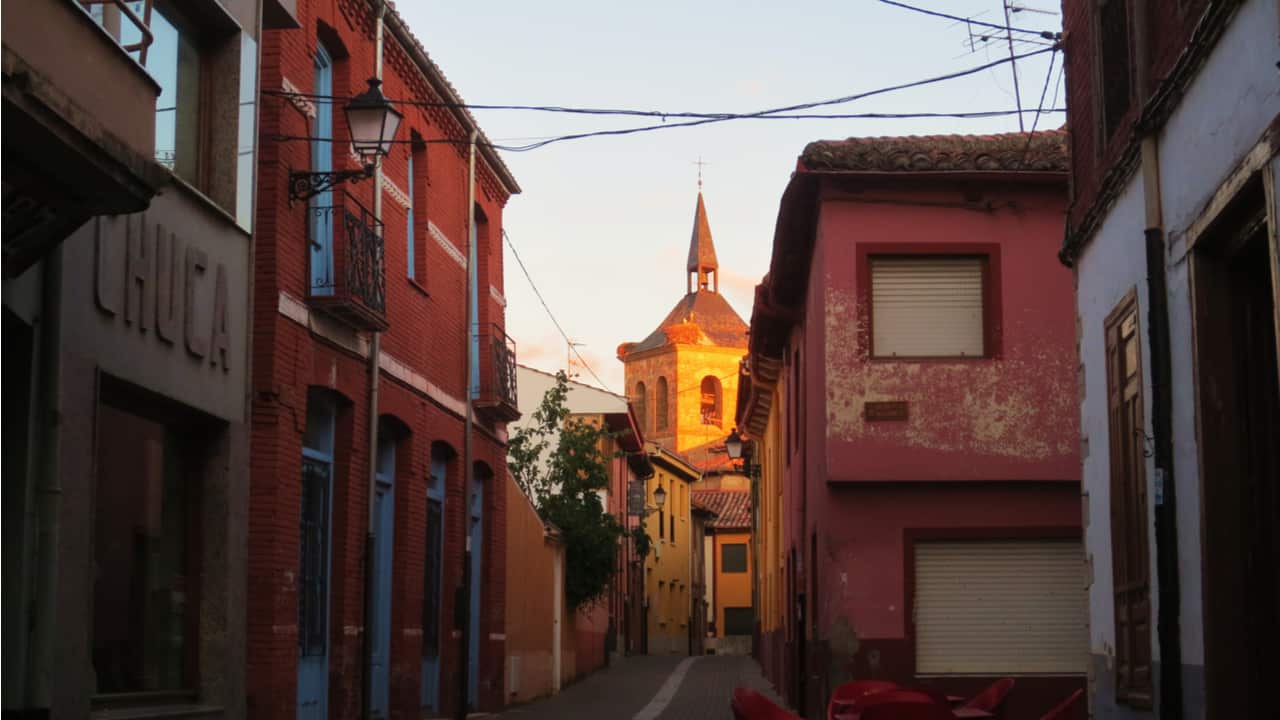
I woke in Mansilla de las Mulas with that particular ache you get in the second half of a long Camino, the one that lives behind the knees and somewhere in the soul. Eighteen kilometres to Leon. Flat. Easy, everyone said. And it was, mostly, in the way that the meseta is easy: a long, quiet line of path that asks nothing dramatic of your legs and a great deal of your patience.
This stage from Mansilla de las Mulas to Leon is the unglamorous one, the section people skip in their photo albums. It runs largely alongside the N-120, with traffic murmuring past your shoulder, and it ends not in a hilltop sunset but in a tangle of suburbs and roundabouts. And yet I would not have missed it. Leon waits at the end of it, the last major city before Santiago, and walking in slowly, on foot, the way pilgrims have for a thousand years, is the right way to arrive.
What follows is an honest account of the day, plus the practical bones you need: distances, villages, where the coffee is, and what to do once the cathedral comes into view.
What is the Mansilla de las Mulas to Leon stage like (distance and terrain)?
The Mansilla de las Mulas to Leon stage covers roughly 18.2 km, a little over eleven miles. It is one of the shorter days on the Camino Frances, and it is genuinely easy underfoot. The path is mostly flat, the meseta's last gentle exhalation before the land begins to fold and rise again towards the mountains of the Bierzo. There is one notable rise, a small climb on the approach between Arcahueja and Leon, and that is the only point where your calves will properly register the day.
Most pilgrims walk it in four to five hours at an unhurried pace, longer if, like me, you treat every village bar as a reason to sit down. Counted in American miles or in kilometers, it lands at the gentler end of any Camino day. You will see this stage written both ways on signs and apps, as Mansilla de las Mulas to Leon and, in Spanish, as Mansilla de las Mulas to León. The defining feature of the stage is not the gradient but the road. For long stretches you walk a path or a track running parallel to the N-120, the old national road into Leon. It is not pretty. It is functional. The eucalyptus and woodsmoke of Galicia are still days away; here the air smells of warm tarmac and dry grass.
Here is the day in brief:
|
Detail |
What to expect |
|
Distance |
About 18.2 km (roughly 11.3 miles) |
|
Difficulty |
Easy, mostly flat, one small rise near Leon |
|
Walking time |
Around 4 to 5 hours, plus stops |
|
Terrain |
Path and track, much of it beside the N-120 |
|
Services |
Bars and cafes in villages roughly every few kilometres |
|
Ends at |
Leon, the last major city before Santiago |
If you have just come from the wide-open silence of the earlier meseta days, this is the stage where the world begins to fill up again with cars, signs, and people. Some pilgrims find that jarring after the emptiness. I found it oddly comforting, like the first murmur of a party heard from the garden.
Why spend time in Mansilla de las Mulas before you leave?
Mansilla de las Mulas is a quiet town, and I almost walked through it without looking up. That would have been a mistake. It sits on the River Esla, and it was a Roman settlement long before it was a pilgrim stop. The name has nothing to do with mules, despite the donkeys on the town crest; it is one of those etymological knots that locals enjoy untangling for you over a coffee.
The thing that stops you is the wall. Mansilla still wears a good stretch of its 12th century town walls, thick and tawny, the kind of medieval masonry that makes you put a hand on it just to feel the centuries. Within them, the old centre is small and walkable, with the 18th century Church of Santa Maria and its unusual circular retablo, an altarpiece that curves round in a way you do not often see.
There is one more reason to linger near here, and it is the best of them. A short distance off the Camino lies the Monastery of San Miguel de Escalada, Spain's finest surviving Mozarabic monastery, built by monks who carried their southern, Moorish-influenced style north in the 10th century. The horseshoe arches alone are worth the detour. It is closed on some days, so check before you build your morning around it; on the wrong day you will stand at a locked gate, as a few footsore pilgrims have learned the hard way.
Before you walk, sort the practical things in Mansilla:
- Eat a proper breakfast; the early villages may not be open when you pass.
- Fill your water bottles, since much of the day is exposed.
- Buy any pharmacy basics, blister tape especially, while a chemist is to hand.
- Grab pastries from a bakery for the road if you like a mid-morning snack.
This town also marks the end of one of the loneliest meseta sections. If you walked in from the west, you will have crossed the long, straight farmland tracks described in the stage from El Burgo Ranero into Mansilla de las Mulas, and you will understand why a town with walls and a coffee bar feels like such a homecoming.
How do you walk from Mansilla de las Mulas to Leon step by step?
Leaving Mansilla is simple. You cross the bridge over the Esla and pick up the yellow arrows that take you out of town and onto the path running roughly parallel to the N-120. The waymarking is clear for the whole stage; this is not a day where you will get lost, only a day where you must keep your wits about you near traffic.
The rhythm of the morning is steady and undramatic. You walk, a village appears, you stop for coffee, you walk again. The land is open and the path is firm. On a clear day you can sometimes pick out the faint line of the mountains ahead, the ones you will climb later in the Camino Frances. For now they are just a promise on the horizon.
A word on safety, because this is a road-adjacent stage and it deserves saying plainly. For much of the day you walk close to a working national road. Keep one earbud out, or both; you want to hear what is coming. Walk on the side that faces oncoming traffic where the path forces you onto the verge, stay visible, and at the two river crossings, Puente Villarente and Puente Castro, take care at the points where pedestrians and vehicles share the same narrow bridge.
For pacing, I would suggest one of two plans depending on your mood:
- Leisurely with cafe stops: linger over coffee in each village, arrive in Leon early afternoon, and treat the walk as a gentle transition day.
- Arrive early to explore: walk steadily with one short break, reach Leon before lunch, and give yourself a full afternoon in the city.
I chose the second, and I was glad of it. Leon is a city that rewards an unhurried afternoon, and arriving early meant I had time to rest, wash, and still wander the old quarter before the evening crowds gathered.
What towns and villages will you pass through?
The gift of this stage is that the villages come at sensible intervals. You are never more than a few kilometres from a bar, a bench, or a working toilet, which on a hot meseta day matters more than scenery. Several of these villages offer regular stops for food and coffee, though hours vary by season and you should not assume everything will be open at eight in the morning.
Here is roughly how the day breaks down by village and distance:
|
Village |
Approx. distance |
What's there |
|
Mansilla de las Mulas |
0 km (start) |
Full services, bakeries, pharmacy, walls |
|
Villamoros de Mansilla |
About 4.4 km |
Small village, a bar for first coffee |
|
Puente Villarente |
About 6.3 km |
Bars, shops, river bridge, services |
|
Arcahueja |
About 10.5 km |
Bar and albergue, regroup before the rise |
|
Valdelafuente |
About 12 km |
Roadside services on the climb |
|
Puente Castro |
About 15.9 km |
Edge of Leon, the city begins |
|
Leon |
About 18.2 km |
Cathedral, albergues, hotels, everything |
What will you find in Villamoros de Mansilla?
Villamoros de Mansilla arrives about 4.4 km in, a small cluster of houses that makes a good first quick stop. If a bar is open, this is the place for a second coffee and a pastry, and an early restroom break before the longer pull to the next stop. Do not count on it being open early; small-village hours are a law unto themselves.
What is in Puente Villarente?
Puente Villarente sits roughly 1.9 km further on, where the Camino crosses the River Porma on a long old bridge. It is the most reliable mid-morning stop of the day, with several bars, a shop or two, and a casa or hostel for anyone wanting to split the stage. I sat here with a cafe con leche and watched a heron stand in the river, utterly unbothered by the pilgrims trooping past. The bridge itself is worth a pause; cross the bridge slowly and look down at the water.
Why do pilgrims mention Arcahueja?
Arcahueja, about 4.2 km after Puente Villarente, is where the day changes. There is a bar and an albergue, and it functions as the natural regroup point before the approach to Leon. This is where the stage's one small rise begins to make itself felt, a gentle climb up towards the alto before the city. The sensible move is to hydrate here, eat something, and steady yourself for the climb and the urban entry to come. It is not a hard climb. It is just the only one, so it feels bigger than it is.
What is Puente Castro and why does it matter?
Puente Castro, roughly 5.4 km after Arcahueja, is effectively the threshold of Leon. You cross a bridge, the houses thicken, and you are suddenly in the city's orbit. The character of the walk shifts entirely: from quiet path to busy pavement, from birdsong to traffic lights. This is the moment to slow down rather than speed up. The waymarking continues through the streets, but it is easy to drift off-route when you are tired and the arrows compete with shop signs and crossroads. Follow the shells set into the pavement and you will be fine.
What are the potential challenges on this stage?
Easy is not the same as effortless, and this stage has its own small trials. None of them is serious. All of them are worth knowing about before you set off, because the things that catch pilgrims out are usually the ones nobody warned them about.
The honest list of what can make the day harder than the elevation profile suggests:
- Road noise and exposure: walking near the N-120 for hours is tiring in a low, grinding way that flat terrain alone is not.
- Sun and wind: the meseta offers little shade, and a hot, windy day on open ground saps you quietly.
- Repetitive strain: flat walking can still bother hips, shins, and feet, precisely because there is no variation in the stride.
- The urban approach: the last few kilometres through suburbs feel longer than they are, and fatigue peaks just as attention drops.
The fixes are unglamorous and they work. Take short breaks before you need them. Stretch your calves and hips at each stop. Keep on top of your feet; this is no day to ignore a hotspot. If blisters are a recurring worry on your Camino, it is worth reading up on blister prevention on the Camino de Santiago before you ever lace up, because prevention on a flat stage like this is far easier than cure. And as you come into the city, do not let your guard down at crossings just because the walking is over; that is exactly when the foot goes wrong.
When should you arrive in Leon, and what should you do there?
Arrive early. I will say it plainly because Leon earns it. This is the last major city before Santiago de Compostela, a genuine milestone on the Camino Frances, and most pilgrims want time to rest, resupply, and simply enjoy being somewhere with proper restaurants and a magnificent cathedral. Roll in at four in the afternoon, exhausted, and you will miss half of what makes the city special.
An early arrival also improves your chances of a good bed. The popular albergues and the better-located private rooms fill through the afternoon, especially in the busy months, so the pilgrim who walks in before lunch has the pick of them and a calmer check-in. There is a strong argument for booking a private room here if your budget allows; after weeks of bunkrooms, a door that locks and a shower of your own can feel like an enormous luxury.
Once you have dropped your pack, the priorities sort themselves out quickly:
- Wash yourself and your clothes; many places have laundry, and your socks will thank you.
- Run errands: pharmacy, gear repairs, a resupply of snacks for the road.
- Eat properly; Leon is famous for its tapas, often served free with a drink in the Barrio Humedo.
- Plan your next stage out of the city before you get too comfortable.
And then, with the practical things done, go and see the city. The Gothic cathedral of Leon is the reason most pilgrims stay, and rightly so. Its stained glass is among the finest in Spain, vast walls of coloured light that turn the stone interior into something close to luminous. Near it stands the Basilica of San Isidoro, with its Romanesque royal pantheon and frescoes that have kept their colour for the better part of a thousand years. Down in the centre you will find the Casa de los Botines, a curious building by Gaudi, all turrets and grey stone, looking faintly as though it wandered north from Barcelona and decided to stay. The plazas fill in the evening, the bars open, and the city does what Spanish cities do best after dark. For a fuller account of what to see, the dedicated guide to Leon on the Camino de Santiago is the place to go.
Where can you stay in Leon?
Leon offers the full range of pilgrim accommodation, from cheap and communal to quiet and private. The right choice depends on your budget, how badly you want a good night's sleep, and how close to the route you wish to be.
The broad options, with their trade-offs:
|
Type |
Roughly what it offers |
Best for |
|
Albergue |
Dormitory beds, communal, lowest cost |
Budget walkers, the social crowd |
|
Pension or hostal |
Simple private or shared rooms, modest price |
A balance of cost and privacy |
|
Hotel |
Full private rooms, more comfort, higher price |
A proper rest before the mountains |
When you choose, weigh a few things beyond price. Proximity to the Camino route through the city saves tired legs the next morning. Early check-in and luggage storage matter if you arrive before your room is ready. Laundry availability is a genuine factor this far into a walk. And give a thought to noise: a central spot near the nightlife is wonderful until two in the morning, when sleep matters more than atmosphere.
The single best thing you can do for your accommodation options is to arrive earlier. In the busier months the good beds go first, and timing your day to reach Leon before the afternoon rush quietly solves most lodging problems before they start.
What apps, books, and websites help most for this section?
You do not need much technology for a stage this straightforward, but a little goes a long way. The waymarking is good, so navigation is more about reassurance than rescue.
What I found genuinely useful:
- A map-based Camino app you can use offline, for confirming you are on route through the city streets of Leon.
- An elevation profile, mostly to remind yourself that the one small rise really is the only one.
- A stage planner and accommodation finder, helpful for booking ahead in the busy season.
- A weather app set to Leon province, since sun and wind are the real variables on open ground.
The one thing I would gently warn against is overplanning. It is tempting to schedule every kilometre and every coffee, but the joy of a stage like this is the freedom to stop when a village bar looks inviting. If you want to dig deeper into route mapping and stage logistics for the wider walk, the broader guide to the Camino Frances covers the whole pilgrimage in detail, and the writing on walking the meseta will help you make sense of the flat, exposed character of these final pre-Leon days.
Leon is also a natural place to think ahead. From here the Camino splits and climbs, and the kilometres begin to feel different. Some pilgrims take a rest day; some push straight on. Whatever you choose, you have reached a place worth pausing in, and you walked every meter of the way here yourself. That counts for something.
Frequently asked questions
How long does it take to walk from Mansilla de las Mulas to Leon?
Most pilgrims walk the 18.2 km in about four to five hours at a steady pace. Add an hour or more if you stop for coffee in the villages, which most people do. Because the terrain is flat and the waymarking clear, your total time depends far more on how often you sit down than on the difficulty of the walking.
Is the Mansilla to Leon stage hard?
No, it is one of the easier stages on the Camino Frances. The terrain is mostly flat, with only one small rise between Arcahueja and Leon. What can make it feel harder than its profile suggests is the heat, the wind, and the long stretches of walking near the N-120, none of which is dangerous but all of which is wearing over several hours.
Are there enough cafes and services along the way?
Yes. Several villages along the route, including Villamoros de Mansilla, Puente Villarente, and Arcahueja, offer regular stops for food and coffee. Bear in mind that opening hours vary by season, and the earliest villages may not be open if you set off at dawn, so eat breakfast in Mansilla before you leave.
What is the one climb everyone mentions on this stage?
It is the small rise between Arcahueja and Leon, a gentle climb up towards the alto on the approach to the city. It is genuinely modest, but because the rest of the day is so flat, it is the only point where you notice the gradient. Hydrate at Arcahueja, take it slowly, and it will be over before you have finished grumbling about it.
Why is Leon considered a milestone on the Camino Frances?
Leon is the last major city before Santiago de Compostela, which makes it a natural place to rest, resupply, and take stock of the journey. It also holds some of the finest art on the whole route, from the stained glass of its Gothic cathedral to the frescoes of the Basilica of San Isidoro, so most pilgrims give it a full afternoon or even a rest day.


