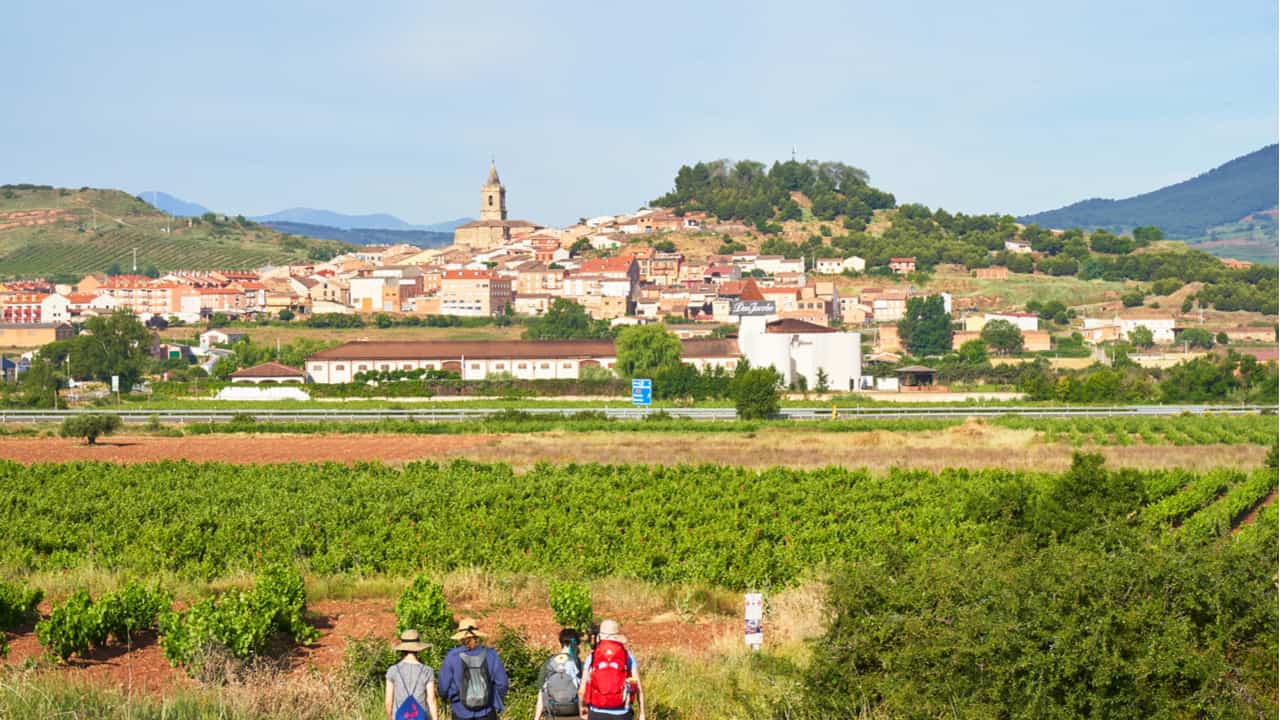
You smell Najera before you see much of it: warm tarmac, the river, a faint thread of someone’s late lunch carrying on the wind. I came down off the long red earth above Navarrete with my socks stiff and my mind half elsewhere, and then the red cliffs rose up on the far bank of the Najerilla and the town simply unfolded beneath them. After a morning of vineyards and silence, the noise of an ordinary Spanish town doing ordinary Spanish things felt almost rude. A scooter. A delivery van reversing. Two old men arguing pleasantly outside a bar. I stood on the bridge longer than I needed to, just to take it in.
This is a guide to Najera as a pilgrim actually meets it, on foot, tired, looking for a bed and a meal and somewhere to sit. It covers where the town sits on the Camino Frances, how you arrive, the history that pulled the route through here in the first place, the one church you should not miss, and the practical business of staying the night. I have woven in what the guidebooks say and what my own feet remember, and I have tried to be honest about both.
Where is Najera on the Camino Frances?
Najera is a town of roughly 8,400 people in La Rioja, northern Spain, sitting on the Camino Frances between Logrono and Santo Domingo de la Calzada. Most stage guides place it at the end of the walk that begins in Logrono and passes through Navarrete, often labelled Stage 8 of the French Way. The name is generally said to come from an Arabic root meaning “between cliffs,” and one look at the russet rock wall behind the old town tells you the name earned itself honestly.
For a pilgrim, the practical headline is this: Najera is a proper town, not a hamlet. After a run of small Camino villages where the only shop is the bar and the bar shuts when the owner fancies a nap, Najera has supermarkets, a pharmacy, banks, restaurants, and a tourist office. It is the kind of place where you can replace the sock that died, find a chemist for your blisters, and eat something that is not a bocadillo. That alone makes it a natural overnight stop.
Here is roughly how the town fits among its neighbours on this part of the route:
|
Place |
Region |
What pilgrims find there |
|
Logrono |
La Rioja |
Large city, tapas streets, the usual start of the stage to Najera |
|
Navarrete |
La Rioja |
Hilltop town, potters and wine, the main midpoint before Najera |
|
Ventosa |
La Rioja |
Small village just off or beside the route, a quiet break stop |
|
Najera |
La Rioja |
Busy market town, full services, Santa Maria la Real, river and cliffs |
|
Santo Domingo de la Calzada |
La Rioja |
The next town along, historic, a common end point for the following day |
If you are still piecing your route together and trying to understand how all these stages knit into the wider walk, the broader guide to the Camino Frances pilgrimage sets the whole French Way in context, from Saint Jean Pied de Port over the Pyrenees through to Santiago de Compostela.
How do you walk into Najera from Logrono and Navarrete?
The day into Najera usually starts in Logrono, a Rioja city that wakes slowly and smells of last night’s wine. You leave through the Parque de la Grajera, a reservoir on the edge of town where joggers and dog-walkers share the path with bleary pilgrims, then climb gently into vineyard country. The vines here are low and gnarled, the soil a deep brick red, and on a clear morning you can see for miles. Navarrete sits on its hill ahead of you for a long time before you reach it, which is either encouraging or maddening depending on how your feet feel.
Navarrete is the obvious place to stop for a second breakfast. A café con leche, a slice of tortilla, a chance to peel off your boots in the small plaza below the church. From there the route rolls on through more vines toward Najera, passing close to the small village of Ventosa, with the cemetery wall on the way out of Navarrete carrying scallop shells set into the stonework. It is a quietly moving thing to walk past, that wall, the symbol of the journey pressed into the place where local journeys end.
The terrain on this stretch is kind by Camino standards. Rolling rather than steep, mostly on dirt farm tracks and quiet roadside paths, with the N-120 and the A-12 never far away. Shade is the main thing missing. La Rioja in high summer can be punishing, and there are long open sections with no trees and no fountain, so this is a day to carry more water than you think you need and to be off your feet by early afternoon if you can.
A few practical notes for the approach into town:
- Leave Logrono early in summer; the open vineyard sections offer almost no shade by midday.
- Resupply in Navarrete if you can, since the villages after it are small and may be closed during siesta.
- Carry extra water for the long, exposed stretches between the towns.
- Watch your footing where the path runs beside the road; cyclists share these tracks and come up quietly behind you.
- The final approach drops you to the river, and the albergues and old town sit across the bridge on the far bank.
If you walked the section before this one, you will already know the rhythm of Rioja walking. The earlier stretch through Los Arcos and on toward Viana shares the same open, agricultural feel of the Camino Francés through this region, all big skies and long sightlines, and it sets you up well for the wider country between Logrono and Najera.
What towns and villages lie between Logrono and Najera?
This is one of the questions pilgrims ask most, usually while squinting at a guidebook over breakfast, because the answer shapes where you take your breaks. The short version is that the day is anchored by two real towns, Logrono and Navarrete, with smaller settlements scattered between and after.
Navarrete is the substantial midpoint, a town in its own right with cafes, shops, and a striking church. Ventosa comes later, a small village that some pilgrims detour into for a drink and others pass by entirely. Between and around these, you walk mostly through open farmland and vineyards rather than a string of villages, which is part of why water and timing matter so much on this stage. The settlement you most want to know about, after Navarrete, is the one you are walking toward: the stretch from Navarrete to Najera is the heart of this day, and it is where the cliffs and the river finally come into view.
Some walkers split the stage differently, stopping short in Navarrete or pushing on past Najera, and that is the quiet freedom of the Camino: the stages in the books are suggestions, not laws. Your knees get a vote. So does the weather.
What is the history of Najera on the Camino de Santiago?
Najera is older and grander than its workaday market-town surface suggests. In the 11th century it was a seat of real power. Sancho the Great, also known as Sancho III, made Najera a centre of his kingdom, and for a time the town served as the capital of Navarre. This was no minor waystation; it was a place where kings lived and were eventually buried.
The Camino connection grew from that importance. The pilgrims’ route was diverted to pass through Najera, drawing the great medieval river of walkers, traders, and clergy in through its streets. A hospital of San Juan de Acre once served pilgrims here, part of the network of care that grew up along the whole pilgrimage to Santiago de Compostela. Walk the old town today and you are following a path that was deliberately bent toward this place nearly a thousand years ago, for reasons of faith, politics, and trade all tangled together.
A rough timeline helps hold it in the mind before you visit the monastery:
|
Period |
What happened in Najera |
|
Early 11th century |
Sancho the Great makes Najera a royal capital of his Navarrese kingdom |
|
1052 |
King Garcia founds the monastery and Church of Santa Maria la Real |
|
Medieval centuries |
The pilgrims’ route is diverted through the town; a pilgrim hospital serves the way |
|
Today |
A busy La Rioja market town and a working Camino Frances stop |
It is worth knowing this before you arrive, because Najera’s bustle can fool you. The supermarkets and the traffic make it feel ordinary. The history sits just behind that, in the rock and in one remarkable church.
What should you see in Najera? Santa Maria la Real
If you see one thing in Najera, see the Monastery and Church of Santa Maria la Real. It was founded in 1052 by King Garcia, and it is built right up against the red cliff that gives the town its name, so that the rock itself becomes part of the building. There is something quietly extraordinary about a church that grows out of a cliff, as though the faith and the geology were always meant to meet.
You do not need a whole afternoon. Thirty to ninety minutes is enough to take in what matters, and that suits a pilgrim who arrives footsore and wants to wash and eat before everything closes. If your time is short, give it to three things: the cave shrine, the Baroque retablo, and the royal pantheon. Each one rewards a slow look.
What is the legend of the cave at Santa Maria la Real?
The church exists because of a cave, and a story. Legend tells that King Garcia, out hunting, followed his falcon into a cave in the cliff and there discovered a statue of the Virgin Mary, with a lamp burning and flowers at her feet. Moved by what he found, he founded the monastery on the spot. Whether you take the tale as history, faith, or folklore, the cave is still there, folded into the heart of the church, and standing in that cool dim hollow with the town’s traffic muffled outside is the kind of quiet that the Camino keeps handing you when you least expect it.
It remains a sacred space and a working place of worship, so the usual courtesies apply: keep your voice low, take your hat off, and be mindful with photographs, especially if a service or a moment of prayer is underway. Pilgrims are welcome. Loud pilgrims, less so.
What royal art and tombs can pilgrims see inside?
Inside, two things tend to stop people. The first is the Baroque retablo, the great carved and gilded altarpiece, dense with figures and gold, the sort of thing that takes a few minutes of standing still before your eye can read it properly. The second is the Plateresque pantheon, a royal burial place holding the tombs of Navarrese kings and queens. This is the thread back to the town’s medieval power: the rulers who made Najera a capital lie here, a few steps from the cave that started it all.
The pieces fit together as one site. The cliff holds the cave, the cave anchors the church, the church houses the retablo and the royal tombs, and the cloister ties the monastery complex around it. For a pilgrim who has spent the day among vines, it is a concentrated dose of why this route carries so much history. A handful of things to look for as you walk through:
- The cave shrine set into the cliff, with its statue of the Virgin Mary.
- The Baroque retablo above the main altar, gilded and crowded with carved figures.
- The Plateresque pantheon and the Navarran royal tombs.
- The Gothic cloister, with its tracery, often the quietest corner of the whole site.
Where can pilgrims stay in Najera?
Najera offers the full range of pilgrim lodging, which is one of the reasons it works so well as an overnight stop. At the budget end sit the albergues, the pilgrim hostels with dormitory beds; the municipal albergue here is well known among walkers, and there are private albergues too, including the often-mentioned Albergue Puerta de Najera near the river. Above those, the town has pensions, a hostal or two, and small hotels for anyone who wants a private room, a door that locks, and a night without the dawn chorus of zips and snoring.
How you choose comes down to what you need that night rather than any rule. Some nights you want company and a cheap bed and do not care about the noise. Other nights, usually after a hard day, you would pay almost anything for a quiet room and a real shower. Both are easy to find here. The town’s range of albergues and pilgrim hostels means you rarely have to settle for the last bed in the worst spot.
A simple way to decide:
- Choose an albergue if you want the cheapest bed, the pilgrim atmosphere, and do not mind a dormitory.
- Choose a pension, hostal, or hotel if you want privacy, quiet, and a better chance of sleep.
- Lean toward private rooms after long or wet days, when recovery matters more than saving a few euros.
- Consider noise and light: river-side and old-town spots can be lively in the evenings.
Before you commit, a few things are worth checking, especially in the busy months. Ask about check-in times, since many albergues open only in the early afternoon. Confirm whether linen and towels are provided or whether you are relying on your sleeping bag liner. Check for laundry, secure bike storage if you are cycling, and how close the bed is to the marked route through town, so you are not adding an extra kilometre to a tired evening.
What problems should you plan for on this stage and in town?
The Logrono to Najera stage is not difficult, but it has its quiet traps, and most of them come down to heat, feet, and timing. The single biggest one is sun. Those open vineyard kilometres bake in summer, with little shade and few fountains, and pilgrims underestimate them every year. Drink before you are thirsty, start early, and treat the midday hours with respect.
Feet are the other recurring theme. The walking is gentle, which tempts people into a faster pace than their skin is ready for, and gentle terrain still raises blisters if your socks are wrong or your laces are loose. Plan your breaks before town rather than pushing through, and deal with hot spots the moment you feel them. If blisters are already a worry for you, the broader advice on blister prevention on the Camino is worth a read before you set out, ideally before the damage is done rather than after.
The town itself has its own small rhythms to plan around. Spanish siesta hours mean shops and some kitchens close in the afternoon and reopen in the early evening, so if you arrive hungry at three you may have to wait, or hunt for a bar still serving. In peak Camino months, beds fill, and a town this popular can run short by mid-afternoon. And because Najera is busier than the villages, the streets near the centre carry actual traffic, so the half-asleep, eyes-down walking that is safe on a farm track is less safe here. Look up. Find the historic centre, or stay on the marked route, and let the town’s noise remind you that you have, for one night, rejoined the ordinary world.
What apps, maps, and resources help most for Najera?
You do not need much technology to walk into Najera, since the yellow arrows do most of the work, but a little planning saves grief. Most pilgrims lean on one navigation app, one accommodation resource, and a paper backup, and leave it at that. The Wise Pilgrim app and guides are popular for stage detail and lodging, and many walkers use Casa Ivar’s forum and listings, alongside the maps in whichever guidebook they are carrying.
For United States pilgrims in particular, who cannot easily nip home for a forgotten charger, a light kit of resources earns its place in the pack. The essentials worth sorting before you fly:
- An offline maps app, so you are not relying on patchy signal in the vineyards.
- An accommodation app or site for albergues and private rooms, for the nights you want to book ahead.
- A basic translation app, since not every albergue host speaks English.
- Emergency contacts saved offline, including your accommodation and insurer.
- A paper guide or printed stage notes as a backup when the battery dies.
None of this is heavy or complicated. The point is simply to have your navigation, your beds, and your emergency details sorted before you fly, so that the only thing left to do in Najera is walk in, find your bed, and let the town look after you for a night.
What logistics should pilgrims from the United States consider?
Walking the Camino from the United States adds a layer of planning that European pilgrims often skip, and a stage like this one, in the middle of the route, is a useful moment to make sure the wider trip is sound. Travel insurance is the part people most often leave too late. A walking pilgrimage runs for weeks, in a foreign healthcare system, with a real if small chance of a sprained ankle, a fall, or a flight delay, and decent cover for medical treatment, trip interruption, and, where relevant, evacuation is worth the modest cost.
When you read the policy, check the specifics rather than trusting the headline. Make sure long-distance walking or hiking is actually covered as an activity, that the trip duration matches your full time away, and that any pre-existing conditions are declared and included. The towns of La Rioja have pharmacies and clinics, Najera among them, but you do not want to discover the limits of your cover from a treatment room in Spain.
Beyond insurance, a short document checklist keeps the boring essentials in order:
- Passport, valid well beyond your travel dates, plus a photocopy kept separately.
- Your pilgrim credential, the passport stamped at albergues and bars along the way.
- Copies of your insurance details and emergency contacts, on paper and saved offline.
- A mix of payment methods: a card that works abroad and some cash for small albergues and rural bars.
Najera, busy and well-served, is a good place to take stock of all this. Restock the pharmacy bag, draw out a little cash, check your onward beds, and let the town’s small conveniences do you a favour before the route narrows again.
How does Najera fit into the rest of your walk?
Najera sits in the heart of La Rioja, roughly a week or so into a full Camino Frances depending on your pace, with the great cities of Burgos and Leon and the green hills of Galicia still well ahead. It is one of those Camino towns that is easy to underrate on arrival and surprisingly easy to miss when you have gone. A market town with a cathedral-sized story tucked behind the supermarket, a cliff with a cave in it, kings sleeping under carved stone, and a river that turns gold in the evening light.
When you leave the next morning, the route carries on toward Santo Domingo de la Calzada, and the day from Najera to Santo Domingo de la Calzada takes you back out into the vineyards and the wheat. Cross the bridge, climb away from the river, and let the town slide behind you. You will carry a little of it onward, the cave, the gold light, the noise of an ordinary place, the way the Camino quietly insists you do with everywhere you pass through.
Frequently asked questions about Najera on the Camino Frances
Is Najera worth stopping for, or should I walk through to the next town?
For most pilgrims, Najera is well worth a stop. It has full services after a run of smaller villages, a major historic site in Santa Maria la Real, and plenty of beds and places to eat. It also offers a kind of cultural reset, a busy ordinary town that feels different after days of quiet hamlets. If you are pushing for distance you can walk on, but you would be passing a genuinely interesting place.
How much time do I need to visit Santa Maria la Real?
Between thirty and ninety minutes is enough for most pilgrims. A quick look takes in the cave shrine, the Baroque retablo, and the royal pantheon. If you want to linger in the Gothic cloister and read the history more slowly, give it the full hour and a half. It fits comfortably into an afternoon after you have found your bed.
Do I need to book accommodation in Najera in advance?
In the peak Camino months, and on weekends, booking ahead is sensible because this popular town can fill by mid-afternoon. In the quieter shoulder season, walking in and finding a bed is usually fine, especially if you arrive early. If you strongly prefer a private room over a dormitory, booking ahead is always the safer choice.
What is the story behind Najera’s name?
The name is generally said to derive from an Arabic root meaning “between cliffs,” and the town’s setting matches it closely. The old quarter is pressed against a wall of red rock on the banks of the river Najerilla, so the name reads almost as a description. It is a small but lovely example of how layered northern Spain’s history is, with Arabic, Navarrese, and Christian threads all woven into one place on the route.
Is Najera a good place to stay the night on the Logrono to Najera stage?
Yes, it is one of the natural overnight stops on this part of the Camino Frances. It sits at a sensible distance from Logrono for a single day’s walk, and it offers far more lodging, food, and services than the villages around it. The main trade-off is that it is busier and a little noisier than a small Camino village, which most pilgrims happily accept for the comfort and the history.


