You reach Palas de Rei with Santiago de Compostela close enough to feel, and that does odd things to a person. By this point on the Camino Francés the maths is simple and slightly terrifying: a few more days of walking and the whole thing ends. Palas de Rei sits squarely in that final stretch, a small Galician town that most pilgrims pass through on the way to somewhere they have been imagining for weeks.
I will be honest. Palas de Rei is not the prettiest stop on the Camino de Santiago. It does not need to be. It is a working town with somewhere to sleep, somewhere to eat, and a Romanesque church that has outlasted its own legend. If you are planning logistics from the United States, sorting distances and daily walking and where to put your feet up, this guide is the practical, slightly tired version of what I wish I had known.
What is Palas de Rei, and why do pilgrims stop here on the Camino Francés?
Palas de Rei is a town in the province of Lugo, in the autonomous community of Galicia, sitting on the Camino Frances roughly two days short of Santiago de Compostela. For walkers doing the last stretch from Sarria, this is usually the end of day 3, give or take a stage, which is why it shows up on almost every itinerary for the final 100 km.
The name carries more weight than the place. Palas de Rei means, loosely, "palace of the king," and the 12th-century Codex Calixtinus, that medieval pilgrim's guidebook, called this spot the "Royal Palace." Tradition links the name to the Visigoth king Witiza, said to have kept a residence of the Visigoth king somewhere nearby in the early 8th century. Whether the royal palace ever stood here in any grand sense is uncertain, and you will find no obvious ruins of one. The grandeur is in the name, not the streetscape.
So why stop? Three plain reasons:
- It breaks the distance neatly before the long stage to Arzúa.
- It has enough beds, bars and restaurants, and a supermarket to resupply.
- It sits at the gateway to a genuinely interesting parish full of old stone.
That last point matters more than the town's modest main street suggests. Spend a night, walk on, and most of you will remember Palas de Rei chiefly as the place you slept before the leg breaker. Fair enough. But there is a little more here if you slow down.
What can you see in Palas de Rei itself, and what is left of its history?
Less than the name promises, and that is the honest answer. The "royal" Palas de Rei is long gone, if it was ever quite as royal as the Codex suggests. What remains is a quiet Galician town that the Camino passes straight through, with a handful of things worth lifting your eyes for.
The one site I would not skip is the Church of San Tirso. The Iglesia de San Tirso is a modest parish church, much rebuilt over the centuries, but it keeps a Romanesque portal from the 12th century set into the newer fabric. Stand in front of it for a moment. The carved doorway, with its receding arches and worn capitals, is the kind of detail that rewards a slow look: the sort of Romanesque stonework the Camino is quietly stitched together from, all the way back to its medieval beginnings.
For orientation, here is roughly what you pass and where, walking through:
|
Feature |
What you will find |
Why pause |
|
Church of San Tirso |
Romanesque portal, 12th century, on a rebuilt church |
The town's one must-see monument; look at the carved doorway |
|
Main street and town centre |
Bars, a couple of restaurants, a small supermarket, a pharmacy |
Resupply, dinner, and the pilgrim stamp before you leave |
|
Camino waymarking |
Yellow arrows and scallop-shell markers through town |
Easy to follow; the route dips downhill on the way out |
|
Accommodation |
Municipal albergue, private albergues, a hotel or two, casas rurales |
Book ahead in summer; beds fill on this busy final stretch |
You will also want your credencial stamped. Most bars, the albergue, and the church area can sort a stamp, and you need two per day on the last 100 km if you want your Compostela in Santiago. It is a small ritual, that thump of the rubber stamp, and oddly satisfying after a long day's walking.
What Romanesque heritage is nearby if you have extra time?
This is where Palas de Rei quietly over-delivers. The surrounding parish and municipality are unusually rich in old churches, with something like twenty Romanesque churches scattered through the wider area. You cannot see them all, and you should not try, not with a 28.5 km day waiting for you.
If you have an afternoon and the legs for a small detour, the one most pilgrims single out is the Iglesia de San Salvador de Vilar de Donas. The church of San Salvador de Vilar de Donas sits a short way off the main route near the village of Vilar de Donas, and it is worth the effort: a 14th-century church with faded medieval frescoes and the tombs of the Knights of Santiago, the military order that once protected pilgrims on this very road. It is the kind of place that feels far older than the modern town you slept in.
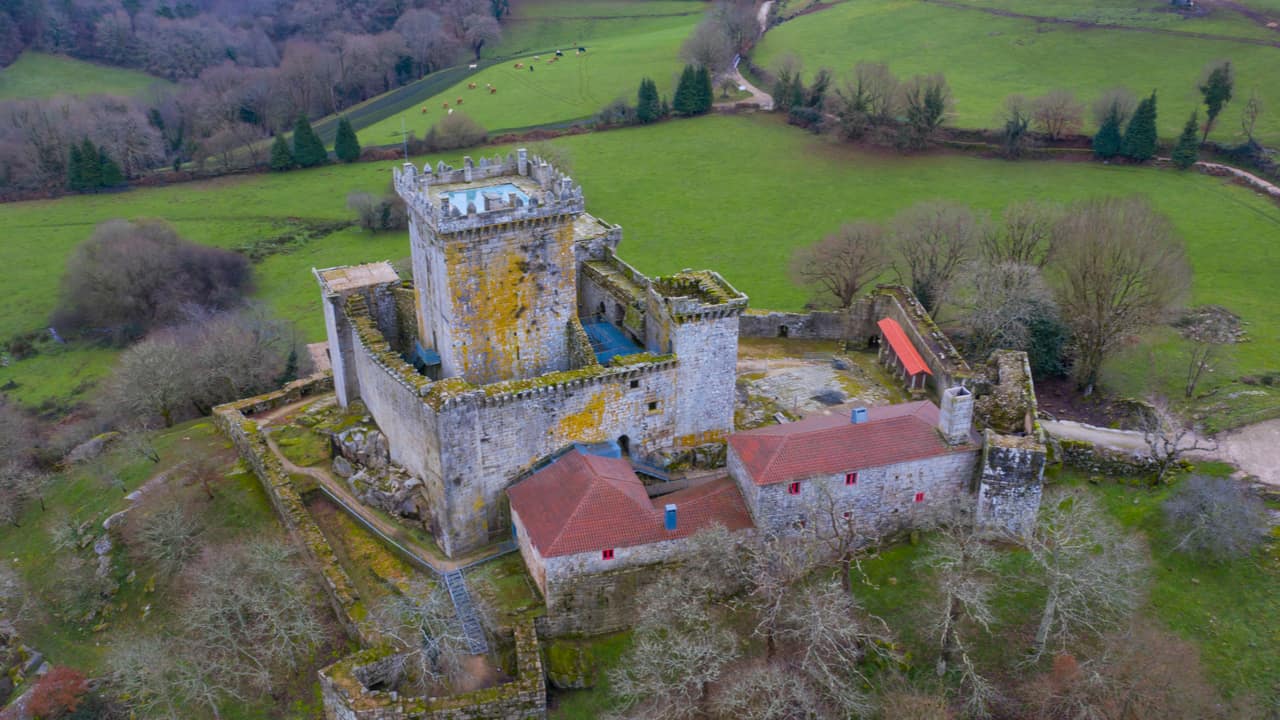
There is also the Castelo de Pambre, a 14th-century fortress on the River Pambre southwest of town, one of the few Galician castles to survive the medieval revolts more or less intact. It is a proper detour rather than a quick stroll, so weigh it against your tired feet. My honest advice: pick one. Choose Vilar de Donas if you love old churches, or Pambre if you want a castle. Trying to do both on a walking day is how blisters are born.
How long is the stage from Palas de Rei to Arzúa, and why is it called the "leg breaker"?
The stage from Palas de Rei to Arzúa runs roughly 28.5 km, and that distance is the whole story behind the nickname. Locals and guidebooks call it the "leg breaker," which sounds dramatic until you remember it lands on day walking number three or four for most people doing the final stretch, when the earlier miles have already taken their toll. It is the length, and the timing, far more than the terrain.
Twenty-eight kilometres is a long day in anyone's book. Add tired feet from previous days, a pack that never quite got lighter, and the particular fatigue of the end of a Camino, and you understand the name. Nobody is breaking a leg. They are just discovering muscles they had forgotten about.
Who should think about splitting it into a shorter day? Honestly, a fair few of us:
- First-time pilgrims still finding their walking rhythm.
- Anyone nursing a blister, a sore knee, or a grumbling Achilles.
- Walkers who would rather arrive smiling than limping.
The usual halfway split is at Melide, around the midpoint, which turns one leg breaker into two gentler days. If you have walked the stage into Palas de Rei from Portomarin the day before, you already know how that end-of-Camino tiredness creeps up. There is no shame in it. The Camino is not a race, whatever the person who overtook you at dawn seems to think.
What is the terrain like from Palas de Rei to Arzúa: is it actually difficult?
Here is the reassuring part. For all its fearsome nickname, this is easy terrain. There are no steep climbs worth the name, no lung-bursting ascents, none of the high drama of the Pyrenees back at the start. The path rolls gently, dipping in and out of river valleys, more undulating than truly hilly. The challenge is endurance, time on your feet, not elevation.
The surfaces are the familiar Galician mix: dirt tracks, old stone lanes, short stretches alongside minor roads, the occasional muddy patch where a stream has had its way. You cross small bridges, pass through one hamlet after another, and rarely walk more than a kilometre or two without seeing a roof. After the emptiness of the Meseta further back, all this company underfoot feels almost crowded.
A few pacing notes that served me well on this section:
- Start early, ideally before full light, to beat the heat and the crowds.
- Keep a steady rhythm rather than charging the flat bits and dying on the rises.
- Take short, frequent breaks instead of one long collapse at lunch.
- Mind your feet on the downhills, where blisters and jarred knees love to gather, and treat any hot spot early with good blister prevention.
None of it is technical. All of it is long. That distinction is the entire character of the day.
What is the walking experience like: shade, forests, and scenery?
This is, for my money, one of the prettier days on the whole Camino Francés. Much of the route threads through shaded paths under oak and eucalyptus forest, and that shade is not just scenery; it is genuine relief. On a hot Galician afternoon the temperature drops noticeably the moment you step into the trees, and the light goes soft and green and dappled.
The eucalyptus trees deserve a word. They are not native, planted for timber, faintly controversial among locals, and they fill the woodland with a sharp medicinal scent that you will forever associate with this stretch of Galicia. The forest floor is soft, the birdsong constant, the occasional stream chattering somewhere off to the side. It is a landscape that asks very little of you except that you keep walking through it.
The shade cuts both ways, mind. Galicia is famously damp, and those same trees that shield you from sun will drip on you long after the rain has stopped. Pack for both: sun protection and something waterproof, because this corner of Spain rarely commits to one mood for long.
Where can you find food, water, and rest stops between Palas de Rei and Arzúa?
The great mercy of this long stage is that you are never far from a café or a fountain. Frequent villages line the route, most with at least a bar, often a small shop, sometimes a proper restaurant. Compared with the lonelier stretches earlier on the Camino de Santiago, the leg breaker is positively sociable.
A sensible food and water plan for the day looks something like this:
- Eat something before you leave Palas de Rei, even if your appetite has not woken up yet.
- Refill your water bottle at the public fountains in each village; many are signed for pilgrims.
- Plan a proper sit-down stop around the midpoint, before the afternoon energy dip arrives.
- Carry a couple of snacks for the gaps, because not every café keeps the hours you would like.
That last point is worth underlining. Opening times in rural Galicia are a loose suggestion rather than a contract, especially out of season. A bar that the guidebook promises may be shuttered, and the next one is a comforting twenty minutes ahead or a maddening hour. Verify nothing and assume the worst, and you will rarely go hungry.
One thing the route does not lack is a place to relieve yourself, the question every pilgrim wonders about and few ask aloud. Bars and cafés along the way have toilets, and pilgrims are an ordinary sight, so a coffee buys you facilities. Between villages, discretion and a respect for private land and field edges is the unwritten rule. The frequency of those villages on this stage means you are rarely caught short for long.
What happens in Melide, and why is it an important Camino junction?
Melide is the beating heart of this stage, the natural lunch stop and a genuine waypoint. It is a proper town, larger than most of what you pass, with banks, shops, restaurants, and that sudden hum of a place that does more than serve passing walkers. If you split the leg breaker, Melide is almost always where you do it.
It is also a meeting of ways. At Melide, the Camino Primitivo merges with the Camino Francés, joining the original way from Oviedo to the French Way for the final push to Santiago. That junction has a real effect on the ground:
- The trail gets noticeably busier as two streams of pilgrims become one.
- Services thicken: more bars, more albergues, more company at every fountain.
- The mood lifts, with that shared, slightly giddy sense of nearly being there.
And then there is the octopus. Melide is famous across Galicia for pulpo a feira, octopus boiled and snipped into pieces, dressed with olive oil, coarse salt, and sweet paprika, served on a wooden plate. The pulperías here are something of a pilgrimage within the pilgrimage. Wash it down with a young Galician wine, follow it with a wedge of local cheese, and you have eaten the region in a single sitting. It is one of the classic Galician dishes every pilgrim should try at least once. Even if you are not normally a seafood person, this is the place to make an exception.
How should you plan this late stage toward Santiago de Compostela?
By Palas de Rei the end is close, and that nearness is both a gift and a trap. The gift is motivation; the body finds reserves it swore it had spent. The trap is overconfidence, the temptation to push too hard, too fast, on tired feet, just because Santiago de Compostela is almost in reach.
For travellers flying in from the United States, a few specifics deserve real attention:
|
Planning factor |
What to watch for |
What helps |
|
Jet lag |
Galicia is several hours ahead; early starts feel brutal in week one |
Build in a buffer day before walking; shift your sleep early if you can |
|
Foot care |
Blisters multiply as daily distances climb past 25 km |
Treat hot spots the moment you feel them; never walk through a forming blister |
|
Weather |
Galicia is wet and changeable, even in summer |
Pack a light waterproof and accept that damp is part of the deal |
|
Booking ahead |
The final 100 km is the busiest part of the Camino Francés |
Reserve a hotel or albergue bed in advance during peak months |
If the full 28.5 km looks like more than your feet can cheerfully give, here are the gentle ways to make it kinder:
- Set off earlier, so the long day finishes before the afternoon heat.
- Plan a longer, slower lunch in Melide and treat it as a genuine rest.
- Split the stage into two shorter days, using Melide as your overnight.
However you cut it, this is the part of the walk where small kindnesses to yourself pay off most. Looser laces, an extra rest day if you need one, a quieter evening before the next stage: the Camino has taught harder lessons than this, but few more useful.
FAQ: Common questions about Palas de Rei and this Camino stage
Is Palas de Rei worth staying in for a night on the Camino Francés?
Yes, mainly for its position. The town of Palas de Rei is not a destination in itself, but it sits at exactly the right distance before the long stage to Arzúa, with enough accommodation, a supermarket, and bars and restaurants to rest and resupply. Stay the night, see the Church of San Tirso, and save your legs for the leg breaker tomorrow.
How hard is the Palas de Rei to Arzúa stage compared to earlier stages?
It is easier underfoot but longer on the clock. The terrain has no steep climbs, unlike the dramatic early days near the Pyrenees, so the difficulty is purely the 28.5 km distance landing on already-tired feet. Walkers who found the hills hard often find this stage gentler; walkers worried about endurance find it the bigger test.
Are there enough cafés and water stops on the 28.5 km leg breaker day?
Plenty. Frequent villages along the route offer cafés, bars, small shops, and public fountains for refilling water, with Melide around the midpoint as the main hub. The one caveat is opening hours, which are unreliable in rural Galicia, so carry a snack and a full bottle as insurance rather than relying on any single stop.
What is the one historic site I should not miss in Palas de Rei?
The Church of San Tirso. Its Romanesque portal, a carved 12th-century doorway set into the rebuilt church, is the town's standout monument and a small piece of the medieval Camino's stonework. If you have an extra afternoon, the nearby Iglesia de San Salvador de Vilar de Donas, with its frescoes and Knights of Santiago tombs, is the finest church in the wider parish.
What does it mean that the Camino Primitivo merges in Melide?
It means the original way to Santiago joins the French Way at Melide for the final stretch. Pilgrims who walked the Camino Primitivo from Oviedo merge with those on the Camino Francés, so the trail becomes busier and better served from that point on, with more bars, albergues, and company all the way to Santiago de Compostela.


