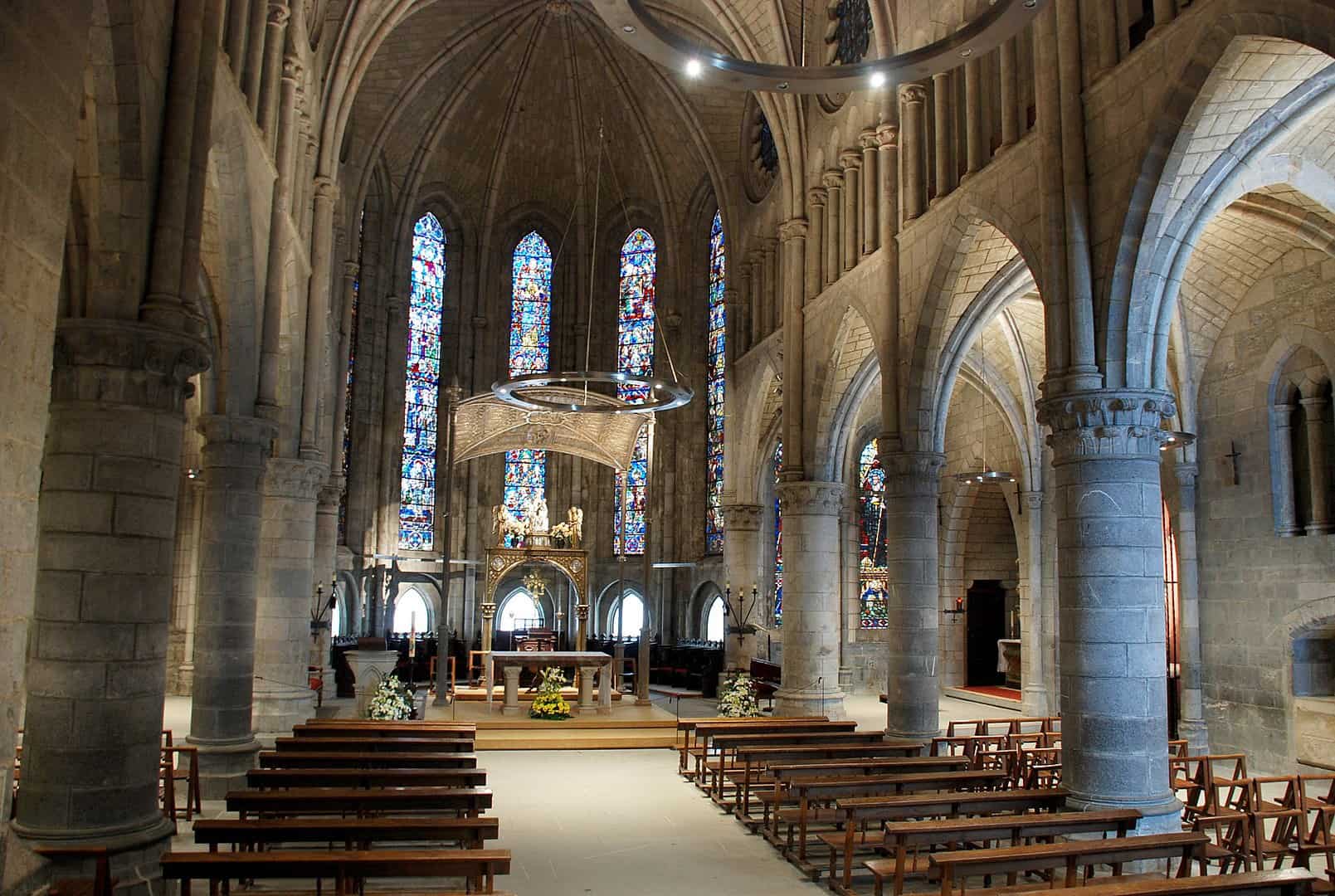
The second morning starts before light. You wake in the long monastic dormitory at Roncesvalles to the sound of zips, the rustle of dry-bags, and somebody three beds down who has clearly never packed a rucksack quietly in their life. Yesterday, if you came over the Pyrenees on the walk from Saint Jean Pied de Port, your legs already know what walking means. Today asks for something gentler. The stretch from Roncesvalles to Larrasoaña is roughly 27.4 km of mostly downhill walking through the Navarra foothills, tree lined and quiet, following the line of the N135 without ever quite belonging to it.
This is day 2 of the Camino Frances, and it has a reputation for being easy. It is, mostly. But easy is a slippery word on the Camino de Santiago, and the long descent into the Arga valley has its own way of finding your knees by mid-afternoon. You will sometimes see the village spelled Larrasoana without the tilde; both forms point to the same quiet town at the end of today's walk. Here is what to expect, where to stop, and a little of the history that gives this section of the Camino its character.
What should you expect on day 2 from Roncesvalles to Larrasoaña?
The short version: a calmer day than the climb that came before it. After the drama of the mountain crossing, the walk from Roncesvalles settles into beech woods, small villages, and a steady loss of altitude. Most pilgrims find the footing forgiving, the gradients gentle, and the scenery green and close rather than vast.
The distance is commonly given as 27.4 km, though some guides list slightly different totals depending on which variants and which start and end points they count. Walking time tends to land somewhere between six and eight hours for an unhurried pilgrim, including a couple of café stops and the inevitable photographs. Plan for a full day rather than a half one.
Here is a quick snapshot before you start walking:
- Distance: about 27.4 km from Roncesvalles to Larrasoaña
- Terrain: predominantly downhill, easy underfoot, with two modest passes
- Surfaces: forest tracks, gravel paths, short road sections, village streets
- Shade: largely tree lined, with open stretches near the towns
- Best for: pilgrims wanting a steadier day after the Pyrenees crossing
Who does this stage suit? Honestly, most people. It is kind to first-time pilgrims still finding their rhythm, and it rewards anyone who wants a quieter day of walking with history tucked into the villages along the way. The one caution is the descent. A long, mostly downhill day is easy on the lungs and surprisingly hard on the knees.
How long is the Roncesvalles to Larrasoaña stage and how is it broken up?
The full stage is often treated as a single long day because the natural stopping points fall a little awkwardly. Zubiri, the obvious mid-afternoon halt, sits at around 21.5 km, which makes it either a short day or an early finish depending on your mood. Pushing on to Larrasoaña adds another stretch of roughly 5 to 6 km, and for many pilgrims that final push is the difference between a good rest and a restless night in a fuller albergue.
It helps to think of today's hike in chunks rather than as one undifferentiated slog. Each segment has its own feel and its own reason to pause:
|
Segment |
Approx. distance |
What to expect |
|
Roncesvalles to Burguete |
3 km |
Gentle start through woodland into a handsome Navarra village |
|
Burguete to Espinal |
4 km |
Quiet lanes and the 14th century Cruz de Peregrinos nearby |
|
Espinal to Zubiri |
14 km |
Two passes, beech forest, then a steep drop to the river |
|
Zubiri to Larrasoaña |
5 to 6 km |
Riverside walking to the end of the stage |
Plenty of walkers decide to stop in Zubiri instead of continuing, and there is no shame in it. Fatigue, weather, and the simple arithmetic of lodging availability all pull people off the path early. Zubiri has more beds and more services; Larrasoaña is smaller and quieter. The choice is genuinely yours, and the next town is never far on this part of the Camino Frances.
What is the route like along the N135?
The terrain profile is the headline here: predominantly downhill, with gentle gradients broken by two short climbs. You cross the Alto de Mezquiriz first, then later the Alto de Erro, neither of them punishing, both of them a reminder that even an easy day on the Camino has its lumps. Between them the path runs through beech woods that hold the morning damp, the kind of green light that makes you slow down without meaning to.
Surfaces vary in a friendly way. You will walk a mix of roadside paths, forest tracks, and village streets, and the footing is generally straightforward. The route shadows the quiet N135 road through the foothills, sometimes running alongside it, more often slipping away into the trees so you forget the tarmac is there at all. When the path and the road do meet, the crossings are the moments to stay alert.
A few practical notes for the road-adjacent stretches and the wooded descents:
- Watch your footing on the final drop into Zubiri, which turns rocky and steep
- Stay visible at road crossings, especially in early morning fog
- Beech leaf litter and wet stone can be slick after overnight rain
- The Alto de Erro descent is the section most walkers remember in their knees
None of this is dangerous. It is simply the kind of terrain that rewards trekking poles and a bit of attention. The Navarran foothills are not the high Pyrenees, but they are not flat either, and the altitude loss across the day is real even when the path feels easy.
What are the key stops and landmarks between Roncesvalles and Larrasoaña?
This stage carries more history than its quiet appearance suggests. The villages along the way are bound up with the legends of the pass, the medieval pilgrimage, and one famous American novelist who liked to fish here. You do not need to stop at all of them, but a few are worth more than a passing glance.
A sensible stop strategy is to mix short photo pauses with one or two longer café breaks. The Cruz de Peregrinos deserves a respectful minute; Burguete earns a proper coffee; Zubiri is the natural place for lunch and a decision about how far to push. Here are the points of interest that give the day its character.
What is the Cruz de Peregrinos and why do pilgrims stop there?
The Cruz de Peregrinos is a historic pilgrims' cross dating, by most accounts, to the 14th century. You will look for it not long after leaving Burguete, a simple stone marker standing where pilgrims have stood for centuries. It is easy to walk past if your head is down and your mind is on your feet.
Why does it matter? Partly the symbolism, partly the sheer continuity of it. Walking the Camino de Santiago can feel like a modern hobby until you reach a spot like this and remember that the route has a medieval spine. People paused here when the path was a genuine danger and the destination an act of faith. A quiet stop, a photograph, and then on; leave it as you found it.
Why is Burguete worth a stop?
Burguete arrives early, only about 3 km from Roncesvalles, which makes it the obvious place for a first coffee while the day is still cool. It is a traditional Navarra village of whitewashed houses with deep eaves and family crests over the doors, the kind of streetscape that makes you reach for your camera before you have even ordered.
The history runs deeper than the architecture. The village sits in the shadow of the Battle of Roncesvalles, the 778 ambush that inspired the medieval Song of Roland, and the whole valley carries those old stories. More recently, Burguete is where Ernest Hemingway stayed and fished the local trout streams. Travellers often seek out the connection to "The Sun Also Rises," and a piano in one of the inns is said to still bear his name scratched into it, though I would treat that detail as local colour rather than gospel.
For pilgrims, Burguete offers practical things too: cafés, a shop or two for water and snacks, and somewhere to sit before the longer middle section of the day. Many pilgrims linger here a little longer than they planned. It is that kind of village.
What should you see in Zubiri, including the Puente de la Rabia?
Zubiri is the major waypoint of the day, a common alternate overnight and the place where the path drops steeply to meet the Arga river. You enter the town across its medieval bridge, the Puente de la Rabia, and the name carries a story worth knowing.
"Rabia" means rabies, and local legend held that an animal led three times around the central pillar of the bridge would be cured or protected from the disease. Whether anyone genuinely believed this or simply enjoyed the ritual is the sort of question the Camino leaves pleasantly unanswered. The bridge is the best thing to photograph in town, and the riverbank below it is a fine place to soak tired feet.
Zubiri is also a decision point. It has a municipal albergue, private hostels, bars, and a shop, which is why so many walkers stop here for the night. If your feet are holding up and the light is still good, you can push on the last stretch to Larrasoaña. If a blister is forming or the weather has turned, this is a perfectly honourable place to call it a day.
What is Larrasoaña like as an end point for day 2?
Larrasoaña is a historic pilgrim town, small and quiet, the sort of place that has been welcoming walkers for so long it no longer makes a fuss about it. You reach it by a footbridge over the Arga, and the village beyond is a single huddle of stone houses, a church, and a municipal albergue that fills steadily through the afternoon.
There is not a great deal to do here, and that is rather the point. After arrival, the ritual is simple: shower, wash socks, find food, and let your legs stop. A short wander takes in the whole village in fifteen minutes. Compared with Zubiri it is calmer and less crowded, a gentler end to the day, though with fewer services and beds to go round.
The trade-off between the two towns comes down to temperament. If you want company, noise, and choice, Zubiri suits. If you want a quiet night and a shorter walk into Pamplona the next morning, Larrasoaña earns its keep.
What practical planning tips help most pilgrims on this stage?
A few small decisions make the difference between a good day and a sore one. None of this is complicated, but the long descent has a way of punishing the unprepared, and the smallest blister can sour an otherwise easy walk.
Start in the morning, ideally not long after 6am if the day is forecast to be warm. Cooler temperatures make the climbs over the two mountain passes easier and give you time to enjoy the beech woods before the sun is high. An early start also means you reach Zubiri or Larrasoaña before the best beds are taken.
On food and water, the strategy is town based. There are reliable refuelling points at Burguete, Espinal, and Zubiri, with longer stretches of nothing in between, so fill your bottle and carry a snack rather than assuming a café will appear when you want one. For the body itself, the watchwords are knees and feet:
- Use trekking poles on the steep drops into Zubiri to spare your knees
- Stretch your calves and hamstrings at your café stops, not just at the end
- Address any hotspot the moment you feel it, with good blister prevention before it sets in
- Pack layers for cool foothill mornings and a rain shell for sudden showers
- Carry sunscreen for the open sections, even on a grey day
Weather in the Navarran foothills can shift quickly. Rain and fog roll through, the beech leaf litter turns slick, and the rocky descent near Zubiri becomes genuinely slippery when wet. There is nothing here you cannot manage with a rain shell and a slower pace, but it pays to respect it rather than assume the easy reputation holds in all conditions.
Where can you stay and what services are available along the way?
Accommodation on this part of the Camino Frances is plentiful but uneven, concentrated in the larger waypoints. In high season the popular beds fill by mid-afternoon, so booking ahead can matter, particularly in summer. Outside the busy months you can usually walk and trust that something will turn up, which is its own quiet pleasure.
The main overnight options across the stage, without turning this into a hotel directory, look like this:
|
Town |
Lodging style |
Notes for pilgrims |
|
Roncesvalles |
Large monastic albergue, hostels |
Starting point; book the famous albergue in peak season |
|
Zubiri |
Municipal albergue, private hostels |
Popular stop; beds often fill on summer afternoons |
|
Larrasoaña |
Municipal albergue, small guesthouses |
Quieter end-of-stage option with limited beds |
Beyond beds, the services pilgrims search for are the ordinary necessities: cafés for coffee and a pilgrim menu, small shops for water and fruit, and basic first aid supplies for the blister you swore you would not get. Pharmacies are scarce in the villages, so carry your own tape and plasters rather than counting on a chemist. If you are walking with luggage transfer arranged ahead, the larger towns are the practical handover points, though plenty of pilgrims simply carry their own backpack and sleeping bag the whole way.
How do you plan today's walk as part of a longer Camino itinerary?
Day 2 sits in the opening week of the Camino Frances, the long pilgrimage that runs west across northern Spain toward Santiago de Compostela. After Larrasoaña comes the short, pleasant walk into Pamplona, then on through Navarre and into the wine country around Estella and the Irache fountain. Eventually the meseta, then Galicia, then the cathedral. This is the second small step of a very long journey.
The thing to manage on this stage is energy, not difficulty. Day 2 can feel surprisingly long precisely because everyone tells you it is easy, so you set off relaxed and arrive more tired than you expected. The descent is the culprit. If you are ahead of your itinerary, stopping in Zubiri shortens the day and saves your legs; if you are behind, the push to Larrasoaña, or even on toward Pamplona, makes up ground without too much strain.
The reason so many pilgrims start their Camino de Santiago from Roncesvalles rather than from Saint Jean Pied de Port is the same reason this stage feels manageable: Roncesvalles allows you to skip the hardest day, the Pyrenees crossing, and begin on gentler ground. It is a popular starting point for exactly that reason, and there is no purity test on the Camino that says you must suffer the mountains to count. Walk the route that suits you.
The historical thread runs underneath all of it. Today's landmarks, the cross outside Burguete, the bridge at Zubiri, the old pilgrim town of Larrasoaña, connect this easy day to the medieval story of the Camino. People have walked this exact ground for a thousand years, most of them tired, many of them blistered, all of them putting one foot in front of the other toward the same distant cathedral.
FAQ: Roncesvalles to Larrasoaña on the Camino Francés
Is the Roncesvalles to Larrasoaña route difficult?
No, it is one of the easier stages of the Camino Frances, mostly downhill and easy underfoot through tree lined foothills. The main challenge is its length, roughly 27.4 km, and the strain that a long descent puts on the knees. Trekking poles and an early start make it comfortable for most pilgrims.
How many kilometres is Roncesvalles to Larrasoaña, and how long does it take?
The stage is about 27.4 km, though some guides give slightly different figures depending on the variants counted. Most walkers take between six and eight hours including café stops, crossing two modest passes, the Alto de Mezquiriz and the Alto de Erro, along the way.
Can you stop overnight in Zubiri instead of walking to Larrasoaña?
Yes, and many pilgrims do. Zubiri sits at around 21.5 km and has a municipal albergue, private hostels, and more services than Larrasoaña, which makes it a popular and sensible place to spend the night. Stopping there leaves a longer, but still gentle, walk into Pamplona the following day.
What is the Puente de la Rabia in Zubiri and is it on the route?
The Puente de la Rabia is the medieval bridge you cross to enter Zubiri, directly on the Camino. Its name means "bridge of rabies," from a local legend that an animal led three times around its central pillar would be protected from the disease. It is the most photographed spot in the town.
What are the best places to take breaks between Roncesvalles and Larrasoaña?
Burguete, about 3 km in, is ideal for an early coffee in a traditional Navarra village with Hemingway connections. Zubiri, near the end of the long middle section, is the natural lunch stop and decision point. Espinal in between offers a smaller pause, and the Cruz de Peregrinos near Burguete is worth a brief, respectful halt.


