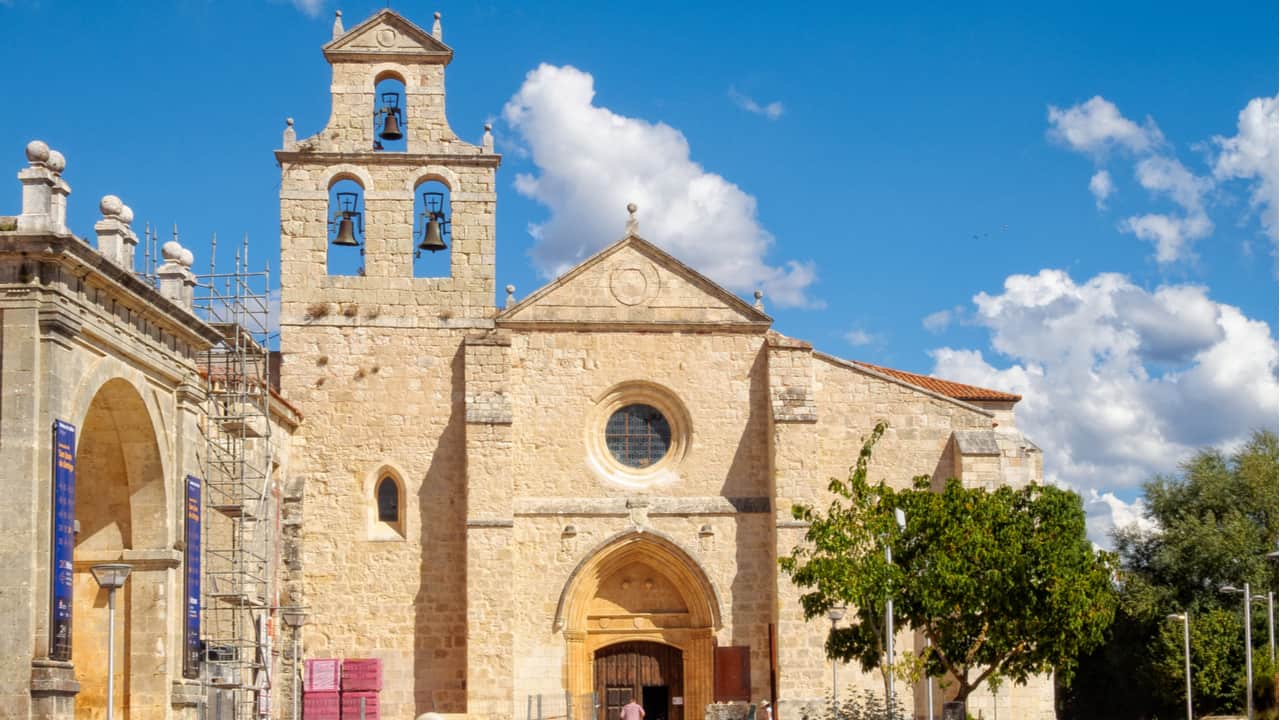
You arrive at San Juan de Ortega and, for a moment, you wonder if you have walked past it. There is a church, a low cluster of stone buildings, a fountain, and not much else. Eighteen people live here year-round. After a day in the pine forest above Villafranca Montes de Oca, the quiet is almost physical, the kind you can feel settle on your shoulders along with your pack.
And yet pilgrims have been stopping in this small village for the better part of nine hundred years. That is the thing about San Juan de Ortega on the Camino de Santiago Frances: it is tiny, it is plain, and it carries more weight than its size suggests. This piece is for pilgrims planning their nights and for the history enthusiasts who want to know why a hamlet this small ended up with a monastery, a saint, and a queen’s gratitude attached to it.
What is San Juan de Ortega on the Camino de Santiago Frances, and why do pilgrims stop here?
San Juan de Ortega is a hamlet in the province of Burgos, in Castilla y Leon, that sits roughly midway between Belorado and the city of Burgos on the Camino Frances. It is named after the saint who founded it, and the village grew up around the monastery and church he built. Today it is barely a settlement: a church, an albergue or two, a bar that keeps seasonal hours, and the eighteen permanent residents who keep the lights on.
Pilgrims stop here for a mix of reasons. Some arrive because the stage from Belorado lands them here at a sensible hour. Some stay precisely because it is small and still, a quiet reset before the noise and traffic of a city. Others come for the history, drawn by the story of the man who cleared these paths. If you are travelling from the United States and picturing a town with shops and choices, recalibrate now. The atmosphere is the attraction. The services are an afterthought.
What you get in San Juan de Ortega is a particular kind of Camino evening: shared dinner, an early night, a church older than most countries, and the sense that you are passing through a place that has been receiving walkers since the Middle Ages. If you want context rather than a checklist, this is a stop that rewards slowing down.
Where is San Juan de Ortega located, and what stages connect to it?
San Juan de Ortega lies in the eastern reaches of the province of Burgos, set among the Montes de Oca, an upland of pine forest and rolling Castilian country. In Spanish the route is the Camino Francés, the French Way, named for the medieval pilgrims who arrived through France. On a stage of the Camino it functions as a hinge: the end of one walking day for many pilgrims, the start of another. Two stages define it.
The first is the approach. Coming from the west of La Rioja, walkers pass through Santo Domingo de la Calzada and Belorado before the climb into the hills. The Belorado to San Juan de stretch is a recognised stage of the camino frances, often listed at around 24 km, and it ends with the long, lonely passage through the woods. The second is the departure: the well-known Juan de Ortega to Burgos stage, commonly given as roughly 25.8 to 27.6 km, the day you trade countryside for a great Gothic city.
For orientation, here are the villages most stage guides string together around this stop:
- West of the village: Villafranca Montes de Oca, the last real services before the forest climb, plus smaller places like Villambistia, Espinosa del Camino, and Tosantos on the run in from Belorado.
- East toward Burgos: Ages, then Atapuerca with its famous archaeological site, followed by Cardenuela Riopico and Orbaneja, and finally the suburb of Castanares before the city itself.
- The Montes de Oca: the wooded high ground that wraps the village, historically the most feared section of this part of the route.
What are the typical distances and walking time expectations to and from San Juan de Ortega?
It helps to think in pilgrim days rather than exact metres, because measured distances shift depending on which variant you take and where a guide places its endpoints. That said, the two connecting stages fall into reliable ranges. The table below gives the figures most commonly cited, but treat them as planning numbers, not gospel.
|
Stage |
Typical distance |
Rough walking time |
Terrain notes |
|
Belorado to San Juan de Ortega |
About 24 km |
5 to 7 hours |
Steady ascent through pine forest in the Montes de Oca; a long, shadeless wooded stretch near the end |
|
San Juan de Ortega to Burgos |
About 25.8 to 27.6 km |
6 to 7 hours |
Gentle start, the alto de Atapuerca climb, then a flat, urban-edge approach into the city of Burgos |
The elevation around the village matters because it explains the history. The Montes de Oca sit at over a thousand meters in places, and for medieval pilgrims this was bandit country, cold, wooded, and easy to get lost in. The saint who built here did so because the passage was dangerous, not in spite of it. When you walk it now, in daylight, with waymarks and a forecast on your phone, it is worth remembering that the calm you feel is itself a kind of monument to him.
Who was San Juan de Ortega, and how did he shape the Camino?
The village takes its name from Juan Velazquez, born around 1080 and dying in 1163, a priest who is remembered as Saint John of Ortega. Ortega means nettle, or rough waste ground, which tells you something about the land he chose to work. He was, by the accounts that survive, a builder by vocation: bridges, causeways, hospices, the practical infrastructure that turned a dangerous pilgrimage into a survivable one.
The turning point, as tradition has it, came at sea. Returning from a pilgrimage to the Holy Land, his ship was caught in a storm. He survived the shipwreck, and in his gratitude he vowed to devote his life to the safety of other pilgrims. Whether you read that as history or as the kind of story a community tells about its founder, the work that followed was real enough.
His chosen battleground was the Montes de Oca. These hills were notorious: thick forest, robbers, and walkers who set out and did not arrive. Juan cleared paths, built shelter, and made the passage navigable. For a medieval pilgrim walking toward Santiago de Compostela, a man who could get you safely through the woods was worth more than any relic. He is one of a small group of road-building saints on this route, alongside Santo Domingo de la Calzada a little to the east, who did much the same thing with bridges and a causeway. Their work is part of the longer history of the Camino de Santiago, the centuries in which a footpath across northern Spain became one of the great pilgrimages of the medieval world.
What did he build in San Juan de Ortega, and why is Saint Nicholas of Bari important?
In the village itself, Juan founded an Augustinian monastery and built a chapel dedicated to Saint Nicholas of Bari. The dedication is not random. Nicholas of Bari is, among other things, the patron of sailors and of those in peril at sea, which ties the chapel directly back to the shipwreck that, by tradition, set Juan on his path. A man who nearly drowned built a shrine to the saint who watches over the drowning.
These were working institutions, not ornaments. The monastery and its hospice meant a bed, a meal, spiritual care, and crucially a safe roof in the middle of the worst stretch of the route. For centuries this is what San Juan de Ortega was: a lifeline in the forest. The Romanesque church that grew here still holds his tomb, and the whole place is best understood not as a tourist site but as medieval pilgrim infrastructure that simply never stopped working.
What should you see in San Juan de Ortega today?
Set your expectations honestly: there is not a great deal to see, and that is rather the point. This is a small village whose significance is out of all proportion to its attractions. Most pilgrims spend an hour or two here and find it is enough, and somehow also exactly right.
The things worth your attention are few and close together:
- The church and monastery complex, with the Romanesque core and the tomb of the saint. The carved capitals inside are the kind of detail you would walk past if no one told you to look.
- The chapel of Saint Nicholas of Bari, tied to the shipwreck story.
- The fountain and the small open space where pilgrims gather, wash socks, compare blisters, and wait for the bar to open.
- The forest edge itself, especially in the soft light of early evening when the day-walkers have moved on.
If you can choose your timing, the village is at its best in the early morning before walkers leave and in the late afternoon once the through-traffic has thinned. Midday can feel oddly busy for somewhere so small, as wave after wave of pilgrims passes through. Stay the night and you get the quiet version: a communal dinner, a church settling into shadow, and the particular stillness of a place that empties out by nightfall.
What is the fertility legend of San Juan de Ortega, and why did Queen Isabel la Catolica visit?
Here is the story pilgrims still trade over dinner, told as legend rather than fact, which is the only honest way to tell it. The saint became associated, somewhere along the centuries, with fertility, with helping the childless conceive. How a road-builder acquired that reputation is anyone’s guess, but it stuck.
The headline visit came in 1477, when Queen Isabel la Catolica is said to have come to San Juan de Ortega after years of childless marriage, seeking the saint’s intercession. By tradition she later bore a son, and the link was made. It is the kind of story that is impossible to prove and easy to repeat, and the village has been repeating it ever since.
Whether you take the legend seriously or simply enjoy it, it tells you something true about the Camino: that places accumulate meaning through the stories carried into them and out again. A tiny hamlet in the Burgos hills holds a queen’s hope, a saint’s tomb, and the soup you will eat tonight, all in the same handful of stone buildings. Folk faith and a footpath, doing what they have always done.
Where can pilgrims sleep, eat, and rest in San Juan de Ortega?
Lodging here is limited, and that is the single most important planning fact about this stop. There is no row of hotels. Accommodation runs to a parish-style albergue and a small number of beds, with the occasional hostel-style or rural option nearby in places like Ages. In peak season, those beds fill, and the pilgrims who arrive late are the ones who walk on.
The plain rules of staying in a tiny hamlet:
- Arrive earlier than you think you need to, especially in summer, if you have set your heart on a bed here.
- Expect albergue-style stays: shared dormitory rooms, a communal pilgrim dinner if one is running, lights-out reasonably early, and a dawn chorus of zips and rustling.
- Carry food and water in. Bar and meal options depend on the season and the day, and you cannot assume anything will be open.
- Bring cash. There is no ATM, and small places do not always take cards.
- Keep a flexible plan. If there is no room, Ages is close and Atapuerca not much further; pushing on is normal, not a failure.
If you would rather not gamble, many pilgrims treat San Juan de Ortega as a place to pause and eat rather than to spend the night, then continue. There is no wrong answer here, only the one that fits your legs and your timing. For a broader sense of how pilgrim hostels work along the route, it is worth reading up on how albergues operate on the Camino de Santiago before you arrive, so the dormitory culture does not catch you off guard.
What services are available, and not available, in such a small hamlet?
It is easier to plan when you know the gaps in advance. In a village of eighteen residents, the offer is thin and the absences are real.
|
Usually available |
Usually not available |
|
A pilgrim albergue and a few beds |
Pharmacy |
|
Simple meals when the bar is open |
ATM or bank |
|
A credencial stamp (sello) |
Supermarket or large grocery |
|
A fountain and a quiet place to rest |
Choice of restaurants |
|
The church and its tomb |
Reliable shops or services on a Sunday or off-season |
For comfort, pack as if the village offers nothing but a roof. Layers help, because evenings in the Montes de Oca turn cool even in summer. A headlamp earns its place for a dawn start in the woods, and your usual blister kit should be within reach rather than buried at the bottom of the pack. None of this is dramatic. It is simply the difference between a smooth night and a fretful one.
What is the walk like from San Juan de Ortega to Burgos?
The day to Burgos is a study in contrasts, which is partly why it is one of the better-known stages of the camino frances. You begin in quiet woodland, the kind of morning where you hear your own boots and little else, and you end in a city of cathedrals and traffic lights. The shift is gradual and then, near the end, abrupt.
The early kilometers carry you out of the pine forest and down toward Ages, a small village that makes a natural first coffee stop. From there the route reaches Atapuerca, famous for an archaeological site of genuine importance to human prehistory, and climbs the modest alto de Atapuerca, a stony rise with wide views back over the country you have crossed. After that, the towns come thicker: Cardenuela Riopico, Orbaneja, then the industrial and suburban fringe that announces a city long before its old town appears.
The arrival into Burgos is the part pilgrims either love or endure. There is a riverside variant along the Arlanzon that is far kinder than the alternative trudge past the airport and along the national road. Choose the river if you can. Whichever way you enter, the reward is the same: the Gothic cathedral of Burgos rising over the old town, a city with everything the village lacked, and a sense of having crossed a threshold. If you are planning a rest day, our city guide to Burgos on the Camino Frances covers what to see once you arrive.
What potential problems should you watch for on the way to Burgos?
Stage guides repeat the same cautions for good reason. None of them is alarming on its own, but on tired legs they compound.
- Exposure and hydration. Long open stretches mean sun and wind with little shade; carry more water than you think, since refill points are spread out.
- Fatigue and pacing. This stage often lands after several hard days; break the walk into named landmarks, Ages, Atapuerca, the alto, and take real rests rather than pushing through.
- Navigation into the city. The urban edge of Burgos is where many pilgrims lose the waymarks, distracted by traffic. Slow down where the route crosses roads, and watch for the arrows on lampposts and kerbs.
- Road sections. Parts of the approach run alongside the N-120 national road; stay alert and visible.
The prevention is unglamorous and it works: an early start, a water strategy, steady foot care, and a little patience on the dull suburban kilometers. Save your attention for the road crossings and your camera for the cathedral.
What apps, maps, or resources help most when planning this stop on the Camino Frances?
Connectivity in the Montes de Oca can be patchy, which is exactly why you should not rely on a live signal to find your bed or your route. A small amount of preparation removes most of the anxiety from a stop like this.
What genuinely helps for the San Juan de Ortega area:
- Offline maps downloaded before you climb into the hills, so a dead zone does not leave you guessing.
- A current stage-planning app or guidebook with albergue listings and distances, so you know your fallback villages before you need them.
- A backup plan written down: which village you will push on to if the beds here are full, and roughly how far it is.
- A note of the bar’s seasonal hours if you can find them, so you carry the right amount of food in.
The principle behind all of it is simple. In a place with limited beds and limited services, the pilgrim who has thought one village ahead sleeps easily, and the one who has not spends the last hour of daylight worrying. For the wider route context around this stretch, our guide to the Camino Frances pilgrimage sets San Juan de Ortega in its place along the whole way to Santiago de Compostela. It also helps to be clear in your own mind about what being a pilgrim actually means before you arrive, since a stop this stripped-back rewards walkers who came for more than the kilometers.
Frequently asked questions about San Juan de Ortega
Is San Juan de Ortega worth staying overnight, or should I walk on?
It is worth an overnight stay if you want a quiet, history-rich reset and you arrive early enough to claim a bed, since lodging is very limited. Walk on if you reach the village late, if the beds are full, or if your timing favours pressing toward Ages or Atapuerca. Both choices are common; the deciding factors are bed availability and the hour you arrive.
How many people live in San Juan de Ortega year-round?
About 18 people live in San Juan de Ortega permanently. It is a genuine hamlet rather than a town, and its services reflect that small population, which is why pilgrims plan food, cash, and accommodation in advance.
What is San Juan de Ortega famous for on the Camino?
It is best known for its founder, Saint John of Ortega (Juan Velazquez, around 1080 to 1163), who cleared safe paths through the dangerous Montes de Oca and built a monastery and a chapel dedicated to Saint Nicholas of Bari. The village is also known for the fertility legend tied to Queen Isabel la Catolica, who visited in 1477.
Do I need to book lodging ahead in San Juan de Ortega?
In peak season it is wise to arrive early or have a booking, because beds here are few and fill quickly. In quieter months you can often find a bed on arrival, but the safest pilgrim strategy is to reach the village early in the day and keep an alternative village in mind in case it is full.
What is the next major stop after San Juan de Ortega?
The next major stop is the city of Burgos, roughly 25.8 to 27.6 km away, reached via the villages of Ages, Atapuerca, Cardenuela Riopico, and Orbaneja. Burgos offers full services and its Gothic cathedral, a sharp contrast to the quiet of the hamlet you are leaving.


