The first thing you notice in Sarria is the queue for credential stamps. Not the castle, not the old church, but a small line of people outside a cafe, shuffling forward with fresh boots and faces that have not yet learned what a long descent does to your knees. I remember thinking they all looked too clean. Then I caught my own reflection in the cafe window and realised I looked exactly the same.
Sarria is a working Galician town of roughly 13,000 people, and it has become the most common place to begin the final stretch of the Camino de Santiago. Most of the pilgrims you meet here are about to walk the last 100km of the camino, the minimum distance you must cover on foot to qualify for the Compostela. Of all the Camino de Santiago routes, this final section of the camino de Santiago is the one most people choose for a first walk. This article is field notes for anyone planning that walk: what Sarria is actually like, how the first walking day unfolds, how the days fit together, and the small practical things nobody tells you until you are sweating up the first hill.
What makes Sarria the traditional starting point for the final 100 km of the Camino Francés?
Sarria sits a shade over 100 kilometres from the cathedral of Santiago, and that single fact explains almost everything about the town’s character. To receive the Compostela, the certificate of completion handed out at the pilgrim office, you must walk at least the final 100km on foot (or cycle the final 200km). Sarria is the first sensible town that clears that threshold with a little margin, which is why it has become the launch point for the classic final stage.
What this means in practice is volume. The path from Sarria carries far more walkers than the lonely stretches further back on the Camino Frances. If you started weeks earlier in the Pyrenees, the sudden crowd can feel jarring, like a quiet country lane that empties onto a motorway. If Sarria is your start, you will feel something else entirely: a buzz of first-day energy, nervous chatter in five languages, and a great many people figuring out their backpack straps in the street.
A few things to expect on this popular section of the camino:
- More services than the remote stages: cafes, pharmacies, gear shops, and stamp points cluster thickly along the way.
- Busier albergues and a stronger push to book ahead in summer.
- A sociable, communal feel, since so many people are starting together on the same morning.
- Mile markers counting down the final 100 kilometres, which become oddly emotional somewhere around the 50 mark.
The crowds put some people off. I understand the instinct, but I would gently push back on it. Walking the Camino de Santiago has never been a solo endurance feat to be earned through suffering. The shared first-day nerves outside that Sarria cafe are part of the thing, not a dilution of it.
What is Sarria like, and what history should pilgrims know before walking out of town?
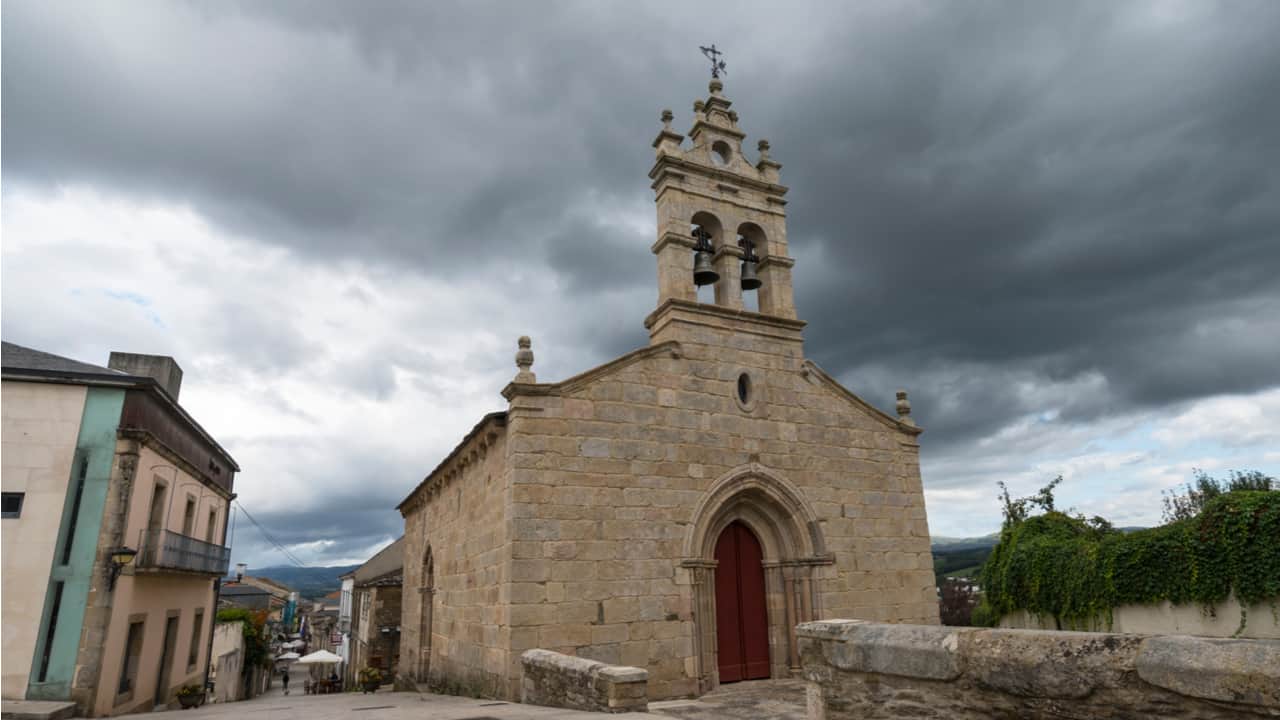
Give Sarria an evening and it stops being a trailhead and becomes a town. The old quarter climbs a hill, the Rúa Maior threading up past stone houses toward the church and the remains of the castle. Down below, the newer streets get on with ordinary Galician life: school runs, the clatter of a bar at lunch, old men on benches watching pilgrims pass with the patience of people who have seen a great many of them.
The roots here run deep. Sarria has origins dating to around the 6th century, and there is evidence of earlier Roman settlement in the area, which is a reasonable claim for much of this corner of Spain given how the old roads ran. I would not stake my life on the precise founding date; medieval town histories are slippery things, and I would rather tell you plainly that the early record is thin than invent a tidy story. What is clear is that Sarria has been a place of passage for a very long time, and walking out of it you are following a worn groove, not breaking new ground.
What are the most important landmarks to see in Sarria before you start walking?
You will not need long. An hour, maybe two, covers the highlights, and most of them sit on the climb up the old town, so you can see them on an evening stroll before your first walking day.
|
Landmark |
Roughly dates to |
What to look for |
|
Parish Church of El Salvador |
12th century |
A solid Romanesque exterior with later touches; a common first stamp stop and a quiet place to gather your thoughts. |
|
Sarria Castle |
14th century |
Largely destroyed in the 1467 civil uprising; a single tower stands above the town, more memory than monument. |
|
Convent de la Magdalena |
13th century |
Origins are disputed and not cleanly documented; worth a look for the calm cloister and the Camino context rather than a firm date. |
On the castle, a small honesty: what survives is essentially one tower. The fortress was largely pulled down during a civil conflict in 1467, part of the wider Irmandiño revolts that tore at noble strongholds across Galicia. Stand at the base of the tower and you are looking at the stub of something much larger, which is its own quiet lesson before a long walk.
The Convent de la Magdalena is the one I would not skip. Its precise origins are genuinely disputed, with accounts disagreeing about who founded it and exactly when, so I will not pretend otherwise. What you actually get is a still courtyard a few minutes from the noise of the Rúa Maior, a good place to sit before the early start. If you want the broader story of the route you are joining, our guide to the full Camino Frances pilgrimage sets Sarria in the context of the whole 780 kilometres.
How long is the Sarria-to-Portomarín stage, and what is the walking day like?
The first stage, Sarria to Portomarín, runs 23.1 km. On paper that is a moderate day. In practice it is the day your body remembers it has not walked 23 kilometres in a while, and your feet file a formal complaint somewhere around the halfway point.
This walking day suits most reasonably fit walkers, and it is a fair test of whether you have your kit sorted. Expect anywhere from six to eight hours, including stops, depending on your pace, the weather, and how often you yield to a cafe con leche. Faster walkers manage it in five; there is no prize for hurrying.
The terrain is classic interior Galicia and a fair introduction to the Camino de Santiago for anyone new to it: hedged lanes, small farms, dripping eucalyptus and oak, the smell of woodsmoke and cattle, and a fair amount of up and down without anything brutal. The day ends with a long descent to the river and a climb up a flight of steps into Portomarín, a village rebuilt on higher ground after the old town was flooded by a reservoir in the 1960s. The church was moved stone by stone, which is the sort of detail that lodges in your head for the rest of the walk.
A few practical notes for the first day on this stretch of the camino:
- Start early, ideally not long after first light, to walk the climbs in cool air and reach Portomarín before mid-afternoon.
- Tend to your feet before they hurt, not after. Tape hot spots the moment you feel them.
- Carry water and a snack even though cafes are frequent; the gaps between villages are longer than the map suggests when you are tired.
- Get your credential stamped at least twice a day from here on, since the last 100km has stricter stamp requirements for the Compostela.
Where do pilgrims typically stop along the way on day one?
The good news on this section of the camino is that you are rarely far from a coffee. Small villages and trail bars punctuate the Sarria to Santiago route closely, especially on this opening leg, so you can travel light and refuel as you go rather than hauling a day’s supplies.
Plan your day one rhythm around a handful of simple needs: an early coffee and stamp before you have walked far, a proper mid-morning stop with a tortilla or a slice of empanada, a restroom whenever a bar offers one (do not gamble on the next one), and a steady trickle of water. The villages blur together pleasantly after a while, which is part of the charm. You stop noticing the names and start noticing the dogs.
How do you plan a 7-day itinerary from Sarria to Santiago (the last 100km of the camino)?
Most people walk from Sarria to Santiago in around seven walking days, sometimes spread across 8 days of travel once you count an arrival night in Sarria and a recovery night at the end. The structure is well worn, and there is comfort in following it. You are not improvising a route; you are joining a procession that has run for centuries.
Here is a common framework for the walk from sarria to santiago. Treat the distances as approximate, since lodging location and small route variants nudge the totals either way:
|
Day |
From |
To |
Approx. distance |
|
Night before |
Arrive |
Sarria |
Rest, stamp, early night |
|
1 |
Sarria |
Portomarín |
23.1 km |
|
2 |
Portomarín |
Palas de Rei |
about 25 km |
|
3 |
Palas de Rei |
Arzúa |
about 29 km |
|
4 |
Arzúa |
O Pedrouzo / Amenal |
about 19 km |
|
5 |
O Pedrouzo |
Santiago de Compostela |
about 20 km |
That five-walking-day version is the brisk reading of it. Many companies and walkers stretch the same ground across a gentler 7-day format by splitting the longer legs, for example breaking the Palas de Rei to Arzúa day in two, or adding a short final morning so you arrive in Santiago fresh rather than footsore. There is no single correct shape. The relaxed version simply trades a couple of long days for more, shorter ones, which your knees will thank you for on the descents.
The classic overnight stops recur across almost every plan you will read: Sarria, Portomarín, Palas de Rei, Arzúa, then a final village such as O Pedrouzo or Amenal, and at last the city of Santiago de Compostela. If you want a longer walk, you can travel further back along the Camino Frances and pick up Sarria mid-route. Our piece on the next leg, Portomarín to Palas de Rei, covers day two in more detail.
What distances should you expect between the main stops?
Daily distances on the final section sit mostly in the 19 to 29 kilometre band, which is moderate walking by Camino standards. The Palas de Rei to Arzúa leg is the longest single day in the classic plan, and the one people most often choose to split.
A short word of caution about totals. The “100km” figure is the official minimum, measured to a fixed point, but the actual ground you cover from Sarria to the cathedral runs a little over that once you add detours to your lodging, the wander into each village, and the inevitable wrong turn out of a cafe. Call it 115 kilometres of real walking and you will not be disappointed.
Where should you stay in Sarria and along the final 100 km?
Accommodation on this stretch of the camino comes in three broad shapes, and choosing between them is really a choice about how much company you want at the end of a long day.
- Albergues: pilgrim hostels with dormitory bunks, typically 10 to 20 euros per night for the public ones, a little more for private albergues with smaller rooms. Sociable, basic, and the cheapest way to walk.
- Guesthouses and small hotels: private rooms, usually 35 to 80 euros, sometimes with a rural casa rural feel out in the countryside. More privacy, more comfort, a touch more planning.
- Comfort tiers on booked trips: “standard” generally means simple guesthouses, while “superior” buys you better-rated hotels and, where they exist, country-style lodgings with a bit of character.
The honest trade-off is social versus solitary, and budget versus comfort. A bunkroom gives you the murmur of strangers, the dawn chorus of zips, and a Camino family by your third night. A private room gives you a door that closes and a night without anyone else’s snoring. Neither is more authentic; they are just different ways to walk the camino.
On booking: the final 100km is the busiest part of the whole network, so in the peak months of roughly June to September I would book the first couple of nights, your night in Sarria and your first stop, well ahead. Out of season you can walk more loosely and decide as you go. For where to lay your head at the finish, our guide to where to stay in Santiago de Compostela covers hotels, hostels and albergues in the city.
How do you get to Sarria, and what should US travellers plan for?
Getting to Sarria from the United States takes a little stitching together, but it is a well-trodden path and nothing to lose sleep over. The usual pattern is to fly into a major Spanish hub, most often Madrid or Barcelona, and then make your way north-west into Galicia by train or bus.
From Madrid, a high-speed train to a Galician city, then an onward regional train or bus to Sarria, is the common route. Some travellers fly internally into Santiago airport and work backwards, taking a transfer or a train from Santiago to Sarria to reach the start. Both work; the Santiago airport approach can be tidy if your flights line up, since you finish near where you flew in.
A few planning considerations for US-based pilgrims:
- Arrive in Sarria the day before you start. A relaxed evening to find your accommodation, get a first stamp, and sleep off the jet lag is worth far more than the saved night.
- Reckon on jet lag biting hardest on day one or two. Go gently, drink water, and do not judge your fitness by how you feel that first morning.
- Buy long-distance train tickets in advance for the best fares, but keep the final local hop flexible if your arrival time is uncertain.
If you would rather not improvise the connections, deciding which airport to aim for first is half the battle; our guide to choosing the best Camino airport walks through the options.
What else do pilgrims need before walking the last 100km of the camino?
Beyond the route itself, a handful of practical matters shape your days on the final section. None of them are complicated, but knowing them in advance saves a lot of fretting on the trail.
On meals: most bars along the way serve a “menú del peregrino”, a pilgrim menu of three courses with bread and wine for a fixed, modest price in the evenings. Breakfasts can be slim and early; many albergues offer little more than coffee and toast, so carry a snack for the first hour. Galicia rewards the hungry walker with caldo gallego, pulpo a la gallega, and an almond tart called tarta de Santiago that you will eat without shame in Santiago itself.
On baggage transfers: for a small fee per stage, a service collects your main bag each morning and delivers it to your next lodging, so you walk with only a daypack. It is not cheating, whatever the purists mutter. For older walkers, anyone with a dodgy back, or those who simply want to enjoy the day, it transforms the experience. You carry water, snacks, a rain layer, and not much else.
A short checklist of the things people most often ask about before they walk the final 100 km:
- Solo walkers: the Sarria to Santiago section is busy and well-marked, which makes it one of the gentler introductions to walking the camino alone. You are rarely out of sight of other pilgrims.
- Walking “in style” versus budget: comfort choices mostly affect your evenings, not your walking. A superior trip buys nicer beds and dinners; the path under your boots is identical.
- Rest days and extra nights: adding a night in Sarria at the start or two nights in Santiago at the end gives you room to recover and actually explore, rather than arriving and immediately packing for home.
- The credential: get your pilgrim passport stamped at least twice daily on this last stretch; the pilgrim office checks it before issuing the Compostela.
For the full kit question, which is the one people agonise over most, our Camino de Santiago packing list covers what genuinely earns its place in your pack and what you will post home halfway.
What is the arrival in Santiago de Compostela actually like?
You will smell the city before you see the cathedral. The trail drops down through Lavacolla and over Monte do Gozo, and then the suburbs fold you in: traffic, apartment blocks, a supermarket, the ordinary edge of any city. It can feel anticlimactic for a moment, this stretch of pavement after days of green lanes. Then you pass under an archway, a piper is usually playing, and you step out into the great square in front of the cathedral of Santiago, the Plaza de Obradoiro itself.
People do different things here. Some weep, some sit down heavily against a pillar, some just stand and look up at the towers with a daft grin. I sat on the cobbles of the Praza do Obradoiro and untied my boots, which is not romantic but felt exactly right. The plaza fills and empties all day with pilgrims arriving in Santiago de Compostela, each carrying their own version of this moment. Whatever you do when you reach Santiago, do not rush it. You have walked the final stage of the camino to get here.
Two practical things remain once you arrive in Santiago de Compostela. First, take your stamped credential to the pilgrim office to collect your Compostela; our guide to the Camino pilgrims office in Compostela explains the process and the queues. Second, try to time the pilgrim mass in the cathedral of Santiago de Compostela, and if you are lucky enough to catch the botafumeiro swinging on its great rope, find a spot near the transept and watch it arc.
Frequently asked questions about Sarria and the final stage to Santiago
Do you have to start in Sarria to get the Compostela?
No. The rule is that you must walk at least the final 100km into Santiago, and Sarria simply happens to be the most convenient town that clears that distance with a little margin. You can start anywhere further back along the Camino Frances, or on another route entirely such as the Camino Primitivo or the Camino del Norte, and still qualify, so long as your last 100km of the camino are continuous and stamped.
How many days does it take to walk from Sarria to Santiago?
Most people take around seven walking days, sometimes packaged as 8 days once you count an arrival night in Sarria. Stronger walkers compress it to five longer days; gentler itineraries split the longest legs to reduce the daily distance. Your pace, the heat, and how many cafe stops you allow yourself all move the number.
Is the Sarria-to-Santiago route crowded?
Yes, this is the most popular section of the camino, especially from late spring through summer and in any Holy Year. You can ease the press by starting each morning early, before the larger groups set off, and by walking in the shoulder months of spring or autumn when the path is quieter and the weather is often kinder anyway.
Do I need to book accommodation in advance?
In peak season, roughly June to September, booking your night in Sarria and your first stop or two ahead is wise, since beds fill quickly on this stretch. Outside those months you can usually walk more spontaneously and find a bed on arrival, though a private room is always safer to reserve than a public albergue bunk.
What is the first day like from Sarria to Portomarín?
The opening stage covers 23.1 km of rolling Galician lanes, manageable for most reasonably fit walkers but a real test of your feet and kit. Expect six to eight hours with stops, a long descent and step climb into Portomarín at the end, and frequent cafes along the way. Set yourself up the night before with an early meal, taped feet, and a sensible bedtime.
Choosing your shape for the walk
So: Sarria gives you the most popular start to the most popular finish, a town with real history under its modern surface, and a first walking day of 23.1 km that announces what the week will ask of you. The rest is a matter of choosing your own shape, a brisk five days or a relaxed seven, an albergue bunk or a quiet private room, your own bag or a daypack while the rest is carried ahead toward Santiago de Compostela.
If you are still weighing when to go, the season changes the walk more than almost anything else; our guide to the best time to walk the Camino de Santiago lays out the trade-offs month by month. Whatever you decide, book your first night or two early, look after your feet from the very first morning, and let the rest unfold at a walking pace. That, in the end, is the whole point.


