What is this "Camino de Santiago poem," and why do so many pilgrims relate to it?
There's a particular poem that keeps circulating in pilgrim forums, printed out and pinned to albergue noticeboards, shared in WhatsApp groups between people who walked together and people who haven't met yet. Syl Nilsen's Camino de Santiago poem is, on the surface, a lighthearted romp through the realities of walking across Spain: the blisters, the snoring, the cold showers, the inexplicable joy. But underneath the rhyming stanzas, something more contemplative is happening. The poem captures the full arc of the pilgrimage, from nervous anticipation to the quiet emotional reckoning of arriving at the Cathedral of Santiago de Compostela.
The signature structure is hard to miss. Each stanza builds toward the refrain "Camino de Santiago," used like a drumbeat, a mantra, a half-prayer. It echoes the rhythm of the walk itself, the way the trail keeps pulling you forward even when your feet are screaming at you to stop. For anyone who has walked the Camino de Santiago, the effect is instant recognition. For those who haven't, it's a vivid, compressed preview of what the experience actually feels like, stripped of the glossy travel-brochure nonsense.
- The poem balances gritty physical realities (blisters, mud, exhaustion) with genuine spiritual payoff
- Rhyming verse with a recurring refrain gives it a song-like, communal quality
- It works as both a preparation tool and a nostalgia trigger for returning pilgrims
- The tone is self-deprecating, warm, and honest, never preachy
If you're considering the Camino and want to feel its texture before committing, or if you walked it years ago and want to remember what it was actually like (not the sanitised version you tell colleagues), this poem lands with uncanny precision.
What "call" draws people to the Camino, and how does the poem capture it?
Most pilgrims will tell you the decision to walk wasn't entirely rational. Something pulls. A restlessness, a curiosity, a life transition that demands a response bigger than redecorating the spare room. Maybe a relationship ended. Maybe a career did. Maybe nothing dramatic happened at all, and that's precisely the problem. The call to embark on the Camino is often quiet, persistent, and slightly embarrassing to explain to people who haven't felt it.
Nilsen's poem captures this beautifully in its opening stanzas. There's the romantic expectation, the "I'll find myself" hopefulness, mixed with the very real nerves of someone about to walk roughly 780 km across northern Spain. The poet doesn't mock the spiritual searching; instead, the verse treats it with the affection of someone who recognises the longing as genuine but also knows what's coming. You want transcendence? First, you'll get wet socks.
|
What pilgrims expect |
What the poem suggests actually happens |
|
Spiritual clarity from day one |
Confusion, sore feet, and a slow surrender to the rhythm |
|
Picturesque solitude |
Shared dormitories with strangers who snore in four languages |
|
A clean, dramatic narrative arc |
A messy, funny, occasionally transcendent muddle |
|
Arriving as a changed person |
Arriving exhausted, emotional, and oddly grateful for cold showers |
The refrain keeps returning, just as the trail keeps returning. You can't outrun the Camino de Santiago once it's in your head. The poem knows this. It mirrors the pull, the obsessive quality of a path that won't leave you alone.
What does the poem say about preparation (and what pilgrims wish they knew beforehand)?
One of the poem's running jokes is the gap between preparation and reality. Every pilgrim packs too much. Every pilgrim thinks their boots are broken in. Every pilgrim imagines they've thought of everything, then discovers on day one that they haven't thought of the right things at all.
Nilsen's verse plays with this lovingly. The "I'll be ready" confidence of the pre-Camino self gets gently dismantled by the road. Your backpack is too heavy. Your sleeping bag is the wrong weight. Your expectations about privacy, comfort, and daily mileage are, to put it kindly, optimistic. The poem doesn't dwell on preparation advice (it's a poem, not a packing list), but it captures the emotional truth of being slightly underprepared no matter how many book chapters and blog posts you've consumed.
- Footwear and blisters: The poem references sore, damaged feet with grim affection. Most pilgrims walk 20 to 30 km per day, which means 5 to 8 hours of walking daily, and blisters are nearly universal in the first week
- Comfort expectations: Albergue dormitories mean bunk beds, shared bathrooms, and very little personal space. This is the deal. The poem makes it clear.
- Weather: Rain in Galicia, heat on the Meseta, wind in the Pyrenees. The poem treats weather as a character, not a backdrop
How does the poem's humour help first-timers feel less anxious?
Here's the thing about anxiety: it shrinks when you laugh at it. Nilsen's poem works as a kind of permission slip. You don't have to be a seasoned hiker. You don't have to be spiritual. You don't have to be fit, brave, or especially stoic. You just have to be willing to show up, be uncomfortable, and find it funny.
There's something deeply reassuring about reading a poem that treats the miserable bits with warmth rather than dread. If the poet can laugh about cold showers and aching legs, perhaps those things are survivable. Perhaps they're even, in a strange way, part of the gift. The verse gives you permission to be imperfect, to struggle, to wonder what on earth you're doing, and to keep walking anyway. That's not a bad metaphor for how to approach most of life, honestly.
What are the toughest realities the poem portrays on the Camino (snoring, cold showers, sore feet)?
Nilsen doesn't flinch from the unglamorous side. This is poetry that smells of damp wool and muscle rub. The albergue scenes are particularly vivid: strangers sleeping centimetres from your face, the midnight symphony of snoring in several different national styles, the 5 a.m. rustling of plastic bags from the pilgrim who decides to pack in the dark. If you've stayed in a hostel dormitory, you know. Multiply that by thirty consecutive nights and you're getting closer.
- Shared dormitories: The poem captures the unique intimacy of sleeping alongside strangers, the vulnerability and occasional absurdity of it
- Cold showers (sometimes without a door): A memorable detail in the verse. Some albergues along the Camino Francés have plumbing that was installed sometime around the Spanish Civil War. You learn to be quick.
- Blisters and exhaustion: Day after day of walking takes a cumulative toll. The poem treats this repetition honestly, the way it grinds you down and, eventually, strips something unnecessary away
- Mud and rain: Especially in Galicia, where the green beauty comes at a cost. Your boots weigh twice as much. Everything is damp.
What's the deeper point behind the hardship scenes?
The suffering isn't the point, but it's not incidental either. Nilsen's poem understands something that most travel writing misses entirely: discomfort is where the stories come from. Nobody bonds over a perfectly comfortable night's sleep. People bond over the shared misery of a dormitory in Burgos where someone's alarm goes off at 4 a.m. and they can't figure out how to turn it off.
There's resilience in the poem, and humility. The verse suggests that surrendering control, accepting that you cannot plan your way out of being cold and tired and uncertain, is where the journey actually begins. The Camino de Santiago symbolises, for many pilgrims, exactly this: the slow realisation that the path requires less conquering and more yielding. You don't walk the Camino. In a real sense, it walks you.
What beautiful moments does the poem highlight (poppies, sunsets, and simple surprises)?
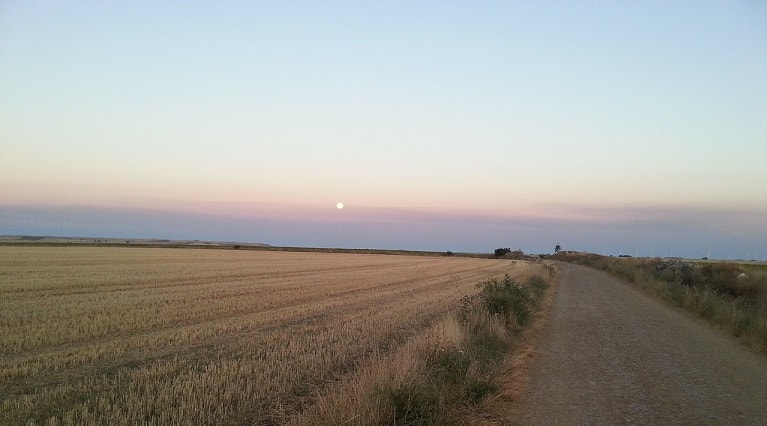
And then, just when the poem has you convinced it's all suffering and damp socks, the beauty arrives. Red poppies along the roadside in spring. A sunset over the Meseta so absurdly dramatic it looks like someone's been at the contrast settings. The first glimpse of Santiago's spires through morning mist.
These moments hit harder because of what came before them. That's the secret the poem understands. A sunset after a comfortable day in a car is pleasant. A sunset after walking 28 km with blisters on both feet and rain in your hair is a revelation. The contrast is everything. Nilsen writes these moments with warmth and restraint, letting the images do the work rather than loading them with meaning. The poppies don't need to symbolise anything. They're just poppies. They're just impossibly, unreasonably beautiful, and you're standing there in your muddy boots, noticing them in a way you never would at home.
- Red poppies along the path between Estella and Los Arcos in late spring
- Sunsets viewed from hilltop towns after a long day's walk
- The first coffee of the morning in a bar that opens at 6:30 a.m., the owner barely awake, the radio playing softly
- Small, unexpected kindnesses from strangers along the way
The poem keeps its tone lightly comic even in these contemplative moments. It never tips into melodrama. There's something very English about that restraint, even from a poet who may not be English at all, the refusal to oversell the beauty, trusting the reader to feel it without being told how to feel.
What Camino traditions and delights show up in the poem (like the free wine at Irache)?
One of the poem's most memorable references is the wine fountain at Irache, located near the town of Estella in Navarra. It's exactly what it sounds like. A fountain. That dispenses free red wine. To tired pilgrims. At nine in the morning, if you're walking early. The Bodegas Irache winery installed it, and it has become one of the most photographed and celebrated points on the Camino Francés. Nilsen's poem treats it with the reverent glee it deserves.
|
Tradition or detail |
Where on the Camino |
Why pilgrims remember it |
|
Wine fountain at Irache |
Near Estella, Navarra (approx. km 90) |
Free wine, absurd joy, perfect comic timing on the trail |
|
Pilgrim menu meals |
Throughout Spain, most towns |
Three courses plus wine for 10 to 15 euros; communal tables |
|
Stamp collection in the pilgrim's credential |
Every albergue, church, and bar |
Ritual of daily verification; becomes a kind of diary |
|
Sharing food at day's end |
Albergue kitchens everywhere |
Someone always has extra bread; someone always needs it |
These small rituals, a stamp here, a glass of wine there, a shared meal in a kitchen where nobody speaks the same language, accumulate into something larger than the sum of their parts. The poem captures how food and drink and tiny traditions become the scaffolding of pilgrim morale. You keep walking because there's a village ahead, and in that village there's a bar, and in that bar there's coffee. The Camino runs on coffee and stubbornness. Nilsen knows this.
How does the poem portray Camino community and the friendships formed on the trail?
I think the most quietly powerful thing about the poem is the way it handles other people. The Camino is, technically, a solo endeavour. You walk alone with your thoughts, your feet, your increasingly questionable decisions about what to eat for breakfast. But the pilgrimage is also one of the most intensely communal experiences you can have. You walk alone during the day and then, at day's end, you arrive at an albergue and there they are: the same faces, rearranged, exhausted, delighted to see you.
The poem captures the "trail family" phenomenon with real tenderness. These are people you would never, under any other circumstance, befriend. A retired teacher from South Korea. A college student from Brazil. An Irish couple in their seventies who walk faster than you. A contemplative German engineer who says almost nothing but shares his cheese at every meal. The poem understands that shared suffering is the fastest bonding agent known to humanity. Walk through rain together for six hours, and you'll tell each other things you haven't told your closest friends.
- International camaraderie that transcends language barriers
- Shared meals where everyone contributes what they have
- The recurring cast of characters who appear, disappear, and reappear over weeks
- The bittersweet quality of friendships formed in transit, people whose last names you never learn
- The traditional pilgrim greeting, "Buen Camino," exchanged thousands of times, meaning something different each time
What should you say to someone on the Camino de Santiago? "Buen Camino." Two words. They carry everything: good luck, safe travels, I see you, keep going, we're in this together. The poem's refrain functions in a similar way. "Camino de Santiago" repeated at the end of each stanza becomes a shared identity marker. Many paths, one road, one destination. The collective identity of pilgrims, stretching back over a thousand years, is embedded in that repetition.
What spiritual or emotional reward does the poem suggest, especially upon reaching Santiago de Compostela?
The final stanzas of the poem carry a different weight. The humour doesn't disappear, but it softens. Something underneath it shifts. You can feel the fatigue in the lines, the accumulated days of walking, the body that has been pushed past what it thought it could manage. And then Santiago de Compostela appears.
The experience of arriving is notoriously hard to describe. Pilgrims who have walked the Camino often say they didn't expect to cry. They did anyway. The poem manages this moment without tipping into sentimentality, which is no small feat in verse. There's pride, certainly. Gratitude, certainly. But also something harder to name: the disorientation of having the journey end, the sudden absence of the daily rhythm that has defined your life for weeks. Does the road wind uphill all the way? Yes, Christina Rossetti wrote, to the very end. And then what?
How many of us have gotten to the end of a long trip to find only stillness waiting? No fanfare, just the end of the trail, and the road still stretching on in some internal sense. The Camino changes you through both grit and grace, and the poem captures this without making grand claims. It suggests, gently, that the pilgrimage isn't really about arriving. It's about the collection of ordinary moments that accumulate into something that feels, in retrospect, sacred. Soup. Tape on blisters. A stranger's kindness. Wine from a fountain. Rain on your face in Galicia. The yellow arrows that guided you, one after another, all the way across the land.
- The emotional release of reaching the Cathedral of Santiago de Compostela, where pilgrims have arrived for over a thousand years
- The contrast between physical exhaustion and spiritual fullness
- The poem's refusal to over-explain what the Camino "means," letting readers find their own truth
- The quiet suggestion that the real journey continues after you go home
The Oficina del Peregrino in Santiago issues the Compostela certificate to those who have walked at least the final 100 km (or cycled the final 200 km) for religious or spiritual reasons. In 2024, over 400,000 pilgrims received the Compostela. Every one of them stood in the same square, looked up at the same cathedral, and felt something that resists easy language. Poetry, at its best, reaches for exactly those feelings. Nilsen's poem is not high art in the academic sense. It's something better: it's true. It's the kind of verse that pilgrims print out and carry in their backpack, folded into the pages of a book, pulled out and read aloud at the end of a long day. That's a form of poetry that matters deeply, even if it never appears in a university collection.
What should you do next if this poem makes you want to walk the Camino (or relive it)?
If you haven't walked the Camino and this poem has stirred something, sit with that feeling for a moment. Notice which parts excited you and which made you nervous. The nervousness is useful. It means you're taking the pilgrimage seriously. The American Pilgrims on the Camino website is a good starting point for practical planning, and there are countless accounts from pilgrims who walked the Camino de Santiago and wrote honestly about what they found.
If you've already walked, the poem probably landed differently. Certain lines will have felt like a photograph of a specific moment you thought only you remembered. That's the nature of shared experience rendered in honest verse. Consider which stanza felt most true. Was it the snoring? The blisters? The Irache wine fountain? The arrival?
- Read or print the poem to share with a walking partner or someone considering the trip
- Explore other Camino poems and reflective writing (David Whyte's contemplative poetry resonates with many pilgrims, though his style is very different from Nilsen's)
- If you're a past pilgrim, revisit the poem alongside your own photos or journal entries
- Use the poem as a conversation starter: the stanza that makes you laugh is often the one that matters most
The Camino keeps calling. That's what the refrain knows. Whether you walk this year or next, whether you walk the Camino Francés or the Camino Portugués or a path closer to home, the pull is the same. One foot in front of the other. The road ahead. The yellow arrows. Buen Camino.
FAQ: Common questions about a Camino de Santiago poem
Is Syl Nilsen's Camino de Santiago poem meant to be funny or spiritual?
Both, and that's what makes it work. The humour carries the spiritual truth rather than competing with it. The funniest lines (cold showers, snoring, heavy backpacks) are also the lines that capture the real texture of pilgrimage. Laughter and reverence aren't opposites on the Camino; they walk side by side.
Does the poem describe the Camino Francés specifically or the Camino experience in general?
Specific references like the wine fountain at Irache place the poem on the Camino Francés, the most popular route starting in Saint-Jean-Pied-de-Port in France and covering approximately 780 km to Santiago de Compostela. However, the themes of exhaustion, community, beauty, and spiritual searching are universal to every Camino route, from the Portugués to the Norte to the Primitivo.
What parts of the Camino does the poem emphasise most, hardship or beauty?
The contrast is the point. The poem interweaves suffering and beauty deliberately, because that's how the Camino works. A stunning sunset means more after 30 km of walking in the rain. Blisters become funny only in retrospect, shared over wine with people who have them too. Neither hardship nor beauty makes sense without the other.
Why does each stanza end with "Camino de Santiago"?
The refrain functions on several levels. It creates rhythm, like the repetitive act of walking. It mirrors the way the Camino stays in your thoughts, returning again and again. And it underscores shared identity: every pilgrim, from every country, walks toward the same destination. The repeated line becomes a kind of communal chant, binding the individual stanzas into a single, collective journey.
Can reading a Camino poem help me decide whether to walk the Camino?
A poem won't give you logistics or training plans, but it can give you something equally important: an honest emotional preview. If Nilsen's verse makes you laugh and also makes something tighten in your chest, that's useful information. Expect discomfort. Expect laughter. Expect community and solitude in unpredictable rotation. Expect, above all, that you'll return home slightly different, in ways that are hard to articulate but impossible to ignore. That's what the Camino de Santiago symbolises for most pilgrims: a journey that changes the walker, not through grand revelation, but through the slow accumulation of ordinary, extraordinary days on the road.



Leave a Reply