The boots were still damp from the day before. Frost had crept across the window of a tiny chambre d'hôtes somewhere south of Charlieu, and the coffee, when it came, was served in a bowl the size of a small planet. I wrapped both hands around it and stared at the map spread across the table. The red line traced a path I'd been walking for eight days, from the ruins of one of medieval Europe's greatest abbeys down through the kind of France that doesn't make it onto postcards. And the strange thing was, I hadn't seen another walker in three of those days.
This is the Cluny to Le Puy section of Le Chemin de Saint-Jacques, and if you're an American dreaming of a walk through the picturesque villages and glorious countryside of rural France without the crowds, without a guided tour, and possibly without another English speaker for hours at a stretch, this post is for you.
What Is the Cluny to Le Puy Route on Le Chemin de St Jacques (and How Is It Different from the Crowded Camino Francés)?
The GR 765 is a long-distance hiking trail that links Cluny Abbey in southern Burgundy to Le Puy-en-Velay in the Haute-Loire department. It covers approximately 300 km of rolling farmland, quiet river valleys, and small medieval villages. While the Camino Francés in Spain draws over 200,000 pilgrims a year, this French approach route sees a fraction of that traffic, especially outside summer.
Le Puy-en-Velay is one of four historic starting points for the Chemins de Saint-Jacques de Compostelle in France. From Le Puy, pilgrims continue south on the Via Podiensis (GR 65), eventually crossing the Pyrenees at Saint-Jean-Pied-de-Port and joining the Camino de Santiago toward Santiago de Compostela. Walking from Cluny simply extends that pilgrimage further back in time, beginning at the great Benedictine abbey that once helped shape the very idea of European pilgrimage.
- Distance: Roughly 300 km, depending on route variants after Marols
- Style: Self-supported, village to village, carrying your own pack
- Typical pace: 13 to 26 km per day, with most walkers covering it in 14 to 20 walking days
- Connection: Arrives at Le Puy-en-Velay, where many pilgrims begin the Via Podiensis toward Santiago
- Crowd level: Very low. In winter, you may walk entire days without seeing another pilgrim
This route is for the walker who wants solitude, not spectacle. If you want a café every five kilometres and a pilgrim community each evening, the Camino Francés is the better choice. If you want France the way it smells at 7 a.m. on a February morning, with woodsmoke and wet stone and nobody around, keep reading.
How Do You Plan a Cluny to Le Puy Walk (Distance Per Day, Timing, and Route Style)?
Planning this walk is less about spreadsheets and more about honesty. Honest about your fitness, your tolerance for cold, and your willingness to eat dinner at whatever time your host decides dinner is served. Which, in a small French village in winter, might be 7 p.m. sharp with no discussion.
|
Planning Factor |
What to Expect |
|
Daily distance |
13 to 26 km, depending on lodging spacing and fitness |
|
Total walking days |
14 to 20 (excluding rest days) |
|
Best season |
May to October for full services; winter for solitude |
|
Booking approach |
Pre-book in winter (limited options); flexible booking possible May to September |
|
Terrain |
Rolling hills, farmland, some forested sections, occasional road walking |
|
Language |
French is essential for booking and daily interactions; very little English spoken in small villages |
A realistic daily range sits between 15 and 22 km for most walkers. What drives that number is not ambition but lodging. In several stretches, the next bed is either 13 km or 26 km away, with nothing in between. Winter compounds this because some gîtes and chambres d'hôtes close from November through March. You cannot assume every listed accommodation will be open.
For Americans managing jet lag in the first few days, start conservative. A 13 km day from Cluny to Tramayes lets you find your rhythm without punishing your body. There will be plenty of longer days later.
Language skills matter here more than on the Spanish Camino. Many hosts speak no English. A basic working vocabulary of French, enough to book a room by phone, order a meal, and ask about the trail, will make everything smoother. Translation apps help, but a genuine attempt at French earns warmth that technology cannot.
What Are the Main Stages from Cluny to Le Puy on the GR 765 (and Which Ones Should You Pay Attention to)?
Stage names and distances vary slightly between guidebook sources and the Fédération Française de la Randonnée Pédestre, which maintains the GR waymarking across France. The sequence below follows the commonly published itinerary. Treat it as a framework, not a contract. Detours happen. A village with a closed gîte forces a rethink. That's part of the walk.
What Are the Standard GR 765 Stages Between Cluny and Le Puy?
|
Stage |
From |
To |
Approx. Distance |
|
Stage 1 |
Cluny |
Tramayes |
~19.5 km |
|
Stage 2 |
Tramayes |
Ouroux |
~16.5 km |
|
Stage 3 |
Ouroux |
Propières |
~20.5 km |
|
Stage 4 |
Propières |
Cergne |
~19 km |
|
Stage 5 |
Cergne |
Charlieu |
~17 km |
|
Stage 6 |
Charlieu |
Saint-Romain-la-Motte |
~24 km |
|
Stage 7 |
Saint-Romain-la-Motte |
Saint-Alban-les-Eaux |
~17.5 km |
|
Stage 8 |
Saint-Alban-les-Eaux |
Bully |
~17 km |
|
Stage 9 |
Bully |
Bussy Albieux |
~21 km |
|
Stage 10 |
Bussy Albieux |
Montverdun |
~15 km |
|
Stage 11 |
Montverdun |
Montbrison |
~17 km |
|
Stage 12 |
Montbrison |
Marols |
~22.5 km |
|
Stage 13+ |
Marols |
Le Puy-en-Velay (via variant) |
~60–80 km (3–4 stages) |
After Marols, the route splits into two variants. The west option passes through Usson-en-Forez, Chomelix, and Saint-Paulien before reaching Le Puy-en-Velay. The east option drops through Leignecq and Retournac, following river valleys. The west route tends to offer more lodging options and passes through slightly larger villages. The east route is quieter still, with some magnificent views over the Loire valley, but requires more careful pre-booking.
The difference between the east route and the west route comes down to what you value: the west gives you more reliable services and a gentler approach into Le Puy; the east gives you wilder terrain and deeper solitude. Neither is wrong. Both lead to Le Puy-en-Velay.
Which Stages Are Best for Shorter or Longer Days (13 to 26 km)?
- Naturally short days: Montverdun to Montbrison (15 to 17 km), Tramayes to Ouroux (~16.5 km), Cergne to Charlieu (~17 km). Good for recovery or jet lag adjustment.
- Stretch days: Charlieu to Saint-Romain-la-Motte (~24 km), Montbrison to Marols (~22.5 km). These are the days to start early and carry extra water.
- Jet lag strategy: If you fly into Lyon and take the train to Cluny, your first two days should ideally be under twenty kilometres. Stage 1 (19.5 km) is manageable if you start by 8 a.m. Stage 2 (16.5 km) gives your body a gentler second day.
What Is It Like Walking This Route in Winter (and What Should Americans Expect in February)?
February on the GR 765 is not hostile, but it is honest. The landscape strips itself bare. Fields are mud and stubble. Dawn comes late and dusk arrives by half past five. You will walk sections in near-silence, with only the sound of your own breathing and the distant bark of a farm dog.
- Temperature: Expect lows around minus 2°C to 5°C (28 to 41°F) at night, daytime highs of 5 to 10°C (41 to 50°F). Higher ground can be colder.
- Ice and snow: Possible on shaded paths and north-facing slopes. Micro-spikes or trail crampons are worth the 100 grams.
- Daylight: Roughly 9 to 10 hours in February. Plan to be walking by 8 a.m. and finished by 4 p.m.
- Services: Many cafés and small shops in villages along the route close or reduce hours in winter. Carry enough food for a full day, just in case.
- Waymarking: The red and white GR markers are generally reliable, but snow cover or fallen branches can obscure them. Carry a backup navigation method.
When winter is worth it: you want the path to yourself. You want to hear the crunch of frost under your boots and arrive at a small hotel where the owner seems genuinely surprised and pleased to see you. When to avoid it: if you need frequent cafés, reliable mobile signal, or the comfort of other walkers nearby. Winter on the GR 765 is a solitary undertaking, and that solitude is either the point or the problem.
What Gear Should You Bring for Cluny to Le Puy (Shoes vs Boots, Pack Weight, and Smart Essentials)?
A local credential bearer in Cluny once offered this advice to a group of departing pilgrims: wear Gore-Tex hiking shoes, not boots. The reasoning was practical. Shoes are lighter, dry faster overnight, and produce less fatigue over a 300 km walk. Boots have their advocates, especially in winter when ankle support on icy ground matters, but for most walkers on the rolling terrain of the GR 765, a good pair of waterproof trail shoes is the better choice.
|
Category |
Essentials |
Leave at Home |
|
Footwear |
Gore-Tex trail shoes, wool hiking socks (2 pairs), liner socks (optional) |
Heavy leather boots, sandals as camp shoes (wear your shoes) |
|
Clothing |
Merino base layer, fleece mid-layer, waterproof shell, warm hat, gloves, buff |
Duplicate trousers, cotton anything, bulky down jacket |
|
Pack |
35 to 40 litre pack, dry bag liner, hip belt that actually fits |
Anything over 45 litres (you will fill it with things you don't need) |
|
Navigation |
Paper guidebook or printed stages, offline maps on phone (Maps.me or similar), portable charger |
Reliance on a single device with no backup |
|
Safety |
Headlamp, whistle, basic first aid, blister kit, emergency blanket |
Full medical kit, heavy multi-tools |
How Do You Keep Your Pack Light Without Sacrificing Safety?
The simplest rule: if you haven't used it in four days, post it home. French post offices (La Poste) exist in most towns along the route, and sending a parcel home costs less than the knee pain of carrying it.
- Must-have for winter: Dry bag or pack liner (wet gear in February is miserable), spare wool socks, gloves and warm hat, waterproof shell that actually works
- Leave at home: More than two changes of clothing, a laptop, heavy reading material, "just in case" items that address scenarios that will not happen
- Target pack weight: Under 8 kg including water. If you're over 10 kg, audit ruthlessly. Every kilogram above 8 compounds across 300 km.
Where Do You Sleep Between Cluny and Le Puy (B&Bs, Small Hotels, Monastery Dorms) and How Do You Book Them?
Accommodation along the entire route falls into a few categories, and none of them resemble a Holiday Inn. That is entirely the point.
- Chambres d'hôtes (B&Bs): The most common option. Typically a room in someone's home with breakfast included. Expect to pay 45 to 75 euros per night for a single or double room.
- Gîtes d'étape: Walkers' hostels with dormitory beds, sometimes with a communal dinner (table d'hôte). Prices range from 15 to 30 euros for a bed. Fewer are open in winter.
- Small hotels: Available in larger towns like Charlieu, Montbrison, and Le Puy-en-Velay. Budget 50 to 90 euros.
- Monastery or religious accommodation: Occasional options, often on a donativo (donation) basis. Simple, clean, and quiet.
In winter, you must book in advance. Two to three days ahead is usually sufficient, but in very small villages with only one lodging option, a week's notice is safer. Many hosts prefer a phone call to an email. If your French is limited, prepare a short script: your name, date of arrival, number of nights, and whether you want dinner. Some properties appear on Booking.com or Gîtes de France, but many do not. A guidebook with listed phone numbers is invaluable.
Practical tips for Americans: carry cash (some rural hosts don't accept cards), arrive before 6 p.m. unless you've arranged otherwise, and accept that dinner will be whatever your host has prepared. It will almost certainly be better than anything you expected.
How Do You Prevent Blisters and Protect Your Knees on a 300 km Walk?
I once met a man in Montbrison who had walked from Cluny to Le Puy three times. He said the secret to finishing was not fitness or willpower. It was feet. "Take care of the feet," he said, "and the feet take care of you." He was eating a crêpe at the time, which somehow made it more convincing.
Blister Prevention
- Check your feet at every rest stop. If you feel a hot spot, stop and tape it immediately with zinc oxide tape or specialist blister tape.
- Change socks at midday if they're damp. Carry a spare pair clipped to your pack to dry.
- Ensure your shoes are properly fitted, with a thumb's width of space at the toe. Feet swell during walking, especially on longer days.
- Consider a thin liner sock inside your main sock to reduce friction.
- At day's end, wash and thoroughly dry your feet. Elevate them. Let them breathe.
Knee Care
- The single most effective thing you can do for your knees is reduce your pack weight. Every kilogram you carry multiplies through your joints on descents.
- Use trekking poles, especially on downhill sections. They redistribute load away from your knees.
- Manage your daily distance honestly. Twenty kilometres with a 7 kg pack is kinder to your knees than twenty-six kilometres with a 12 kg pack.
- Stretch calves, quads, and hamstrings each evening. Five minutes makes a measurable difference by day ten.
- If inflammation starts, ibuprofen (with food) and cold water on the joint can help. But persistent pain is a signal to rest, not a challenge to overcome.
What Are the Highlights and Meaningful Stops Between Cluny Abbey and Le Puy-en-Velay?
This is not a route of grand tourist moments. There is no botafumeiro swinging above your head, no cathedral square packed with weeping pilgrims. The highlights here are quieter, and they tend to sneak up on you.
- Cluny Abbey: The walk begins where European monasticism once reached its peak. The abbey, founded in 910 AD, was the largest church in Christendom until St Peter's in Rome was rebuilt. Much of it is gone now, but what remains, the Romanesque south transept, the museum, the surrounding town, is enough to feel the weight of where you're starting. The Centre des Monuments Nationaux manages the site.
- Charlieu: A small town with a remarkable Benedictine priory and carved Romanesque doorway. Worth a slow hour.
- The Côtes Roannaises vineyards: Between Saint-Alban-les-Eaux and Bully, you pass through gentle wine country. In season, some producers welcome visitors. In winter, the vines are bare but the landscape has a stark beauty.
- Montverdun: A tiny village crowned by a priory on a volcanic outcrop. The view across the Forez plain is one of the finest on the entire route.
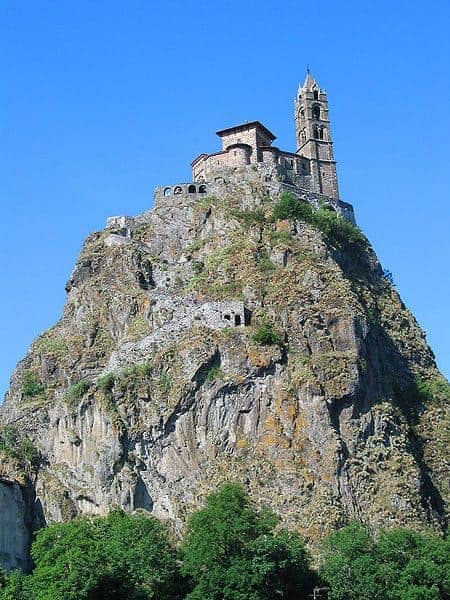
- Le Puy-en-Velay: The arrival. The town sits in a volcanic landscape that feels almost otherworldly. The Cathedral of Notre-Dame, the statue of Notre-Dame de France on the Rocher Corneille, and the chapel of Saint-Michel d'Aiguilhe perched on its needle of rock are all extraordinary. Le Puy is where many pilgrims begin the Via Podiensis, so arriving here on foot, having already walked 300 km, gives you a particular satisfaction. You have earned this place.
But the real highlights, the ones that stay with you, are smaller. The way a host set out a plate of cheese without being asked. A Romanesque church in a village of forty people, unlocked, with a single candle burning. The sound of a stream in a valley where the trail drops below the treeline and the world goes quiet. These are the things you walked for, even if you didn't know it when you started.
FAQ: Cluny to Le Puy on Le Chemin de St Jacques
How long does it take to walk from Cluny to Le Puy-en-Velay?
Most walkers take between 14 and 20 walking days, depending on daily distance and the route variant chosen after Marols. At a pace of 18 to 22 km per day, expect roughly 16 walking days. Add two to three rest days for a total trip of about three weeks. In winter, shorter daylight and caution on icy paths may add a day or two.
Do I need a pilgrim credential (crédencial) for this section?
A credential is not strictly required to walk the GR 765, but it is useful. Some gîtes d'étape and pilgrim-specific accommodations ask to see one. It also provides continuity if you plan to continue from Le Puy toward Santiago and eventually apply for a Compostela in Santiago de Compostela. You can obtain a credential from the Association des Amis de Saint Jacques or from the tourist office in Cluny before you begin.
Is GR 765 well-marked and easy to follow for first-time Americans?
The red and white GR waymarking maintained by the FFRandonnée is generally reliable along the entire route. However, winter conditions (snow cover, fallen branches, reduced visibility) can obscure markers. Carry a paper guidebook with route descriptions and an offline map on your phone as backup. The route passes through some remote rural sections where mobile signal is weak or absent, so do not rely solely on a phone for navigation.
Can I do this route without carrying camping gear?
Yes. The Cluny to Le Puy route is designed as a village-to-village walk with accommodation at each stage. You do not need a tent, sleeping bag rated for outdoor use, or cooking equipment. A lightweight sleeping bag liner is worth carrying for gîtes that provide blankets but not sheets. The key is pre-booking, especially in winter when some lodgings close. Luggage transfer services such as La Malle Postale operate on some French Camino routes, though availability on the GR 765 is limited and seasonal.
What is the biggest mistake people make on a quieter French Camino section?
Three things, in order of frequency. First, overpacking. The temptation to bring "just in case" items for a remote French trail leads to packs that are two or three kilograms too heavy, and that weight accumulates as knee pain and blisters over 300 km. Second, underestimating winter closures. A village with three listed accommodations in summer may have one open in February, or none. Call ahead. Third, pushing mileage too hard in the first three days. Jet lag, an unfamiliar pack, and new boots are a recipe for injury if you try to cover twenty-five kilometres on day one.
Want Help Planning Your Cluny to Le Puy Camino Days and Packing List?
If you're considering this walk, whether in the quiet of February or the warmth of June, there are a few things that might help as you plan.
- Subscribe to the site for more posts on French Camino routes and itineraries, including detailed notes on the Via Podiensis from Le Puy to Saint-Jean-Pied-de-Port
- A lightweight packing checklist and blister prevention kit list are available to download, built around the principles in this post
- Leave a comment with your planned timeframe (winter, spring, autumn) and your target daily kilometres. Specific questions about stages, lodging, or the east vs. west variant after Marols are welcome
The path from Cluny to Le Puy-en-Velay is not famous. It does not appear on bucket lists. It will not trend on social media. What it offers instead is something rarer: three weeks of walking through a France that most visitors never see, with time to think, time to be quiet, and a slow, earned arrival at one of Europe's great pilgrimage cities. The scallop shell on your pack will mean something different by the time you reach Le Puy. Not because the route changed you in some grand, dramatic way, but because 300 km of putting one foot in front of the other has a way of making things clearer. Simpler. Lighter.
Buen Camino. Or, as they say here, Bon chemin.



Leave a Reply