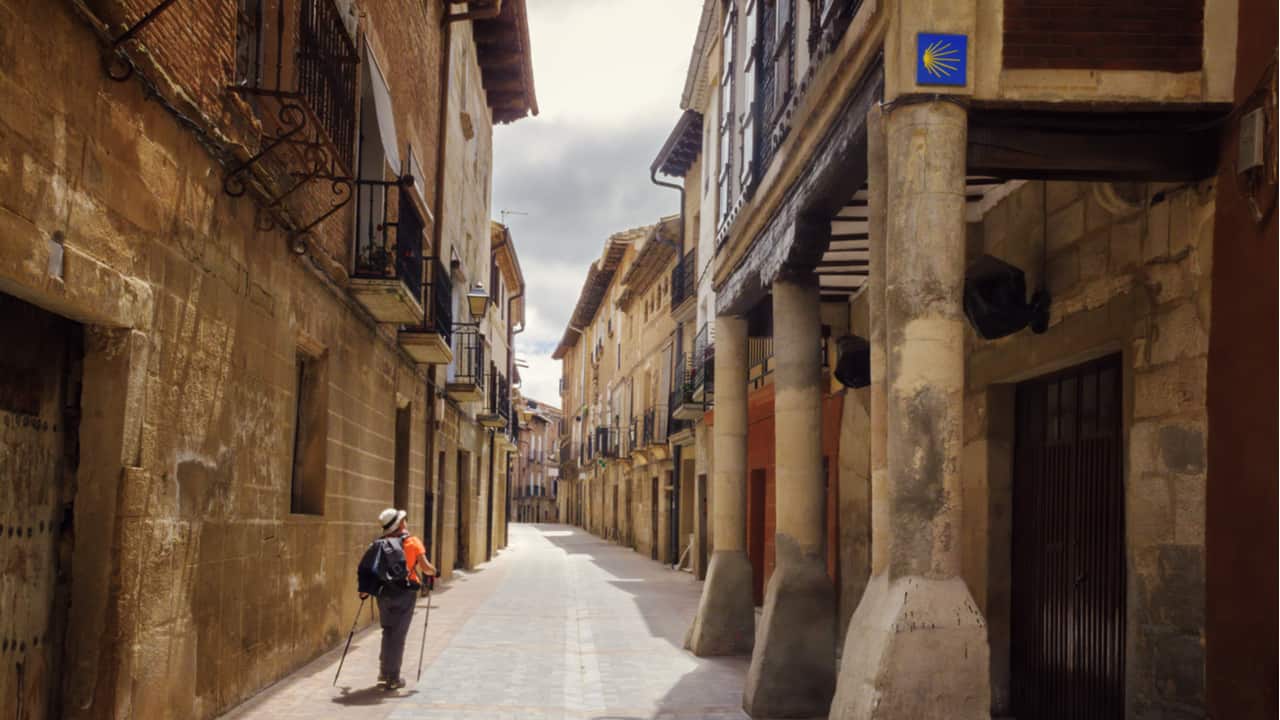
You smell Los Arcos before you see much of it: dust, cut hay, the faint sweetness of vineyards baking in the afternoon sun. After the long, exposed haul from Estella, the town arrives the way most Navarre towns do on the Camino Frances, quietly, a church tower lifting above the rooftops, then a bridge over the Río Odrón, then the cool shade of stone streets. I remember arriving footsore and slightly cross with myself for setting off too late, and being surprised by how completely the place took the edge off.
This is a small rural town, smaller than its history suggests. The population has nearly halved since 1960, a figure you can almost feel in the empty afternoon squares. And yet Los Arcos gives a pilgrim everything they actually need: a bed, a meal, a pharmacy, a bar where the same familiar faces from the trail turn up an hour later. It is a stop worth taking slowly.
What should pilgrims expect when arriving in Los Arcos on the Camino Frances?
Los Arcos sits in the dry, golden heart of Navarre, roughly a day's walk past Estella and a comfortable stage short of the La Rioja border. The stage from Estella to Los Arcos is one most walkers take as a single day, and the town is the natural overnight after the climb out of the Estella valley, the night before the push toward Viana and Logroño. It is compact enough to cross on foot in ten minutes, which is exactly what your legs want by then.
The feel of the place is agricultural and unhurried. Tractors more than tour buses. There is a working pilgrim rhythm here: arrivals through the early afternoon, the slap of laundry being pegged out, then the long Spanish pause of the siesta when the shutters come down and the streets go still. If you arrive hungry at three o'clock expecting a hot lunch, you may be disappointed. Plan around the quiet rather than fighting it.
Here is what a pilgrim can reasonably expect to find in Los Arcos:
- Several places to sleep, from a municipal-style albergue to private albergues and small hostals
- Bars and restaurants clustered around the town centre and the main square
- A pharmacy, a small shop or two for resupply, and an ATM
- The Church of Santa María, the town's one unmissable monument
- A genuine medieval old quarter, easy to wander in an hour
None of this is grand. That is rather the point. Los Arcos is the sort of stop that rewards a pilgrim who slows down, drops the pack, and lets a small town be a small town.
Where is Los Arcos on the Camino Frances, and why is it historically important?
On the French Way, Los Arcos falls between the Navarre towns east of it, including Estella and the famous Irache wine fountain, and the approach to La Rioja and Logroño. It is one of those waypoints that has been catching pilgrims for the better part of a thousand years, and the layers of its past are still legible in the streets if you know to look.
The town has Roman origins. Five tombs found here are usually cited as the clearest physical evidence of that early settlement, a reminder that people were passing through this corner of Spain long before Saint James gave them a reason to. Much later, Los Arcos sat near the contested frontier between the kingdoms of Castile and the wider Aragonese sphere, and its strategic position gave it a real military weight. A frontier town learns to build walls and gates, and to look after travellers, both of which matter to a modern walker.
That layered history shows up in the shape of the town: a defensive old core, a fine church far larger than the present population would seem to warrant, and the worn stone of a place that has always been a crossing point rather than a destination. The Camino de Santiago did not create Los Arcos, but it has kept it alive.
What are the best things to see in Los Arcos, and what shouldn't you miss?
You can see the best of Los Arcos in one or two unhurried hours, which suits a tired pilgrim perfectly. There is no pressure to tick off a long list. The pleasure here is small-scale: a square to sit in, a church to be quietly astonished by, a few old streets where the Camino threads through arches and past coats of arms carved into lintels.
A simple, pilgrim-friendly loop might look like this:
- Start in the main square, the town's natural living room, and order something cold before you do anything else
- Step into the Church of Santa María, ideally when the light is low and the bell tower throws a long shadow
- Wander the old quarter, looking for the remnants of the medieval wall and the town gates the Camino once passed through
- Find the bar your trail companions have already colonised, and let the evening assemble itself around a few tapas
If you have extra time and an appetite for it, the town's small cultural spaces are a pleasant add-on, though honestly most pilgrims spend their surplus energy on a second drink and an early night. There is no shame in that. The walk to Viana the next morning will ask more of you than any museum.
What makes the Church of Santa María in Los Arcos so special?
If you see one thing in Los Arcos, make it the Church of Santa María. From the outside it is handsome but not overwhelming; step through the door and the interior does something genuinely disorienting, a riot of gilded Baroque that feels far too lavish for a town this size. I stood there with my pack still on, blinking, until a local gently suggested I sit down.
What makes it remarkable is the span of its building history. The church grew across centuries, with the oldest fabric reaching back to the 12th century and later work continuing into the 18th, and you can read that long timeline in its different parts. The result is less a single design than a conversation between generations of builders.
|
Feature |
Style and period |
What to look for |
|
Gothic cloisters |
Later Gothic |
The quiet, arcaded courtyard; a cool, contemplative pause away from the nave |
|
North facade |
Plateresque |
Intricate, finely carved stonework up close, almost like silverwork in stone |
|
Bell tower |
Renaissance |
The tower that shapes the town skyline and makes the best photo viewpoint |
|
Interior |
Baroque |
The gilded altarpiece and ornamentation that overwhelm first-time visitors |
The Gothic cloisters reward a slow circuit; they are the part of the building where the noise drops away. The plateresque north facade is the detail to study closely, the kind of carving that only gives itself up when you stop and lean in. And the Renaissance bell tower is the silhouette you will photograph against the evening sky, whether you mean to or not. For a town that has lost half its people in living memory, Santa María is an act of stubborn, beautiful continuity.
What facilities and services are available in Los Arcos for Camino pilgrims?
For its size, Los Arcos covers the basics well. This is not a place to do serious gear shopping, but every essential a pilgrim needs at the end of a day is here, usually within a few minutes of the centre. The trick is timing, because a small Spanish town runs on its own clock.
The practical checklist for what you will find:
- Beds: a municipal-style albergue plus private albergues and a hostal or two
- Food: bars and restaurants doing pilgrim menus, plus tapas in the evening
- Resupply: a small shop or grocery for snacks, fruit, and next-day provisions
- Health: a pharmacy for blister supplies, tape, and the usual small disasters
- Money: an ATM, useful before the quieter stretches ahead
The single most useful habit is to shop for tomorrow tonight. The stretch from Los Arcos toward Viana has limited services between towns, so buy your breakfast, water, and trail snacks the evening before, while the shop is open and you still have the energy to care. Many pilgrims learn this lesson the hard way, standing at a shuttered shop at seven in the morning, and it is a lesson worth borrowing from someone else's experience instead.
Mind the siesta. Shops and some bars close in the early afternoon and reopen later, and dinner in Spain runs late by northern European standards. If you want a proper meal, aim to be showered, laundered, and seated when the kitchens reopen for the evening rather than wandering hopefully at five o'clock.
Where can you stay in Los Arcos, and how do you choose the right accommodation?
Accommodation in Los Arcos follows the familiar Camino pattern, and choosing well is mostly about being honest with yourself about what kind of sleeper you are. A snorer in a forty-bed dormitory is everyone's problem, including their own. There is a fuller guide to the different kinds of pilgrim accommodation worth reading before you go, but the short version applies here as anywhere on the route.
The main types you will find:
- Municipal or public-style albergue: cheapest, basic, sociable, first come first served
- Private albergues: a little more comfort, sometimes private rooms, often a kitchen or laundry
- Hostals and pensions: private rooms with more quiet and privacy, at a higher price
How you choose comes down to your priorities on that particular night. If you are walking on a tight budget and want company, the public albergue is the obvious call. If you crave quiet, an early lights-out, or simply a door that closes, a private room in a hostal earns its keep, especially after a hard stage. Think about whether you need a kitchen, a laundry line, or an early start, and let that decide.
|
Priority |
Better choice |
Why |
|
Lowest cost |
Municipal-style albergue |
Cheapest beds, sociable atmosphere |
|
Privacy and quiet |
Hostal or private room |
Your own door, no dormitory snoring |
|
Kitchen and laundry |
Private albergue |
Self-catering and washing facilities |
|
Early, flexible start |
Albergue with no curfew |
Leave before the midday heat without waking a dormitory |
On booking: in the high summer months and around any holiday, beds in a small town fill fast, and a little forward planning saves a lot of anxiety. Booking ahead through the usual sites, or simply ringing the place, makes sense in peak season. In the shoulder months you can usually walk in and find a bed without fuss. When you arrive, check the practical details early: check-in times, whether beds are assigned, where the laundry lines are, and any curfew or quiet hours. Sort those first, then go and sit in the square.
How do you walk from Los Arcos to Viana, 18.5 km, and what will you see on the way?
The stage from Los Arcos to Viana runs about 18.5 km, a moderate day that most pilgrims walk in roughly four to five hours depending on heat, breaks, and how heavy the pack has become by this point in the journey. It suits walkers who are finding their rhythm: long enough to feel earned, short enough to leave time for the evening in Viana.
The walking itself is classic Navarre. Open country, vineyards, big skies, and a couple of sections that dip through deep ravines where the path gets more uneven underfoot. After the flatter approaches, these descents and climbs ask a little more of your knees and your concentration. Trekking poles help, and so does a slower pace through the rougher ground.
Two waypoints break up the day:
- The Ermita de San Blas, a small hermitage that makes a natural pause; a shaded spot to drink, breathe, and let the morning settle
- Torres del Río, a notable village with a famous octagonal church, a good place for coffee and a rest, with services that vary by season
Torres del Río is the obvious mid-route stop, sitting in a fold of the land so that you drop down into it and climb back out, a small rehearsal for the day's terrain. From there the path rolls on through more vineyards before Viana finally appears, a larger, livelier town than Los Arcos, with food, a handsome old centre, and the next day's planning to be done. When you roll in, the order of business is the same as ever: bed, shower, food, and a quiet sit-down. The guide to Viana and the onward walk picks up where this stage ends.
What are common problems on the Los Arcos to Viana route, and how do you avoid them?
This is not a dangerous stage, but it has its small traps, and most of them come down to heat and exposure. Much of the way is open, with little shade between waypoints, and the Navarre sun in summer is no joke. I have watched stronger walkers than me wilt on this kind of terrain simply because they started too late.
The challenges, and how to handle them:
- Heat and sun: start early to beat the worst of the midday sun, carry enough water, and use sun protection
- Uneven footing near the ravines: slow down on the rougher descents and use poles for balance
- Limited services between towns: carry cold drinks and snacks, since you cannot rely on a bar at every turn
- Open, exposed stretches: pack a light layer and a rain shell for wind or a sudden shower
The biggest single challenge is simply the sun on an exposed path. Treat an early start as the default, not the heroic option, and most of the day's difficulty quietly dissolves. Walk in the cool, rest in the heat, and arrive in Viana with something left in the tank.
How do you plan your day in Los Arcos? A suggested itinerary for pilgrims
A good Los Arcos day has two halves: a gentle afternoon of recovery, and a disciplined early morning departure. Getting both right turns the stop from a mere bed-and-go into one of the small pleasures of the Camino Frances.
An afternoon arrival might run like this:
- Drop the pack, claim a bed, shower, and get the laundry on the line while the sun can still dry it
- Visit the Church of Santa María, when the light is kind and the tower casts its shadow
- Walk a slow loop of the old quarter, looking for the medieval wall and the arches the Camino passes through
- Settle into the square or a bar for tapas and a drink, and let the evening unfold with whoever turns up
For the morning, the watchword is "before the heat." Take breakfast as early as the place allows, fill your water, and aim to be walking while the air is still cool. If you bought your snacks the night before, departure is simply a matter of lacing up and stepping out. And if you have any extra time, spend it back at Santa María with the history and the architecture, rather than rushing the one genuinely special thing the town has to offer.
FAQ: What else do pilgrims ask about Los Arcos on the Camino Frances?
Is Los Arcos worth staying overnight, or can you walk through?
For most pilgrims, Los Arcos makes sense as an overnight stop. It is well placed at the end of a day from Estella, it has the beds, food, and services you need, and Santa María alone justifies a pause. Walking through is possible if your legs and your timetable demand it, but you would be skipping a genuinely good small town and pushing into a long onward stage. Unless lodging ahead is uncertain or you are short on days, stay the night.
How long does it take to walk from Los Arcos to Viana?
The 18.5 km stage typically takes around four to five hours of walking, not counting breaks. Heat, the weight of your pack, and how often you stop at the Ermita de San Blas and Torres del Río all change the pace. Treat it as a moderate day, start early, and you will reach Viana with the afternoon still ahead of you.
Are there places to eat and resupply in Los Arcos?
Yes, though on a small-town scale. You will find bars and restaurants serving pilgrim meals and tapas, plus a small shop for groceries and snacks. The realistic approach to resupply is to buy your next-stage provisions the evening before, because the stretch toward Viana has limited services and the shop may not be open when you set off at dawn.
What is the must-see sight in Los Arcos?
The Church of Santa María, without question. Its building history spans roughly the 12th to the 18th century, and it brings together Gothic cloisters, a finely carved plateresque north facade, a Renaissance bell tower, and an interior of overwhelming Baroque gilding. It is far grander than the town's size would lead you to expect, which is exactly what makes it memorable.
What towns and villages do you pass after Los Arcos on the way to Viana?
Leaving Los Arcos, you pass the Ermita de San Blas, a small hermitage that makes a good first pause, then the village of Torres del Río with its striking octagonal church and a chance for coffee. From there the path continues through vineyards and open country before reaching Viana, the larger town that closes the stage.
A quiet town worth the pause
Los Arcos is not a place that announces itself. It does not need to. It is a working Navarre town that has been quietly looking after pilgrims for centuries, and it asks only that you slow down enough to notice it. Sit in the square, lose an hour in Santa María, sleep well, and leave early. That is the whole art of a good Camino stop, and Los Arcos teaches it gently. Buen Camino.
If you are walking this part of the route in sequence, the stages on either side are worth reading too: the day into Estella and the Irache wine fountain that brings you here, and the onward walk to Viana and beyond toward Logroño. For wider planning, the full guide to the Camino Frances sets each stage in context, and a closer look at how albergues work along the way will help you choose where to lay your head in towns like this one.




Leave a Reply