You smell Puente la Reina before you see the bridge. Frying garlic from a bar on the main street, the dust of a hot afternoon, the faint church-cool damp when you step out of the sun and into a doorway. By the time most pilgrims arrive here, on the fourth day out of Saint-Jean or the fifth, the legs have learned their job and the mind has gone quiet, and a small medieval town in Navarra feels like exactly the right size of place to stop.
This is one of those Camino towns that does more than feed and bed you. It marks a joining. For centuries, two great pilgrim roads met just outside the walls, and the single way that left town toward Santiago is the one almost everyone still walks today. That history is not abstract. You feel it underfoot, on cobbles worn smooth by a thousand years of boots and sandals and bare tired feet.
Why do Camino walkers stop in Puente la Reina (Gares)?
Puente la Reina, known as Gares in Basque, is a key stop on the Camino de Santiago Francés in Navarra, northern Spain. It sits roughly a day's walk west of Pamplona, and it has been a pilgrim town since the bridge that gives it its name was raised across the Arga in the 11th century. The Spanish name means "the Queen's Bridge," and the queen in question was probably Muniadona, wife of Sancho III, who is credited with ordering it built so that pilgrims could cross the river safely.
What makes the town feel like a milestone is the convergence. The Camino Francés, coming down from Roncesvalles and through Pamplona, joins here with the Camino Aragonés, the route that crosses the Pyrenees further east at the Somport pass. Two streams of peregrinos, who may have walked for days without crossing paths, suddenly share one narrow main street. From Puente la Reina there is, for a long while, only one way to Santiago.
For a traveller coming from the United States, here is the honest shape of the place. It is small, very walkable, and built for people on foot. The services are geared to pilgrims, the food is better than a town this size has any right to offer, and you can see the main sights in an afternoon. Whether to pass through or stay the night is the only real decision, and it depends mostly on your legs.
- Best time to visit: late spring and early autumn, when the heat eases and the albergues are open but not heaving.
- How long to stay: one to two hours if you are pressing on, a relaxed afternoon and a night if you want the bridge at dusk.
- What to expect: a quiet medieval centre, a famous bridge, two notable churches, and a strong Navarra food scene.
- Getting around: entirely on foot; the whole town unfolds along one street.
What is Puente la Reina famous for?
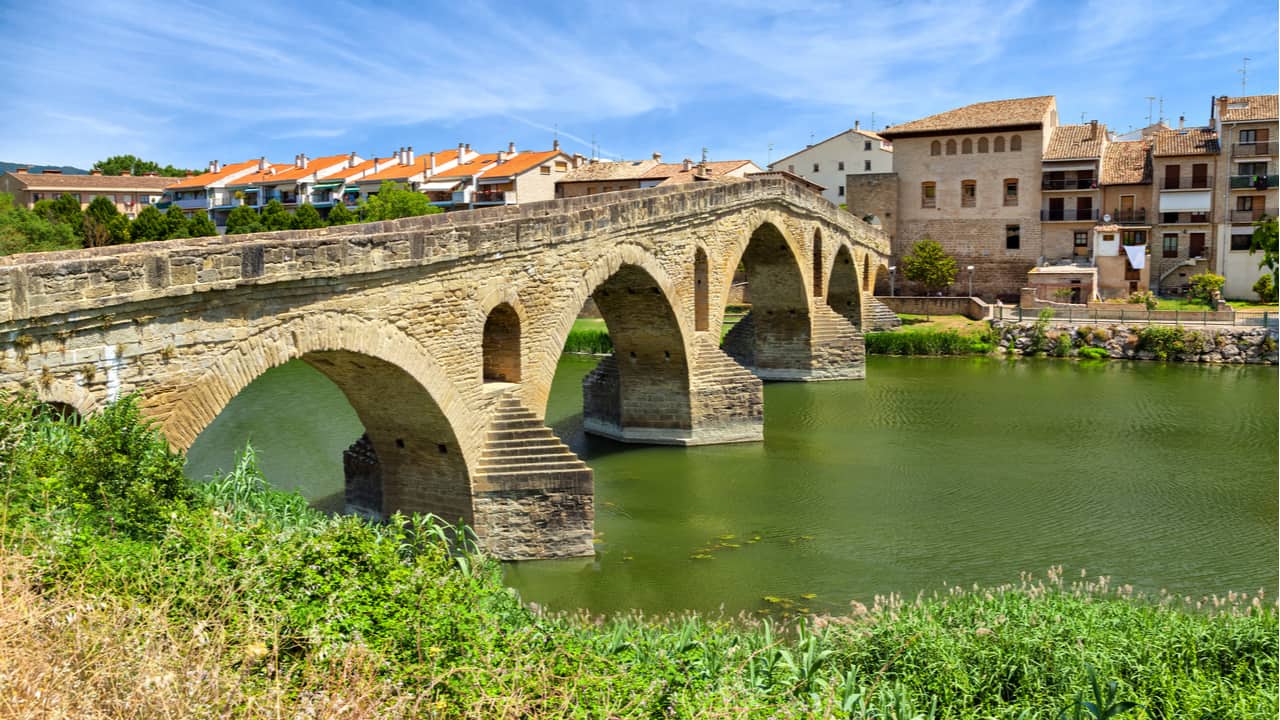
The town is famous for one thing above all: its bridge. The Romanesque bridge over the river Arga is the reason the place exists in its modern form, the reason it carries a queen's name, and the image you will see on every postcard and guidebook cover. It is a graceful run of arches in pale stone, humpbacked in the old way, and walking across it is the last thing most pilgrims do as they leave town heading west.
Beyond the bridge, Puente la Reina is famous as a Camino town in the fullest sense. The pilgrimage built it, shaped its single long street, and still fills it each spring and summer. The medieval character is intact in a way that does not feel staged. These are working houses with washing on the lines, not a film set, and that ordinariness is part of the charm.
The Calle Mayor and the town's medieval centre
The Calle Mayor is the spine of the town and the main street the Camino follows straight through. The waymarking does the navigating for you here; the yellow arrows simply point down the middle of it. The street is lined with cafes and restaurants, a few shops, and the doorways of churches, and in the morning the smell of coffee leaks out of every other one.
Walk it slowly. The buildings lean in, the light falls in slabs across the cobbles, and you pass under the carved stone of old façades that most people hurry past without a second glance. It is a short street. You can cover it in ten minutes. Resist that, because the whole point of stopping in a pretty village like this is to not be in a hurry for once.
What are the best things to do in Puente la Reina on the Camino Francés?
The good news for tired legs is that everything worth seeing sits within a few hundred metres of everything else. You do not need a taxi, a plan, or much energy. A simple walking route through town takes you from one end to the other and hits every highlight, and you can do the short version in an hour or the long version across a lazy afternoon.
Here is a sensible order, following the way the Camino itself runs through town, from the entrance churches down the Calle Mayor to the bridge at the far end:
- Start at the Iglesia del Crucifijo, near where the route enters town, with its unusual Y-shaped crucifix.
- Walk the length of the Calle Mayor, stopping for a coffee or a midday beer.
- Visit the Church of Santiago to see its carved portal and quiet interior.
- Carry on to the Church of Santa María and its 15th century altarpiece.
- Finish at the Romanesque bridge, ideally with the low evening sun on the stone.
If you have only an hour, do the bridge and one church and let the rest go. If you have an afternoon, add a meal, the local museum, and a slow second crossing of the bridge for photographs. The trick is to pace your sightseeing so you are not wrecked for the next stage. There is little glory in limping into Estella because you spent the previous evening pounding cobbles in your sandals.
What should you know about the Romanesque bridge over the Arga River?
The bridge was built in the 11th century specifically as pilgrim infrastructure, a piece of medieval engineering meant to get the faithful across the Arga without paying a ferryman or risking the ford. It is a Romanesque bridge of several arches, and for a structure roughly a thousand years old it remains remarkably sound. People still cross the bridge on foot every day, exactly as intended.
To reach it, simply follow the Calle Mayor to its western end; the street delivers you straight onto the approach. The best light is early morning and late evening, when the sun is low and the stone glows amber rather than flat white. Photograph it from the riverbanks below for the classic profile, the arches doubled in the water if the Arga is calm.
A word on etiquette. In high summer the bridge can crowd with day-trippers and pilgrims at once, all angling for the same shot. Be patient, stand aside for people genuinely crossing, and do not park yourself in the middle of an arch with a tripod. The bridge is a monument, yes, but it is also still a road.
Which churches should you visit in Puente la Reina?
Two churches earn the time. The Church of Santa María, sometimes called Santa María la Real, holds a 15th century altarpiece that is the artistic highlight of the town, all gilt and painted panels glowing in the dim. Step in out of the heat and let your eyes adjust; it takes a moment, and then the gold surfaces from the shadow.
The Church of Santiago, on the Calle Mayor itself, is the one most Camino guides point you toward. Look for the Romanesque church origins beneath later Gothic additions, and the carved portal that has greeted pilgrims for centuries. Inside there is a noted statue of Saint James as a pilgrim, which feels apt in a town this devoted to the road.
A note on visiting. Opening hours for both vary with the season and with services, and they are not always posted in English. These are working places of worship before they are sights, so keep your voice low, your hat off, and your camera quiet if a mass is underway.
Where can you see Roman history near Puente la Reina?
Near the town lie the remains of a Roman villa, a reminder that people were settling and farming this fertile corner of Navarre long before any pilgrim thought to walk to Compostela. What survives is partial, foundations and mosaics rather than standing walls, and it rewards curiosity more than it dazzles.
This is one for the history lover or the longer-stay traveller rather than the pilgrim with one eye on the next albergue bed. It involves a short walk or a taxi out of the centre, and a little time. If Roman archaeology is your thing, it is worth the small detour; if you are saving your feet for Estella, you will not have missed the heart of the town by skipping it.
Is there a museum in Puente la Reina worth visiting?
There is a small local museum covering the town's history and its long entanglement with the Camino de Santiago. It will not eat your whole day. Budget half an hour to an hour, and treat it as a good wet-weather option or a gentle thing to do on a rest day when your walking companions want to sit down for a while.
For non-walking travelling companions, the kind who drove the bags or are meeting you here, the museum and the churches together make a pleasant low-effort morning while the pilgrims recover. It is the sort of place that quietly fills in the context for everything you are walking through.
Where should you eat in Puente la Reina, and what local foods should you try?
Navarra eats well, and Puente la Reina is no exception. The rhythm of meals here will feel late to an American stomach: lunch rarely before two, dinner rarely before eight or nine. Plan around that. If you arrive ravenous at five in the afternoon, you may find kitchens closed and only a bar serving pintxos to tide you over, which is hardly a hardship.
The dishes to look for are the regional ones. Two in particular are worth ordering:
- Cordero asado: roast lamb, slow-cooked until it falls from the bone, rich and unfussy and exactly what walking legs crave.
- Pimientos del piquillo: sweet, slightly smoky piquillo peppers, often roasted and peeled, sometimes stuffed, served as a tapa or a starter.
You will face a choice between tapas, which the Basque-influenced north calls pintxos, and the set pilgrim menu. The pilgrim menu, usually three courses with bread and wine for a fixed and modest price, is the practical option when you are hungry and watching your euros. Pintxos, picked one by one off the bar, suit a smaller appetite and a wandering evening. Both have their place, sometimes on the same night.
A small piece of recovery advice, learned the hard way. After a long day, your body wants salt and carbohydrate more than it wants a feast. A plate of patatas, some bread, a little protein, and plenty of water will set you up for tomorrow better than three courses and half a bottle of wine. Eat early enough to sleep, and your morning self will thank you.
What wine is Puente la Reina known for, and how close is Rioja?
Navarra is wine country in its own right, long overshadowed by its famous neighbour but quietly very good, especially its rosados, the dry rosé wines the region does so well. Order the house wine by the glass and you will rarely be disappointed. It is cheap, local, and made for drinking with the food in front of you rather than for contemplating.
The Rioja region begins not far southwest of here, and you will walk into its edges within a couple of days as the Camino carries you on past Estella and toward Logroño. So while Puente la Reina itself is Navarra, the broader wine country you are entering is some of the most celebrated in Spain. The famous wine fountain at Irache, a free trickle of red for passing pilgrims, lies just a short stretch further along the way.
One honest caution, with no moralising attached. Wine is part of the table here, and a glass with dinner is one of the small pleasures of the road. A second bottle the night before a long stage is a decision your knees will help you regret at seven the next morning. Enjoy it; just keep one eye on the kilometre count waiting outside.
Where should you stay in Puente la Reina: albergues, hostels and hotels?
Accommodation in Puente la Reina covers the full pilgrim spectrum, from communal albergue dormitories to private hotel rooms. Where you land depends on your budget, how well you sleep among strangers, and whether you are walking solo, as a couple, or with family. The town is compact enough that almost everything sits within easy reach of the Calle Mayor.
The broad categories you will meet, listed across the town's lodgings, look like this:
|
Type |
Who it suits |
What to expect |
|
Municipal or parish albergue |
Budget pilgrims, the full communal experience |
Bunk beds, shared bathrooms, early check-in, lights out and an early start |
|
Private albergue and hostel |
Pilgrims wanting a little more comfort |
Smaller dorms or private rooms, often a kitchen, sometimes laundry |
|
Hostal or hotel |
Couples, families, light sleepers |
Private en-suite room, quiet, breakfast available, more privacy |
|
Apartment or rural stay |
Groups, longer stays, self-caterers |
More space, a kitchen, the feel of a home rather than a bunkroom |
One well-known option just outside the town entrance is the Jakue complex, which pairs a private albergue with a hotel and restaurant under one roof, a useful arrangement if some of your party want a bunk and others want a proper bed. There are camping options in the wider area too, for those carrying a tent, though most walkers gratefully take a roof.
When choosing, think about the things that actually affect your night. The amenities that matter to most pilgrims are simple ones:
- Location near the Calle Mayor, so food and the bridge are a short stroll away.
- Quiet, away from the bars if you are a light sleeper.
- Laundry, or at least a sink and a line, after several days on trail.
- A kitchen, if you would rather cook than eat out.
- Working heating or cooling, which matters in both the cold shoulder months and the high summer.
As for booking, the old wisdom mostly holds. In the quieter months you can often wing it and find a bed on arrival. In the busy stretch of late spring through summer, and in a Holy Year, reserving a night ahead saves you the grim march to the next town with no room left. For more on how the network of pilgrim albergues works across the whole route, it is worth reading a general guide to albergues on the Camino de Santiago before you set out.
What is the next stage like, from Puente la Reina to Estella?
The stage that leaves Puente la Reina heading west is, on most schedules, Stage 5 of the Camino Francés, and it ends in the larger town of Estella. It is a popular route and a manageable day, somewhere around twenty kilometres depending on exactly where you started and stopped, through rolling farmland and a string of small villages.
You leave by crossing the bridge, which is a fitting way to start, and climb gently out of the Arga valley. The villages on the way each have their own small character, and the table below gives the rough running order most walkers follow:
|
Stop |
Character |
Notes for walkers |
|
Mañeru |
Small hilltop village |
First settlement after the climb, a possible coffee stop |
|
Cirauqui |
Steep, stone-built medieval village |
A short, sharp climb through cobbled lanes and a Roman road below |
|
Lorca |
Quiet roadside village |
Bar and fountain, a good place to refill water |
|
Villatuerta |
Larger village before Estella |
Romanesque church, a sign you are nearly there |
|
Estella |
Historic town |
The usual overnight, with the Irache wine fountain just beyond |
Plan for an early morning departure, especially in summer. Get the climbing done before the heat builds, carry enough water for the gaps between villages, and do not count on every bar being open when you reach it. Estella makes a popular next overnight because it is big enough to have a proper choice of beds and food, and because it stands at the threshold of the wine country to come. If you want the detail of this leg, the day from Estella onward toward Los Arcos picks up where this stage leaves off.
What problems should pilgrims plan for between Puente la Reina and Estella?
This is not a brutal stage, but a few things catch people out. Heat and sun are the main ones; much of the walking is open, with little shade, and the wind that funnels across these hills can dry you out faster than you notice. Carry more water than feels necessary, and wear a sun hat even on a grey morning, because the cloud here burns off fast.
Foot care is the other. By this point you are several days in, and the small hot spots you ignored near Pamplona are ripening into proper blisters. Stop early, tape generously, and do not walk through pain in the name of making the next town. A short list of sensible prep, none of it glamorous:
- Sunscreen and a sun hat, applied before you leave, not when you are already burning.
- Enough water capacity for the dry stretches between bars.
- Snacks for energy, since some villages have nothing open early.
- Hiking poles if your knees feel the descents, particularly down out of Cirauqui.
- An honest pace, and rest stops taken before you need them rather than after.
The waymarking is generally good through the villages, but the uneven cobbles and the odd ambiguous turn mean it pays to keep half an eye on the yellow arrows rather than drifting along behind the person in front. If you want the broader picture of how this fits the whole French Way, the full guide to the Camino Francés sets out every stage from the Pyrenees to Santiago. And if you are still deciding what to carry over these hills, the day out of Pamplona to Puente la Reina covers the approach from the city side.
Frequently asked questions about Puente la Reina on the Camino
Is Puente la Reina a good place to spend the night on the Camino Francés?
Yes, for many pilgrims it is one of the better overnight stops in Navarra. It is the right distance out of Pamplona for a comfortable day, it has a full range of beds from albergue bunks to hotel rooms, the food is excellent, and the bridge at dusk is worth lingering for. If you are walking strong and want to push on to Estella in one go you can, but if you fancy a relaxed evening and a famous monument on your doorstep, this is a fine place to stop.
How much time do you need to see Puente la Reina's main sights?
One to two hours covers the highlights: the Calle Mayor, one or both churches, and the bridge. Stretch it to a half-day if you want to add the local museum, the Roman villa nearby, and a proper sit-down meal rather than a snatched coffee. The town is small and walkable, so you are never far from the next thing, which makes it easy to see a lot without tiring yourself before the next stage.
Is Puente la Reina safe for solo travellers and pilgrims?
It is, by the ordinary standards of small Spanish towns, very safe, and the Camino itself is well travelled and watched over by fellow pilgrims. Use the same sense you would anywhere: keep an eye on your valuables in shared dormitories, do not leave your pack unattended, and take care if you walk out of town in the dark before dawn. Solo pilgrims, including women walking alone, make this journey in large numbers every year.
What is the best time of year to visit Puente la Reina on the Camino?
Late spring, roughly May and June, and early autumn, September into October, give the best balance of open services and bearable weather. July and August bring heat and crowds, with beds filling fast and the midday sun making the open stretches hard going. Winter is quiet and atmospheric but many albergues close, so you will have fewer choices for a bed and a meal.
What should US travellers know about the name Puente la Reina versus Gares?
The two names refer to the same town. Puente la Reina is the Spanish name, the one you will see most often in English-language guides for the Camino Frances and on the Camino de Santiago waymarking. Gares is the Basque name, common on local signage and maps in this corner of Navarre. If you are asking directions or matching a map to a road sign, recognising both will save you a moment of confusion.




Leave a Reply