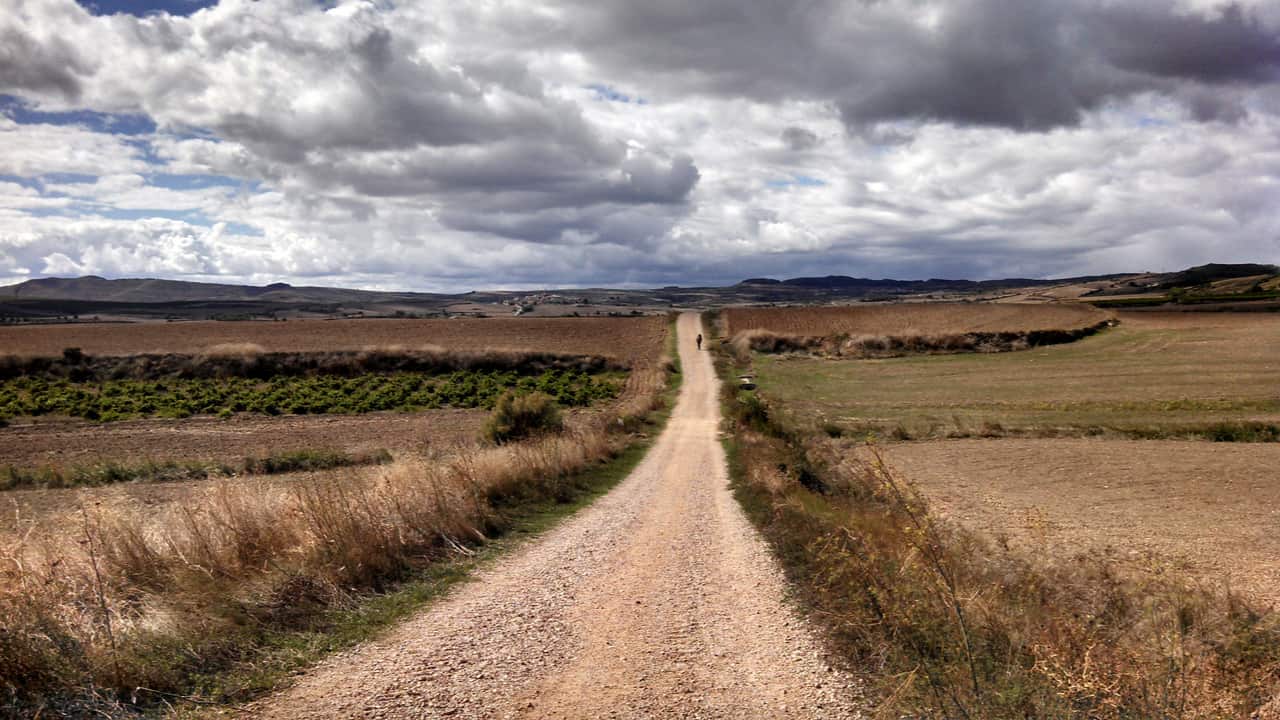
The first morning, I could not have told you why I was there. I was somewhere above Saint-Jean-Pied-de-Port, lungs burning, fog dripping off the gorse, watching a Korean man in his sixties stride past me as though the Pyrenees were a flat suburban pavement. I had a half-formed answer ready for anyone who asked, and nobody asked, and by the third week I had stopped believing my own version anyway.
That is the honest thing about this walk. People set out with one reason and finish with another. Still, when you stand in a bunkroom listening to a dozen accents murmur in the dark, certain motivations come up again and again. Below are the five I heard most, plus what the walk is actually like once the reason wears off and you are just a tired pilgrim looking for the next bar.
What Is the Camino de Santiago (and What Is the 800km Route Most People Mean)?
The Camino de Santiago is not one path. It is a network of old pilgrimage routes, the way of Saint James, that thread across Spain, Portugal, and France and all end at the same place: the cathedral in Santiago de Compostela, in Galicia, where tradition holds the remains of the apostle are kept. People have followed the way to Santiago de Compostela since at least the 9th century, and the cluster of routes is recognised by UNESCO.
When most Americans say they want to walk the Camino de Santiago, though, they mean one specific route: the Camino Frances. That is the classic 800km line from Saint-Jean-Pied-de-Port on the French side of the Pyrenees to Santiago, roughly 500 miles, the one in the Emilio Estevez film. It crosses the Pyrenees on day one, runs through Pamplona, Puente la Reina, Burgos, and Leon, grinds across the flat Meseta, and climbs into the green hills of Galicia for the final stretch.
If you want the full background before committing, our guide to the Camino Frances pilgrimage walks through the stages, the towns, and the planning in detail. Here is the shape of the commitment at a glance.
|
What you are signing up for |
The Camino Frances reality |
|
Distance |
About 800km / 500 miles, Saint-Jean-Pied-de-Port to Santiago de Compostela |
|
Time |
Roughly four to six weeks for the full route, depending on pace and rest days |
|
Daily walking |
Commonly 25 to 30km, with shorter and longer days mixed in |
|
Lodging |
Albergues (pilgrim hostels), small hotels, and rural guesthouses |
|
Terrain |
Mountain crossings, long flat plains, and Galician hills; not technical climbing |
That is the skeleton. The reasons people walk are the muscle and the blood. Let us start with the one I heard most often from people stepping off a plane from the United States, jet-lagged and quietly desperate.
Reason 1: Why the Camino Feels Like Time Out From Modern Life
Ask why people walk and the first answer, more than any spiritual one, is that they wanted out. Out of the inbox. Out of the group chats. Out of the low hum of being reachable at every hour. The Camino offers something modern life almost never does: a single, obvious task that takes all day and cannot be done from a phone.
The daily rhythm is almost comically simple. Wake before light, walk, eat, rest, sleep, repeat. There are no decisions to agonise over because the yellow arrows make them for you. You stop checking the time and start checking your feet. The act of walking, one foot in front of the other for hours, does something to the noise in your head that no app has ever managed for me.
What I noticed, around day four, was attention coming back. Small things got loud. The smell of woodsmoke from a farmhouse. A magpie on a fence post. The specific misery of a wet sock. Pilgrims often describe this as stress relief, but it is more like a recalibration of what counts as an event.
Here is what tends to drop away when you spend your days on the camino:
- The reflex to reach for your phone in every quiet moment
- Decision fatigue, since the route and the schedule are largely fixed for you
- The sense that you should be doing three things at once
- Self-consciousness, after a few days of looking equally bedraggled as everyone else
None of that is automatic. You have to actually put the phone away. But the structure of the walk makes it easier than any digital detox weekend I have tried, mostly because there is nothing to scroll toward when you are this tired.
What Does a Typical Day Look Like Walking 25 to 30km?
A normal day starts in the dark, to the small symphony of zips and rustling and someone's headtorch in your eyes. You are usually walking by six or seven, often before breakfast, chasing the first open bar for coffee and a tortilla. Then you walk in blocks: a couple of hours, a stop, a couple more, until the heat or your knees suggest it is time to find a bed.
The priorities shrink to four things: your feet, your water, your food, and your sleep. That is genuinely the whole of it. If you want the granular version, hour by hour, we have a full account of a typical day on the Camino. The point for now is that this routine is what makes the mental quiet possible. Repetition is the doorway.
Reason 2: Why People Walk the Camino for the Physical Challenge
Plenty of people walk the Camino de Santiago simply because they want to find out if they can. Twenty-five to thirty kilometres a day, that is roughly 15 to 18 miles, for about a month. Said aloud it sounds enormous. It is, and it isn't.
What makes it a particular kind of physical challenge is that it is not technical. You are not scaling cliffs or reading a map in the dark. It is long-distance endurance dressed in ordinary clothes: walking long days, again and again, on legs that did not sign up for this. The difficulty is the repetition, the accumulation, the way day eleven sits on top of day ten. The physical and mental challenges braid together; your body gives out, then your resolve, then both recover by morning, usually.
The satisfaction comes from visible progress. You can point at a map and see the line you have drawn with your feet. Every town you reach is a small, undeniable milestone, and the credential filling up with stamps becomes oddly motivating, a paper proof that yesterday happened. There is comfort, too, in the infrastructure: this is a long-distance hike with villages, beds, and food, not a wilderness expedition.
|
Aspect |
Harder than expected |
Easier than expected |
|
Your feet |
Blisters, hot spots, swelling by afternoon |
Manageable with good shoes and daily care |
|
Navigation |
Occasional confusing junctions |
Yellow arrows and the scallop shell symbol mark the way |
|
Logistics |
Finding a bed in peak season |
Towns along the route mean food and lodging are rarely far |
|
Endurance |
The cumulative tiredness of days of walking |
The body adapts faster than most first-timers believe |
What Are the Hardest Parts for Most First-Timers?
Blisters, mostly. Then the knees and the tendons, especially on the long descents that nobody warns you about because everyone fixates on the climbs. Carrying too much is the classic first-week mistake, and the post offices along the way do a brisk trade in pilgrims mailing home the gear they were sure they needed.
There are mental lows, too. Somewhere on the Meseta, the flat heart of the route, a lot of people quietly want to quit. The trick, the one veterans repeat, is to stop thinking about Santiago and think only about the next town. The whole month is unbearable to hold in your head. The next coffee is not.
Reason 3: Why People Walk the Camino for Reflection and a Life Reassessment
A great many pilgrims arrive at a hinge in their lives. A redundancy, a divorce, a death, a fortieth birthday that landed harder than expected. The Camino has a reputation as a place to think things through, and the reputation is earned, though not in the tidy way the films suggest.
Here is the mechanism, as best I understand it. You give yourself six hours a day with nothing to do but walk and notice. No meetings interrupt the thought you were avoiding. The thing you have been not-thinking about for two years surfaces somewhere around Logrono, gets turned over for forty kilometres, and quietly settles into a different shape. People call it soul searching, but it feels more like decluttering a room you have been afraid to enter.
I will not pretend it is always profound. Some days you reflect deeply on your marriage; other days you reflect on whether your left boot is actively trying to end you. The honesty of the walk is that both are allowed. The reflection is not summoned. It arrives when it is ready, usually when you have stopped chasing it.
How Does Camino Thinking Actually Happen on the Trail?
Walking is a meditative act, the original moving meditation. Thoughts surface, run their course, and dissolve into the rhythm of your steps. You do not have to do anything clever. Many pilgrims journal in the evenings, set a quiet intention for the day, or simply let the silence of an early start do the work.
The most useful instruction I ever got was to let go of outcomes. Stop trying to solve your whole life by Santiago. Focus on the next town, the next ridge, the next bowl of soup. Clarity, when it comes, tends to arrive sideways, while you are thinking about something else entirely. If the inner side of the walk interests you, our piece on the spiritual aspects of the Camino de Santiago sits with this at greater length.
Reason 4: Why People Walk the Camino for Spiritual or Religious Reasons
It is worth remembering, under all the modern motivations, that this is at root a Christian pilgrimage. For over a thousand years, the faithful have walked to the shrine of Saint James, Santiago, the patron saint, to pray, to give thanks, or to ask for something. Many still do. You will pass devout Catholics walking for religious reasons that are entirely uncomplicated to them, and there is a steadiness in their company.
Today the spectrum is wide. Some pilgrims are deeply religious; many describe themselves as spiritual but not affiliated; plenty are simply curious travellers who find themselves moved despite their scepticism. The traditions are quietly available to anyone who wants them: a moment in a Romanesque church, a candle lit, the Pilgrim's Mass in the Santiago de Compostela cathedral where, on some days, the great botafumeiro swings.
You do not need to share the faith to be touched by the architecture of belief that built this route. The bridges, the churches, the worn stone thresholds where centuries of pilgrims have paused. A pilgrim is, after all, just someone walking toward something they consider worth the distance. If the word itself interests you, we get into its meaning and traditions in what it means to be a pilgrim on the Camino.
Do You Have to Be Religious to Walk the Camino?
No. This comes up constantly, and the answer is a plain no. Many pilgrims walk for mixed reasons, and the meaning of the walk often shifts under them as they go. Someone who set out purely for the exercise can find themselves unexpectedly still in a chapel at Roncesvalles, not entirely sure why.
What matters is respect. Sitting quietly through a pilgrim mass, even as a non-believer, is part of the cultural experience, not a betrayal of your scepticism. The route holds room for the devout, the doubtful, and the frankly confused, often in the same pew.
Reason 5: Why People Walk the Camino for the People They Meet
This is the reason almost nobody lists beforehand and almost everybody names afterward. The community on the Camino is its quiet engine. You are all moving at roughly the same pace, suffering roughly the same blisters, chasing roughly the same bed, and that shared predicament dissolves the usual social caution within about two days.
Friendships form at a speed that would be alarming back home. You meet a Dutch teacher at breakfast, leapfrog her for three days, share a bottle of Rioja in Najera, and somehow know more about her than people you have worked beside for years. The albergues do a lot of this work: shared kitchens, shared dormitories, communal dinners where strangers pass the bread. For solo travellers especially, the Camino offers connection without obligation. You can join a table or walk on alone, and nobody minds either way.
Here is what makes the social side click for most people:
- A shared pace and shared destination that gives everyone instant common ground
- The reunion pattern, where you keep meeting the same faces town after town
- Communal meals in albergues, often cooked and eaten together
- The freedom to walk alone by day and find company by evening
- Mutual care: someone always has tape, ibuprofen, or a spare safety pin
What Are Camino Families and Why Do They Matter?
A Camino family is the small, accidental group that forms around your walking pace. Nobody plans it. You simply notice, somewhere past Burgos, that you have a handful of people you keep ending up with, and that you have started saving them a bunk. They become your support system: they keep you walking on the low days, they look out for you, they listen while you process whatever the trail has dredged up.
These bonds can outlast the walk by decades, which is partly why returning home can feel so flat. We dig into how these groups form in our piece on what a Camino family is. Many pilgrims will tell you, plainly, that the people were the whole point, even if they did not know it when they started.
What Should Americans Know Before Deciding to Walk the Camino Frances?
If you recognise yourself in any of those five reasons, the Camino will probably reward you. The walk suits people who can tolerate simplicity, early mornings, and a degree of physical discomfort, and who are not too proud to share a bathroom with eleven strangers. It tends to frustrate those who need control, privacy, and a predictable mattress.
The two things most within your control are your footwear and your pack weight. Get those right and you have removed most of the avoidable suffering. Beyond that, it pays to build up to consecutive long walking days before you fly out, since the back-to-back nature is what catches untrained legs off guard. A useful trial is a weekend of long walks on two consecutive days, with the pack you intend to carry.
|
If your main reason is |
The Camino is great for you if |
You may struggle if |
|
Time out from modern life |
You can genuinely unplug and embrace the slow rhythm |
You need to stay reachable for work |
|
Physical challenge |
You enjoy endurance and visible daily progress |
You expect comfort and rest on demand |
|
Reflection |
You are at a crossroads and want space to think |
You expect instant, neat answers |
|
Spiritual or religious |
You value ritual, history, and quiet faith |
You dislike religious settings entirely |
|
People and community |
You are open to fast, transient friendship |
You need privacy and predictable solitude |
On accommodation, set your expectations early. Albergue dormitory beds are basic and cheap, often a bunk in a shared room; private rooms in small hotels and rural guesthouses cost more and offer a door you can close. Either way, the lodging is part of the experience, not a luxury layer over it. Anyone planning a walk in 2025 or beyond should know that the popular routes, the final 100km into Santiago especially, fill up fast in summer, so a loose plan helps.
FAQs About Why People Walk the Camino de Santiago
Is the Camino de Santiago only for religious pilgrims?
No. While the Camino began as a Christian pilgrimage to the shrine of Saint James, today people walk for a wide mix of reasons: physical challenge, reflection, time away from modern life, and the community along the way. Plenty of walkers are not religious at all, and many find that their reason for walking changes by the time they reach Santiago de Compostela.
How long does it take to walk the full 800km from Saint-Jean-Pied-de-Port to Santiago?
Most pilgrims take roughly four to six weeks to walk the Camino de Santiago in full on the Camino Frances, covering around 25 to 30km a day. Your exact timing depends on your pace, how many rest days you build in, and whether injuries such as blisters or tendon strain force you to slow down. There is no prize for speed, and many walkers deliberately go slower to enjoy the towns.
How hard is walking 25 to 30km a day for a month?
The hardest parts are usually your feet and joints, with blisters and knee strain on the long descents being the common complaints. What surprises people is how much is easier than expected: the route is well marked with yellow arrows and the scallop shell symbol, and food and lodging are rarely far. The challenge is the repetition rather than any single brutal day.
Is it normal to walk the Camino alone?
Yes, and it is very common. Many pilgrims start solo and quickly find themselves part of an informal Camino family within the first week. The shared pace and communal albergues make it easy to find company by evening even while you walk alone by day, which is part of why the Camino suits solo travellers so well.
What is the biggest reason people say the Camino changed them?
Most point to the combination rather than any single factor: the simplicity of the daily routine, the sustained physical effort, the unhurried space for reflection, the brush with something spiritual, and the connection with other pilgrims. No one of those alone explains it. Walked together, day after day, they tend to leave people thinking differently about work, relationships, and what they actually need.
Choosing Your Own Reason to Walk the Camino de Santiago
So why do people walk the Camino de Santiago? Five reasons keep surfacing: to step out of modern life, to meet a physical challenge, to reflect, to walk a spiritual or religious path, and to find people. Most pilgrims arrive holding one of these and leave holding another, which is the strange grace of the thing.
If you are weighing it up, you do not need to settle the question before you go. Pick the reason that hums loudest for you right now, write it down in a single sentence, and accept that the walk may quietly rewrite it. Then test the rhythm: a weekend of two long back-to-back walks with a loaded pack will tell you more than any amount of reading. The rest, the blisters and the strangers and the soup at dusk, you discover one town at a time.




Leave a Reply