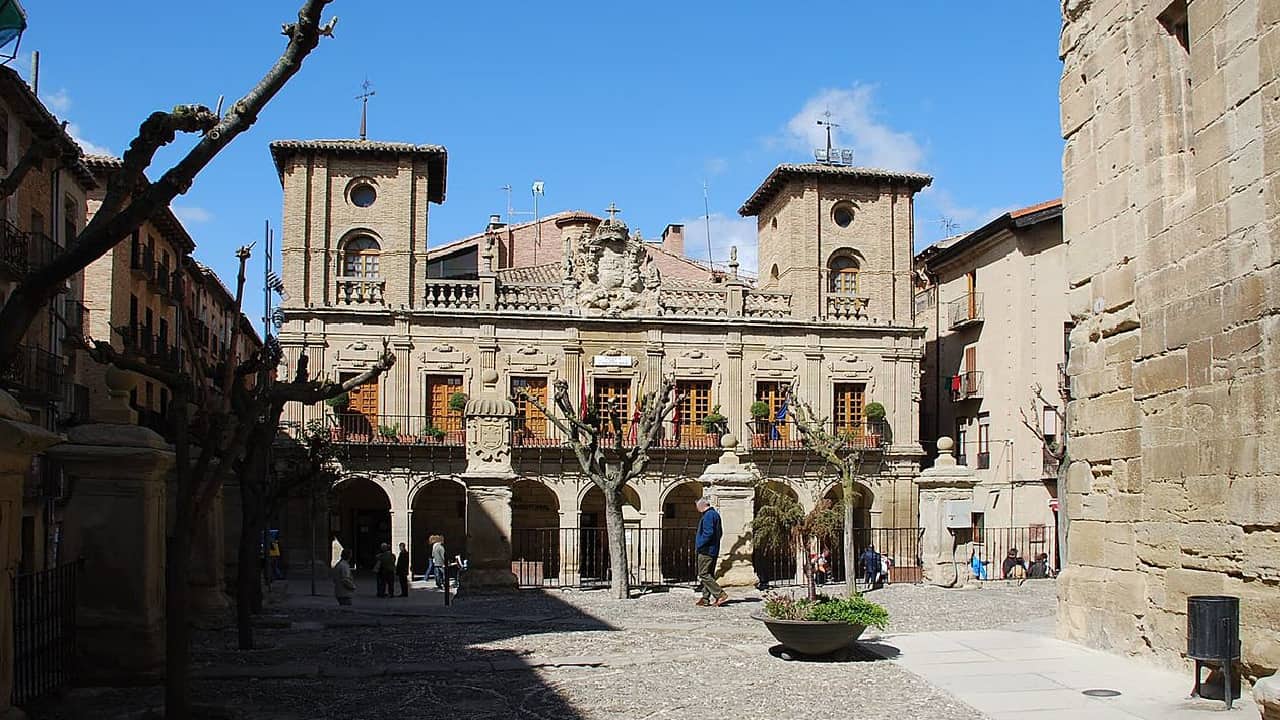
You smell Viana before you see it properly. Bread, somewhere, and the warm dust of a stony path that has been climbing for the last half hour. I remember leaning on my poles at the edge of the old town, looking back at the vineyards I had crossed, and thinking that I had stumbled into somewhere that took itself seriously. Viana does. It sits on a low hill in eastern Navarre, the last real town before you cross into La Rioja, and it has the quiet confidence of a place that has been fought over for a very long time.
This is a guide for pilgrims walking the Camino Frances, written with U.S.-based walkers in mind, the ones planning stages from a kitchen table thousands of miles away. It is also for anyone who loves history and finds that a good story makes tired legs lighter. Viana gives you both: a stunning Gothic church, a frontier-town layout you can read in the streets, and the grave of one of the most notorious men of Renaissance Europe.
What is Viana on the Camino Francés, and why do pilgrims stop here?
Viana is a fortified hilltop town in Navarra, northern Spain, and a classic stop on the Camino Francés just before pilgrims cross from Navarre into La Rioja. Most walkers reach it after Los Arcos, footsore and ready for a coffee, and many use it as the staging post before the bigger city of Logroño a short way ahead.
What makes it distinctive is not one single sight but the layering. The town began as a defensive frontier settlement, and that origin still shapes how it feels: tall houses pressed together, a long central street, the sense that the buildings themselves once formed a wall. The Church of Santa María dominates the centre. And then there is Cesare Borgia, the famous son of a pope, who died in battle nearby and lies just outside that church.
For the skimmers among us, and I have been one of those at the end of a long day, here is the short version of why Viana earns its place on the Camino map.
- Best for: a Gothic church interior, a medieval frontier-town feel, and the strange Cesare Borgia story
- Time needed: roughly 1 to 3 hours to see the highlights properly, longer if you stay overnight
- Position on the route: a Navarre town near the La Rioja border, between Los Arcos and Logroño
- Pilgrim services: hostel and hotel beds, bars, a small historic centre easy to explore on foot
Stop here even briefly and the town rewards you. Stop here overnight and it does something quieter, which is to give you an evening in a place where pilgrims have been arriving for the better part of a thousand years.
Where is Viana located, and how does it fit into the Camino Francés route?
Viana sits in the far southwest corner of Navarre, perched on a ridge above rolling farmland and vineyards, with the city of Logrono, more commonly written Logroño, visible across the valley on a clear day. Historically it was a border town, a Navarrese strongpoint facing the Kingdom of Castile, and that frontier position is the whole reason it exists in the shape it does today.
The Camino Francés, the French Way, threads straight through the town. The yellow arrows lead you up into the historic centre, along the main street past the church, and out the far side towards the river and the regional border. You do not skirt Viana; you walk through its heart, which is part of why so many pilgrims pause here rather than pressing on.
Many walkers time their stop in Viana for practical reasons. It falls at a convenient spacing between the major Camino towns of this stretch, and it offers a calmer overnight than the busier city ahead. Some treat it as a long lunch break before finishing the day in Logroño; others sleep here and start fresh in the morning.
What distances and route context should pilgrims know from Viana?
Pilgrims planning this stretch tend to look up two things again and again: the distance from Viana to the next stop, and how the surrounding stages fit together. The honest answer is that exact figures shift depending on which guidebook and which path variant you follow, so I will keep to the route logic rather than quote a precise km figure I cannot stand over.
The reliable shape of it is this. Viana sits towards the end of a Navarre stage that often begins in Los Arcos, and it leads on into La Rioja and the city of Logroño not far beyond. From there the Camino Francés rolls westward through Navarrete and Nájera, deeper into wine country, then on across the long span of northern Spain towards Santiago de Compostela. When you are planning, weigh up these few things.
- How far you genuinely want to walk the next day, not how far you think you should
- Whether you prefer to sleep in a quiet town like Viana or push into a city
- The terrain ahead, which on this stretch is gentle, open, and exposed to sun
- Starting early enough to enjoy the church and old town before you move on
If you want the full picture of the stage that delivers you here, the guide to walking from Los Arcos to Viana covers the approach in detail. For the wider route, the overview of the Camino Francés pilgrimage sets Viana in the context of the whole French Way.
How did Viana become a fortified frontier town?
Viana was founded in 1219 by Sancho VII of Navarre, known as Sancho the Strong. He created the town by combining eight existing villages into a single fortified settlement, built on the site of a former Roman settlement on the hill. The aim was blunt and military: to hold the frontier against Castile.
That word, frontier, is the key to everything you see. In the Middle Ages this corner of Navarra was contested ground, and a fortified town here functioned as a shield for the kingdom. Walls, a tight defensive street pattern, houses built shoulder to shoulder along a defensible ridge: these were not decorative choices but survival ones. The medieval layout you wander through today is, in effect, a piece of military architecture you can walk inside.
Across the centuries that followed, Viana endured sieges and saw control shift in the long struggle between the crowns of Castile and Navarre. It was the seat of the Principality of Viana, a title given to the heirs of the Navarrese throne, which tells you how much the place mattered to the monarchs of the day. For a small town, it carried an outsized weight in the politics of a divided peninsula.
Here is the part I find quietly moving as a pilgrim. The same defensive instinct that built these walls also built the church, the plaza, the dense knot of streets at the centre. You are walking through someone’s idea of safety, eight hundred years on, with nothing heavier to defend than a pack and a pair of tired feet.
What is the Cesare Borgia connection in Viana, and where is he buried?
Cesare Borgia was the son of Pope Alexander VI, and one of the most infamous political and military figures of Renaissance Italy. A cardinal who renounced his red hat for a sword, a ruthless commander whose ambition is said to have shaped Machiavelli’s idea of the ideal prince, he was a man who made and broke alliances across Europe. And he died, of all places, here.
In 1507 Borgia was killed in battle near Viana, fighting in the service of his brother-in-law, the King of Navarre, during a local conflict. The story goes that he was ambushed and cut down a short way outside the town walls, far from the courts of Rome and the schemes that had defined his life. There is a stark lesson in that for anyone walking a pilgrimage road, though I will leave you to draw it yourself.
Cesare Borgia is buried outside the Church of Santa María, in the open ground beside it rather than within. A simple stone marks the spot. To find it, walk to the church in the centre of town and look around the exterior near the entrance; the grave is set into the ground and easy to miss if you are not watching for it. Locals and pilgrims alike know where it is, so a quiet question usually does the trick.
If you visit, treat it as you would any burial place on a pilgrimage, which is to say gently. Stand a moment, read the stone, and remember that the Camino has always been a road that runs past the dead as much as the living. You do not have to admire the man to find the spot worth a pause.
What should you see at the Church of Santa María in Viana?
The Church of Santa María is the one thing in Viana you should not walk past, even on a tight schedule. It rises over the historic centre with a heft that feels almost defensive, fitting for a frontier town, and it holds a stunning Gothic interior alongside a south portal celebrated for its rich sculptural detail.
The building took shape over generations, and it shows the ambition of a town that wanted a church worthy of its status. Step inside and the Gothic bones reveal themselves: soaring stone, the cool hush that all big old churches seem to keep no matter the heat outside. After a morning of sun on an exposed path, that coolness alone is worth the steps up to the door.
A simple viewing order helps you see it well without lingering longer than your day allows.
- Start outside, taking in the scale and the way the church anchors the plaza
- Study the south portal, the carved entrance that is the building’s showpiece
- Step inside for the Gothic interior, the columns, vaulting, and quiet
- Finish at the Borgia grave outside, completing the town’s central story
Is it worth going inside even if you are racing for the next albergue? In my experience, yes. Ten minutes in the cool of that interior resets something. As for light, the south portal repays a morning visit when the sun rakes across the carvings and throws the figures into relief, which is also, conveniently, when most pilgrims are passing through.
What details should you look for on the south portal sculptures?
Rich sculptural detail can sound like guidebook filler, so here is what it actually means at Santa María. The south portal is dense with carved figures and decorative stonework: saints, biblical scenes, ornamental bands worked into the arch above the door. It is the kind of carving that medieval builders used to teach and impress, a sermon in stone for a population that mostly could not read.
You do not need an art-history degree to enjoy it. The trick is to look twice. First step back and take in the whole composition, the way the figures are arranged around the doorway. Then move close and let your eye settle on the small things: a face, a fold of robe, a creature tucked into a corner that the carver clearly enjoyed making. That shift, from whole to detail, is how the portal opens up.
What other points of interest in Viana are worth a quick detour?
Beyond the church, Viana rewards a slow wander, and its best features are not single monuments but the texture of the place itself. This is a town to read rather than tick off, and most of what is worth seeing ties straight back to its frontier past.
A few things repay the short detour from the main Camino street.
- Remnants of the old fortifications and the medieval street pattern, still legible if you look
- The edges of the historic centre, where the town drops away and you understand its defensive position
- The central plaza and town hall, the civic heart of the old settlement
- Quiet viewpoints over the surrounding vineyards and the valley towards Logroño
- Small markers and old houses that hint at the Castile and Navarre frontier story
If your time is tight, and on the Camino it usually is, here are two simple loops to match your schedule.
|
Loop |
Time |
What you see |
|
Essential |
About 30 minutes |
Church of Santa María, south portal, Cesare Borgia grave |
|
Extended |
About 60 to 90 minutes |
The above, plus an old-town wander, the plaza, and a viewpoint at the town’s edge |
The longer loop is the one I would choose if the weather is kind. There is a particular pleasure in walking the medieval streets of a town built for defence while carrying nothing more dangerous than a water bottle.
What practical information do pilgrims need for a stop or overnight in Viana?
Viana is well set up for pilgrims, with a range of places to sleep, eat, and rest before the push into La Rioja. The town has a pilgrim hostel and several hotel and casa rural options, so whether you want a dormitory bunk or a private room, you can usually find a bed without booking weeks ahead, outside the busiest summer weeks.
Food and water follow the Spanish rhythm, which catches out a lot of first-time pilgrims, especially those used to all-day American kitchens. Bars open early for coffee and a pastry, but full restaurant meals tend to come later, with lunch from around 1pm or 2pm and dinner often not before 8pm. If you arrive mid-afternoon hungry, aim for a bar’s pilgrim menu or a sandwich rather than expecting a sit-down dinner.
A few practical notes worth keeping in mind as you move through town.
- Fill your water bottle before leaving; the next stretch towards Logroño is open and exposed
- Decide early whether to stop or continue, ideally before your feet decide for you
- Plan rest breaks around Spanish meal hours rather than fighting them
- Mind the midday sun on this stage and take a proper foot-care break in the shade
- Keep your valuables close in busier bars and at the hostel, as you would anywhere
The decision that matters most is whether to sleep here or carry on to Logroño. If you crave a city night, push on. If you want quiet, a slower evening, and a town you can walk end to end in twenty minutes, Viana is the better bed.
How can you make the most of Viana if you love history but are walking the Camino?
The gift of Viana for a history-minded pilgrim is that its whole timeline sits within a few hundred metres. You can walk its centuries in an afternoon, which is rare and rather wonderful when you usually only have an afternoon to spare.
Hold the sequence in your head as you go and the town becomes a single unfolding story rather than a scatter of old stones. Roman roots on the hill, then the 1219 founding under Sancho, then the long centuries of border conflict between Castile and Navarre, and finally 1507, when Cesare Borgia met his end outside the church. Four chapters, one short walk.
There is a Camino mindset that suits this kind of stop. Rather than treating the history as a museum exhibit, let the frontier-town story sit alongside your own reasons for walking. A place built for conflict, now crossed daily by people seeking the opposite, makes a quiet companion for thinking about power, endings, and why any of us set out at all. For history buffs who like to keep a record, a small checklist helps.
- Photograph the south portal carvings, both wide and close
- Note the line of the old fortifications and where the town’s edge falls away
- Find and read the Borgia grave stone outside Santa María
- Jot one thing the place made you think about, before the next town crowds it out
If the wider history of the route pulls at you, the history of the Camino de Santiago gives the long view, and the running list of cities and towns on the way helps you slot Viana among its neighbours.
FAQ: What do pilgrims ask about Viana on the Camino Francés?
Is Viana directly on the Camino Francés route?
Yes. The Camino Francés runs straight through the centre of Viana, with the waymarked path leading up into the historic town, past the Church of Santa María, and out towards the La Rioja border. You walk through the heart of the town rather than around it, which is one reason so many pilgrims pause here.
How much time do I need to see the Church of Santa María and the south portal?
Around 30 minutes covers the essentials: the exterior, the carved south portal, the Gothic interior, and the Borgia grave just outside. Allow 60 to 90 minutes if you also want to wander the old town and reach a viewpoint at its edge. Even ten minutes inside is worth it on a tight schedule.
Where exactly is Cesare Borgia buried in Viana?
Cesare Borgia is buried outside the Church of Santa María, in the open ground beside the building rather than within it. A simple stone marks the spot near the church exterior. It is easy to walk past, so look around the entrance area, or ask a local, as most know exactly where it is.
What is Viana most famous for among Camino towns?
Viana is best known for three things: its origins as a fortified frontier town founded in 1219, the Gothic Church of Santa María with its richly carved south portal, and the grave of Cesare Borgia, the son of Pope Alexander VI, who died in battle nearby in 1507. Together they make it one of the more historically loaded stops on the French Way.
Is Viana mainly a history stop, or does it have pilgrim services too?
Both. Viana has genuine historical weight, but it is also a working pilgrim town with a hostel, hotel and casa rural beds, bars, and places to eat and resupply. You can treat it as a quick history-rich break before Logroño, or stay the night and enjoy a quiet evening in the old centre.



Leave a Reply