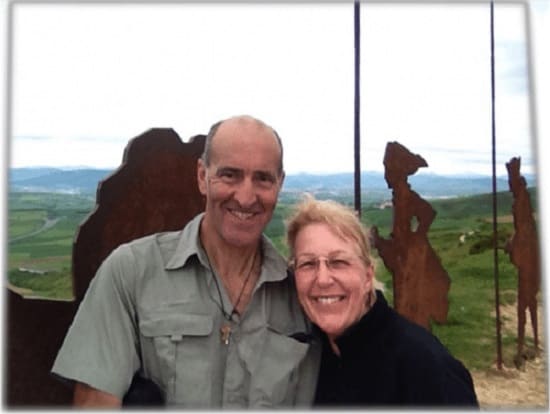
Douglas and Christine Ball, a married couple from Gateshead in the north-east of England, set off across the Pyrenees in the spring of 2015 carrying more anxiety than gear. They were not athletes. They were two people in late middle age who had read a great deal about the Camino and walked very little of it. This is their account, told plainly, of what 35 days on the most famous pilgrim road in Europe actually felt like, one ordinary day after another.
If you are sitting in Ohio or Oregon wondering what you would do all day, every day, for a month on a Spanish footpath, this is written for you. Not the brochure version. The version with wet socks in it.
What is the Camino de Santiago, and why do so many people walk it?
The Camino de Santiago is not a single trail but a web of ancient routes threading across Europe, all of them aimed at one point: the cathedral in the city of Santiago de Compostela, in Galicia, north-west Spain. Tradition holds that the remains of Saint James, the apostle, were buried there. For more than a thousand years people have walked toward that claim, and the network of paths they wore into the land became known collectively as the Way of St James.
The cathedral and the old town around it form a UNESCO World Heritage site, which tells you something about how seriously the place is taken. But the reasons people walk now are looser than they once were. Some come as a Catholic pilgrimage, in the old devotional sense. Many do not. They come for grief, for a turning point, for the plain physical challenge of it, or because a film or a friend put the idea in their head and it would not leave.
What unites them is the shape of the thing: you walk, you carry what you need, you sleep where you can, and you keep going until you arrive. That simplicity is most of the appeal.
- It is a long-distance walk with a destination, not an aimless ramble.
- The infrastructure is unusually good: signposting, hostels, cafes, and a culture built around helping pilgrims.
- You can walk a week or the whole way, alone or in company, on a tight budget or a comfortable one.
- The community on the path is real, and strangers become familiar faces within days.
Douglas and Christine chose the classic version of the Camino de Santiago pilgrimage, which is the subject of everything that follows: a day-by-day account of one full Camino Frances.
Who are Douglas and Christine, and why walk in 2015?
They were not on a spiritual quest, or said they were not. Christine had retired the year before. Douglas was winding down a long career and felt, in his own words, like a man waiting in a corridor for something to happen. A documentary did the damage. They watched it on a wet Sunday, and by the Monday Christine had ordered a guidebook.
What they hoped for was modest: time together without the usual interruptions, a body that still worked, a long walk somewhere beautiful. What surprised them was how quickly the walking stopped being the point and the people became it. That shift happened within the first week, and neither of them saw it coming.
Their story is useful precisely because they were ordinary. If you are a US-based reader weighing whether this is for you, you will recognise more of yourself in two retirees from Gateshead than in a twenty-three-year-old ultrarunner. The Camino does not require you to be remarkable. It only requires you to keep walking.
Which Camino route should you choose, and why the Camino Frances?
There are several main routes, each with a different character, and choosing between them is the first real decision a pilgrim makes. The Camino Frances, or French Way, is the busiest and best supplied, which is exactly why it suits a first camino. You are rarely far from water, food, or a bed, and you are rarely walking entirely alone unless you choose to.
Here is a plain comparison of the main camino routes people tend to weigh against each other:
|
Route |
Rough length |
Character |
Best for |
|
Camino Frances (French Way) |
About 780 km from Saint-Jean-Pied-de-Port |
Well served, sociable, classic villages and cathedrals |
First-time pilgrims wanting structure and company |
|
Camino del Norte (Northern Way) |
About 820 km |
Coastal, hillier, quieter, more demanding |
Walkers seeking solitude and sea air |
|
Camino Portugues (Portuguese Way) |
About 240 km from Porto, more from Lisbon |
Gentler, multiple starting points, popular |
Those with less time or wanting a Portuguese flavour |
|
Camino Primitivo |
About 320 km |
The original way, mountainous, remote |
Fit walkers chasing the oldest path |
|
Camino Ingles (English Way) |
About 120 km from Ferrol |
Short, coastal, historically the route of British pilgrims |
Time-strapped pilgrims wanting the full credential |
Other options sit around the edges of that list. The Via de la Plata runs north from Seville and is long, hot, and lightly walked. The Camino del Norte and the Camino Portugues both draw walkers who have done the Frances once and want something different the second time. The Portuguese coastal way, starting in Porto and hugging the Atlantic, has grown popular for good reason.
Douglas and Christine never seriously considered anything but the French way. They wanted the version with the most support, the most company, and the most written about it. For a first pilgrimage, that instinct is sound. If you want to weigh the full set, our guide on how to choose the best Camino de Santiago route walks through the trade-offs in more detail.
What does a typical day on the Camino look like?
The honest answer is that a typical day is wonderfully boring, and that turns out to be the gift. You wake, you walk, you arrive, you wash, you eat, you sleep. The repetition does something to the mind that is hard to describe until you have felt it. Decisions shrink to almost nothing, and that smallness is restful.
Here is the rough shape of a typical walking day as Douglas and Christine settled into it:
|
Time |
What happens |
|
6am to 6.30am |
Zips, headtorches, the rustle of others packing. Up and dressed in the dark. |
|
6.30am to 7am |
Start walking, often before breakfast, watching for the first cafe to open. |
|
9am to 9.30am |
Coffee and toast at a roadside bar; the best part of the morning for many pilgrims. |
|
Midday to 2pm |
The hard hours. Heat, tired feet, the day stretching out. |
|
2pm to 3pm |
Arrival, a bed claimed, boots off at last. |
|
Evening |
Shower, laundry in a sink, a pilgrim menu, journaling, lights out by 9.30pm. |
A few concepts make a typical day legible to a first-timer. Albergues are the pilgrim hostels, with dormitory beds usually costing 10 to 20 euros a night, run by municipalities, parishes, or private owners. You check in, you are given a bunk, you sleep among strangers, and by the next afternoon some of those strangers are friends. Waymarking is the other quiet miracle: yellow arrows and scallop-shell signs appear just often enough to keep you on the path, and learning to trust them is part of the walking.
Then there is foot care, which is not glamorous but is central. A blister can end a day or a week. Douglas got his first one outside Pamplona and treated it badly; Christine, more patient, taped her feet every morning and finished with skin intact. If you want to start that habit early, our guide to blister prevention on the Camino de Santiago is worth reading before you go, not after.
How did their Camino Frances unfold, day by day?
Rather than list all 35 days, which would test anyone’s patience, this account follows the four great movements of the Camino Frances: the mountains, the meseta, the green west, and the arrival. Each had its own weather, its own mood, and its own lesson, usually learned the hard way.
What happened in the early Camino, from the Pyrenees to Rioja?
The traditional start is Saint-Jean-Pied-de-Port, a small French town at the foot of the Pyrenees. From there the first day climbs hard over the mountains to Roncesvalles, and it is generally agreed to be the toughest single day of the whole route. Douglas described it afterwards as the day he nearly went home. The ascent went on for hours, the mist came down, and his legs simply stopped cooperating near the top.
They made it. Most people do. The days that followed eased into Navarra and then Rioja, through Pamplona with its broad squares, past vineyards heavy with the promise of wine, into medieval towns that looked the same as they had for centuries. This was where the body protested loudest: stiff legs, aching shoulders, the first blister. It was also where the first friendships formed, in an albergue kitchen over shared pasta, in the way only shared discomfort allows.
- Saint-Jean-Pied-de-Port to Roncesvalles: the mountain crossing, about 25 km of relentless ascent.
- Roncesvalles onward: the body adjusting, weather swinging between sun and cold rain.
- Pamplona and the vineyards of Navarra: first cities, first wine fountains, first real fatigue.
What was the middle stretch like, through Burgos and the Meseta?
After Burgos, the Camino changes utterly. The meseta is the high tableland of central Spain, flat and open and treeless, and many pilgrims dread it. The walking is repetitive, the shade is scarce, and the horizon never seems to move. Some people skip it by bus. Douglas and Christine did not, and they were glad.
Burgos itself was a milestone, mostly psychological. Its cathedral rises suddenly out of the city, vast and pale, and walking into its shadow felt to Christine like reaching a chapter break. They took a half day there, ate well, and let their feet recover. If you reach it yourself, our city guide to Burgos on the Camino Frances covers what to see in the time you have.
The meseta taught them pace. They started earlier to beat the sun, walked in companionable silence for long stretches, and found that the emptiness was not empty at all. There is a particular meaning that opens up when nothing is happening and you have only your own footsteps for company. The hardness of the meseta and its strange reward sit side by side, and most pilgrims who walk it come to defend it.
What changed in Galicia as Santiago drew closer?
Galicia announces itself with rain. The landscape turns green and close, the eucalyptus drips, and the air smells of woodsmoke and wet earth. From Sarria, the last 100 km, the path grows busier as new walkers join to complete the minimum distance for the Compostela certificate. After weeks of relative quiet, the crowds can jar.
The mood among long-haul pilgrims shifts here too. There is anticipation, certainly, but also a creeping reluctance to finish. Christine wrote in her journal that she had started walking more slowly on purpose, savouring towns and villages she would once have hurried through. The end was near, and part of her did not want it.
What was arriving in Santiago de Compostela like?
The arrival is not cinematic, and that is its honesty. You walk into the modern outskirts of the city of Santiago de Compostela, past traffic and apartment blocks, before the old streets finally narrow and pull you toward the cathedral. Then you step into the great square in front of it, and the weeks land on you all at once.
Douglas wept. He had not expected to. They attended the Pilgrim’s Mass, watched the enormous incense burner swing across the transept, and queued at the Pilgrim’s Office to receive the Compostela, the certificate awarded to those who walk the final stretch. The feelings that followed were not pure joy. There was relief, exhaustion, and a thin grief that something good had ended.
What were the rewards and challenges of their Camino?
Ask them now what it gave them, and they struggle to answer cleanly, which is how you know the answer is real. The physical toll was considerable: sore feet, a lost toenail, the deep tiredness that comes from 30-plus days of effort. Against that, both finished fitter and a little lighter than they began, and prouder than either would readily admit.
The mental arc moved roughly as follows, and it is one many pilgrims recognise:
- Doubt in the first week: the body rebels, the mind asks what on earth it has signed up for.
- Adaptation in the second: a rhythm forms, and the walking starts to feel like the natural state.
- Flow in the long middle: days blur into one another in the best way, the mind quiet at last.
- Reflection near the end: a gathering sense of what the whole thing has meant.
The human side was the part neither expected to matter so much. There was the German engineer who shared his blister plasters, the Korean student who walked alone and joined their table each night, the hospitalera who pressed extra soup on Christine without a word. A sense of community forms on the Camino that is hard to manufacture anywhere else, and it forms fast.
Would they change anything? Two things. They would pack lighter, having carried fear in the form of extra clothes they never wore. And they would take more rest days, having pushed too hard early and paid for it later.
How can this account help you plan your own Camino from the United States?
Turning their experience into your plan is mostly a matter of logistics and expectation. Getting to the start from the US usually means flying into Madrid, Bilbao, or Paris, then taking onward trains or buses to Saint-Jean-Pied-de-Port. Bilbao is convenient for the Frances start; many pilgrims route through it. None of this is hard, but it takes a day or two, so build that into your timeline.
How long it takes is the next question, and the answer is genuinely variable. A full Camino Frances runs around 30 to 35 days of walking for most people, covering an average of 20 to 25 km a day. Faster walkers do it in less; those who take rest days or shorter stages take more. There is no virtue in rushing.
A simple preparation checklist, drawn directly from their story:
- Train by walking, not just by going to the gym. Time on your feet matters more than cardio fitness.
- Sort your footwear and sock strategy early, and practise taping your feet before you fly.
- Pack light, then take a third of it out again. Aim for roughly 10 percent of your body weight.
- Decide your comfort level: book ahead for certainty, or walk and trust the beds will appear.
On timing, most pilgrims walk between April and October. High summer brings heat across the meseta; spring and autumn are kinder. Two practical reads before you commit are our piece on the best time to walk the Camino de Santiago and, for budgeting, the breakdown of how much it costs to walk the Camino de Santiago. Both will save you guesswork.
Frequently asked questions about walking the Camino de Santiago
How long does it take to walk the Camino Frances?
Most pilgrims complete the full Camino Frances in around 30 to 35 days, walking from Saint-Jean-Pied-de-Port to Santiago de Compostela. The figure depends heavily on your daily distance and how many rest days you take. Walking roughly 20 to 25 km a day, with a day off here and there, lands most people in that range.
How many miles or km do people walk each day on the Camino?
Daily distances commonly fall between 20 and 25 km, though they range from short 12 km days to long 28 km ones depending on where the albergues sit. There is no fixed schedule; you walk to the next sensible place to rest. Listening to your feet matters more than hitting a number.
Do you have to be religious to walk the Camino?
No. The Camino began as a Catholic pilgrimage and retains that meaning for some, but many pilgrims walk for personal, reflective, or simply physical reasons. The path welcomes all comers, and the Compostela certificate is awarded on the distance walked, not on your beliefs. Most people you meet are walking for reasons they cannot fully explain.
What is the difference between the Camino Frances, Camino del Norte, and Camino Portugues?
The Camino Frances is the most popular and best supplied, crossing northern Spain from the Pyrenees. The Camino del Norte follows the cooler, hillier Atlantic coast and draws walkers wanting solitude. The Camino Portugues starts in Portugal, often in Porto or Lisbon, and is generally gentler underfoot. Terrain, crowd levels, and services differ across all three.
How much money do I need to walk the Camino de Santiago?
A modest budget covers it. Albergue dormitory beds typically cost 10 to 20 euros a night, and a pilgrim menu del peregrino runs around 10 to 15 euros. Many pilgrims walk comfortably on 35 to 50 euros a day, more if they choose private rooms and restaurant meals. Your daily spend is largely a matter of how you sleep and eat.



2 responses to “Walking the Camino de Santiago: A Day by Day Account”
My husband & I walked the first 100 miles of el Camino Frances in September 2015, same year as Doug & Christine Ball. We had to leave as the injury to my right knee prevented me from further walking. It was wonderful reliving the walk with them & recognizing the town names, the scenery and laughing with them about exhaustion, dining issues along the way and meeting the various personalities from all over the world! Thank you for this.
I loved every minute of that journey. It brought back so many memories thanks i passed that way in 2012