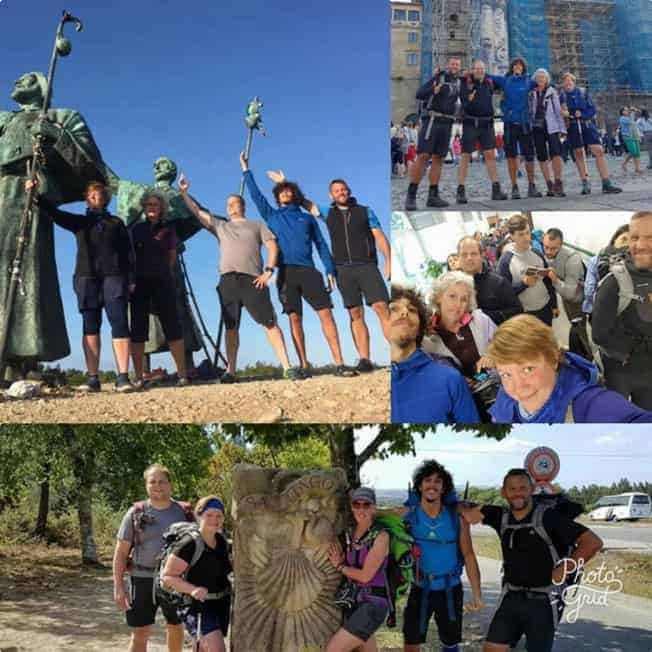
I walked the Camino Portugues from Porto to Santiago de Compostela in 2016, and I set out alone. That was the plan: a solo pilgrim, a small pack, a few weeks of walking and thinking. What I did not plan for, what nobody quite warns you about, is that you rarely stay alone for long. Somewhere around the third or fourth day I found myself eating dinner with a Canadian woman called Nadia and two people whose names I had only learned that afternoon, and we were laughing as though we had known each other for years. That, more or less, is a Camino family.
It is one of those phrases pilgrims toss around as if everyone understands it. They do not, not at first. So let me tell you what it actually means, how it forms, and why people keep going back to find it again.
What does "Camino family" mean on the Camino de Santiago?
A Camino family is the close, often unexpected group of fellow pilgrims you bond with while walking the Camino de Santiago. You start as strangers. You share a few stretches of trail, a few meals, a bunk room or two, and within days you are swapping life stories with people you would never have met at home. The term is sometimes called a "trail family," and it captures something true: these connections feel less like holiday acquaintances and more like kin.
It happens organically. Nobody appoints a Camino family. It assembles itself out of shared pacing, shared albergues, and the small daily rituals of the route, the café con leche before the morning fog lifts, the relief of pulling boots off at the same village bar. You walk together for a while, drift apart, and somehow the group reshapes itself around whoever happens to be moving at your speed.
It is worth clearing up one common confusion. A Camino family is not the same as a family Camino, the kind of trip where parents bring their children to walk a route together. Those exist, and they are wonderful, but the phrase here means found family: the companions the trail hands you, not the ones you arrived with.
If you are new to the route, a little of the lingo helps. You will hear these words constantly:
- Buen Camino: the universal greeting and blessing pilgrims exchange on the trail, roughly "have a good way."
- Albergue: a pilgrim hostel, usually with shared dormitories and a kitchen.
- Peregrino: the Spanish word for pilgrim, the person doing the walking.
- Credencial: the pilgrim passport you stamp along the way to prove your journey.
For a fuller glossary, the post on Camino lingo and pilgrim speak is a good place to start before you go.
How do you meet your Camino family if you start the Camino alone?
This is the question I hear most from people about to walk solo for the first time. They are nervous, understandably. What if nobody talks to me? What if I spend three weeks eating dinner by myself? I felt all of that before Porto, and I can tell you the fear is almost always misplaced.
The Camino is, in a quiet way, socially designed. Everyone is heading the same direction, at roughly walking speed, stopping in the same towns, sleeping in the same handful of places. You bump into the same faces again and again, and familiarity does the rest. The meeting points tend to be predictable:
- Breakfast stops and café rituals, where half-awake pilgrims queue for the same coffee.
- Albergues, especially the check-in line, the shared kitchen, and the bunk room.
- Waymark pauses: a fountain, a viewpoint, the photo everyone stops to take.
- The unplanned help moments, when someone offers you tape for a blister or points out you missed a yellow arrow.
You do not have to force any of it. In fact, forcing it tends to backfire. The connections that lasted, for me, were the ones I did not engineer. Nadia and I met at a crossroads, both of us squinting at a signpost, both equally unsure. We started walking and talking, and that was that. No grand introduction, just two people moving in the same direction.
People in Camino forums often ask how long it takes to meet a Camino family. The honest answer is that it varies. Some walkers click with people on day one; others walk a quiet first week and find their group later. The Camino Frances, busier and more travelled, often throws people together faster than a quieter path. But there is no schedule, and that is fine. If you are weighing the social side of going it alone, the piece on travelling solo or in a group is worth a read.
Why do Camino families form so quickly on the trail?
It still surprises me how fast it happens. At home, friendships take months. On the Camino, a week can feel like a year. There are reasons for this, and they are not mystical.
The first is shared vulnerability. Everyone is tired. Everyone has a blister coming, or a pack that is too heavy, or a doubt they have not said out loud. When you strip life back to walking, eating, and sleeping, the usual social armour falls away. You meet people without the scaffolding of job titles and postcodes, and that openness is contagious.
The second is repetition and rhythm. You see the same walker at breakfast, then again at the next town, then again at the albergue that evening. Familiarity compounds. By the third sighting you are nodding hello; by the fifth you are saving each other a bunk.
The third is the Camino's own social architecture. Compatible pace matters more than personality at first. You bond with whoever walks roughly as fast as you do, because those are the people you keep crossing. Add communal lodging and town-to-town stages, and the route practically arranges your friendships for you.
Then there are the micro-traditions that seal the thing: the agreed café stop, the shared dinner, the unspoken arrangement to wait at the next village for the slower ones. Small rituals, repeated, turn strangers into a Camino family before anyone notices it has happened.
What does a Camino family actually do together day to day?
Less than you might think, and that is rather the point. A good Camino family is not a tour group marching in formation. It is loose. You walk together when it suits, apart when it does not, and nobody takes offence either way.
A typical day looks something like this:
|
Part of the day |
What the family tends to do |
|
Early morning |
Quiet starts, headlamps, the first café con leche. Some walk in silence; some chat from the first step. |
|
Mid morning |
Leapfrogging along the trail. You walk and talk for a while, then drift to your own pace and meet again later. |
|
Lunch |
A shared snack at a village bar, or fruit and bread pulled from packs on a wall in the sun. |
|
Afternoon |
Arriving in town, claiming bunks in the same albergue, the ritual of washing socks. |
|
Evening |
The pilgrim menu dinner, cheap wine, life stories that run long past dark. |
The evening meal is the heart of it. A menu del peregrino is rarely good food, three courses and a carafe for ten euros or so, but it is where a Camino family becomes one. You celebrate small milestones, the hundred kilometre marker, someone's birthday, a brutal day survived. You trade practical tips too: how to pack lighter, how to drain a blister, which albergues are worth the detour.
And you carry each other through the rough patches. Rain that does not stop. Fatigue that makes you weepy over nothing. The doubt that creeps in on the long flat stretches. Having people who simply nod and keep walking beside you turns a hard day into a bearable one. That, honestly, is the whole Camino experience distilled: ordinary kindness, repeated daily, between people who owe each other nothing.
Why do pilgrims part ways and reunite like long-lost relatives?
Here is the strange rhythm nobody tells you about. You will lose your Camino family, more than once, and then find them again as if no time has passed.
It happens because everyone walks differently. One person needs a rest day. Another takes a detour to see a town off the route. Someone's knee gives out and they take a taxi ahead a stage. Bed availability scatters people too; a full albergue sends you on to the next village while your friends stay put. A short distance can split a group: one extra hour of walking, and you go to sleep together and wake up scattered.
And then, days later, you round a corner into a café and there they are. The reunions are absurdly emotional for people you have known a fortnight. There is hugging. There are occasionally tears. You greet each other like long-lost relatives, because in the compressed time of the trail, that is what you have become.
You learn to recognise each other by small things: a particular pack, a hat, the rhythm of someone's stride seen from behind. The greatest reunions happen in Santiago de Compostela itself, in the square below the cathedral, where pilgrims who scattered across two hundred kilometres of trail somehow all arrive within a day of each other and collapse onto the stones together.
It is worth saying plainly: these friendships can be intense and short, and that does not make them less real. Some last a lifetime; some belong only to those weeks. Both kinds matter.
What is the Camino Portugues from Porto to Santiago like for building connection?
My own Camino family formed on the Camino Portugues, walking north from Porto, so this is the route I can speak to honestly. It is quieter than the Camino Frances, which means the social side works a little differently.
Porto has a particular start energy. Pilgrims gather at the cathedral for their first stamp, faintly self-conscious in new boots, and you can almost see the clustering begin. Fewer people walk the portugues than the frances, so you bond with a smaller cast, but you see them more reliably. The same faces appear day after day because there are simply fewer faces to begin with.
Route choice shapes who you meet. The Portuguese path splits into a Coastal variant and a Central one, and the two attract slightly different crowds before merging again later. Walk the coast and you share the trail with people drawn to sea and dunes; walk inland and you meet those after the older villages and Roman bridges. If you are deciding, the full guide to the Camino Portugues lays out both options.
The vibe differs from other routes in a way that is hard to pin down. The Camino del Norte feels more solitary and rugged; the Primitivo is for those chasing endurance over the original way; the Frances is sociable to the point of crowded in summer. The Portugues sits somewhere gentler, scenic without being dramatic, social without being overwhelming. For a solo walker nervous about company, I would call it close to ideal.
Why do people return to the Camino again and again?
You have no doubt read about pilgrims who walk the Camino five, ten, fifteen times. From the outside it looks like an obsession. From the inside it makes perfect sense, and the Camino family is most of the reason. People who set out to hike a single route somehow find themselves planning the next one before the blisters have even healed.
People return for the people they have not met yet. There is a particular kind of belonging on the trail, easy and immediate, that proves very hard to find back home. You walk into an albergue a stranger and walk out three days later with friends; few things in ordinary life work like that, and once you have tasted it you want it again.
There is also the loop the Camino runs on you: the reflection, the simplicity, the way meaning gathers around small things when you have stripped life down to the act of walking. It is genuinely difficult to recreate at a desk in February. So people go back.
And the families themselves do not always end at Santiago. Plenty roll on into group chats, into reunions in other countries, into next Caminos planned together over a year of messages. I still hear from a couple of mine. The trail ends; the relationships, sometimes, do not. If the comedown sounds familiar, the piece on the Camino blues after returning home will ring true.
How can you increase your chances of finding a Camino family?
You cannot manufacture a Camino family, but you can make yourself easy to find. The walkers who connect most are not the loudest; they are the ones who stay open and say yes. A few gentle, practical things help:
- Stay in albergues sometimes, even if you can afford a hotel, when connection is the goal. Dormitories and shared kitchens do the introducing for you.
- Eat at communal tables and accept invitations to share a meal. Half of all Camino families start over a carafe of cheap wine.
- Start walking at a fairly consistent time each morning, so you keep crossing the same faces.
- Be open without being relentless. Respect solitude, both yours and other people's; a good Camino family knows when to walk in silence.
A little trail etiquette smooths the way too. Keep quiet hours in bunk rooms. Mind your pack space. Pass others without barging. And greet people, always: a simple Buen Camino to a passing walker is the small social currency the whole route runs on.
None of this depends on being young or fast. Introverts find their people through one quiet conversation at a time. Older pilgrims often anchor a Camino family rather than trailing it. Those walking slowly, or managing an injury, frequently end up at the warm centre of a group precisely because the others choose to wait. Connection on the Camino is not reserved for the gregarious; it simply asks you to keep showing up.
FAQ: Camino Family Questions People Ask Most
How long does it take to meet your Camino family?
It varies more than people want to hear. Some pilgrims click with others on the first day; others walk a quiet first week and find their group only later. The busier the route and the more social your lodging, the faster it tends to happen, with the Camino Frances usually quickest of all. Stay in albergues, eat communally, and keep a consistent pace, and most people find their group within several days.
Is a Camino family the same as travelling with your real family or kids?
No. A Camino family is found family, the fellow pilgrims you bond with along the way despite arriving as strangers. A family Camino, by contrast, means walking the route with your actual relatives or children. The two can overlap, since families who walk together also meet other pilgrims, but the phrase usually means the companions the trail gives you.
Do you have to walk with the same group every day?
Not at all, and trying to would miss the point. Camino families flex constantly: they split, scatter across different paces and rest days, and reunite in the next town or in Santiago. Walking alone for a stretch is entirely normal and nobody takes it personally. The looseness is what keeps the group easy.
What if I want company but I am introverted?
The Camino is unusually kind to introverts. You do not need to be outgoing; you need only stay open to small moments. A short chat at a fountain, a shared dinner, walking one stage beside someone, choosing a social albergue now and then. Connection builds quietly, one low-pressure conversation at a time, and plenty of the closest Camino families are made of quiet people.
Can Camino families last after the trip ends?
Yes, often. Many stay in touch through group chats, meet up in other countries, and even plan future Caminos together. Some bonds remain tied to those particular weeks and fade gently afterwards, and that is fine too. A friendship that belonged only to the trail still counts; it does not need to last forever to have mattered.



4 responses to “What is a Camino Family?”
I enjoyed your comments on your continuing Camino adventures. I walked the Camino Frances summer 2019. The last 200 miles or so I walked in a lot of pain. I’m 67. But I completed my journey. When done, I vowed never to do that again. However in the 5 months since returning home, like you, I am more & more drawn to return. It is not crazy. It is pure life & truth. Buen Camino to each & every peregrino.
In each of our Caminos, we have evolved as part of a “family”. We met two German men in 2008 on Camino Frances, Henk and Heiko. We enjoyed each others company all the way to Santiago. It was a sad parting. We keep in touch since by email, christmas cards. Perhaps we will meet in person again.
In 2013 on Caminho Poruguez we evolved into a family of six: I was the only male. I was with five women: my wife from the US, Olga from Slovakia, Sheila from Ireland, Kristal from Estonia, Susia from South Aftrica. We had wonderful times together.
Then in 2015, another Camino Frances. We started with an American friend, Susan. Along the way we teamed up with three other Americans, Steve and Barbara from Oklahoma and Vonnie, from Washington state. We all remain in touch and had a reunion the following year. Steve, Barbara, and Vonnie were on their first long distance walk, inspired by “The Way”. It is questionable if they could have completed the Camino with out us.
It is not possible to be alone on the Camino. A side benefit is the lasting friendships.
Love this post Leslie. In all of my Caminos, bar 2, I travelled solo. Within days I had met total strangers soon to be Camino family. I have some great memories from my Caminos but I am sure I will create more when I return. In the meantime, I keep in touch with my family and relive those memories.
I have walked the Celtic Camino from A Coruna, having walked a stage in Ireland. It is a lovely walk but very short. A nice alternative to the Sarria – Santiago dance.
Lovely Camino trails and tales Sarah. I remember when you started. You must have walked thousands of miles up to today. Your stamina is amazing. I find it sad in parts because of the caring and sympathy you find hundreds of miles from home given by strangers who become “family”. So sad when you have to say good bye but then you always have a new Camino to look forward to. I hope that on the next one you find someone to take your loneliness away forever…well ….for a few days at a time…theres only so much company a loner can take…..brilliant writing.. lovely photos x Jean x