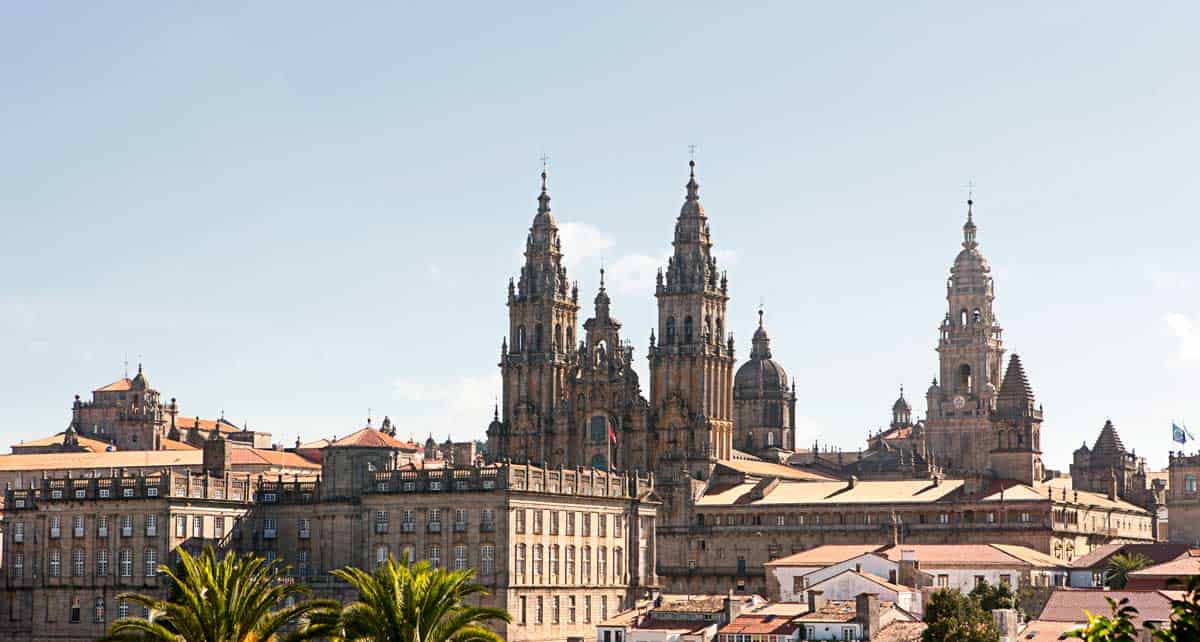
You smell the wet granite before you see the towers. After weeks of walking, the last hour into the old town does something odd to your legs, half a stumble, half a sprint, and then the streets narrow, a busker is playing the gaita somewhere off to your left, and you step out under the arch into the open square. The cathedral of santiago is suddenly there, enormous, soot-dark and pale at once, far bigger than the photos let you believe. I sat on the cobbles of the Obradoiro for a long while the first time, boots still wet from O Cebreiro, not quite able to take it in.
This is a guide to the cathedral of santiago de compostela for pilgrims and travellers, what it is, what to see inside and out, how the Pilgrim's Mass works, when the botafumeiro swings, and the quiet, practical things nobody tells you until you are standing in the nave. Most of it I learned by getting it slightly wrong first.
Why is the cathedral of santiago de compostela so important to pilgrims?
For most people walking any route of the camino de santiago, this building is the final destination. Not Finisterre, not the coast, not the sea: this. The whole pilgrimage points here, to the spot where tradition holds the apostle Saint James is buried. After 100 kilometres or 800, you arrive at the same square and look up at the same facade, and the leveling of that is part of the point.
The reason is the tomb. The cathedral grew up around the burial place of the apostle saint james, James the Great, one of the closest companions of Christ. The story runs that his remains were carried by sea to Galicia and lost for centuries, then rediscovered by a hermit guided by lights in a field, with the local bishop diego of Iria confirming the find. From that came a shrine, then a church, then this. The city of Santiago de Compostela grew outward from the tomb like rings around a stone dropped in water.
It is a UNESCO World Heritage Site, both the cathedral and the old town around it, and it has been a place of christian pilgrimage for over a thousand years. The Way of St James was one of the three great medieval pilgrimage roads of Europe, alongside Rome and Jerusalem. None of that is what you feel when you arrive, though. What you feel is mostly relief, and a strange grief that the walking is over.
If you want the wider context of the saint himself, the patron of pilgrims, there is more in our guide to Saint James the Great and his role on the Camino.
What does Santiago de Compostela mean in English?
Santiago is Spanish for Saint James, a contraction of "Sant Iago." Compostela is usually read as "field of the star," from the Latin campus stellae, a nod to the legend of the lights that revealed the tomb. So the name reads, loosely, as "Saint James of the field of stars." Scholars argue about the etymology, and some trace Compostela to a word for a burial ground instead. Either way the romance of stars has stuck, and after a fortnight watching the dawn come up over the meseta you will not begrudge it the poetry.
What is the history of the cathedral, in plain terms?
You do not need to memorise dates to enjoy the building, but a rough timeline helps you read the stones. The thing was not built in one go. It is layered, like sediment, and once you know the layers you start to see the joins.
An earlier church stood on the site, and before that a small pre-romanesque shrine over the grave. That older structure was largely destroyed in a raid around the year 997. The cathedral you walk into today was begun in 1075 under bishop diego Peláez, a great romanesque cathedral built to receive the flood of medieval pilgrims arriving along the camino. King Ferdinand ii of León was among the royal patrons who pushed the work along in the 12th century, and it was consecrated in the years that followed.
|
Period |
What happened |
What you can still see |
|
Around 997 |
The earlier church on the site is sacked; the tomb is spared |
Fragments and foundations beneath the present building |
|
1075 onward |
The romanesque cathedral begun under bishop diego Peláez |
The core nave, the bones of the building |
|
12th century |
Master Mateo completes the Portico of Glory; Ferdinand ii a key patron |
The Portico da Gloria, behind the western facade |
|
16th century |
Renaissance cloister and later Gothic touches added |
The cloister and parts of the chapels |
|
1700s |
The Baroque Obradoiro facade built over the older front |
The grand western face on the main square |
This is why the cathedral looks like a different building depending on which side you approach from. The romanesque heart is wrapped in later skins. The plain truth is that each century added what it could afford and what it loved, and the result is a happy collision rather than a single design. The history of the camino itself runs in parallel with all this; you can trace it in our history of the Camino de Santiago pilgrimage.
What should you see on the outside?
Walk around the whole building before you go in. It takes fifteen minutes and it is free, and each of the four squares around the cathedral has its own character and its own light. Pilgrims tend to rush straight for the door, then never see three of the four faces. Do not be that pilgrim.
What is the Obradoiro facade and why is it on Spanish euro coins?
The western facade of the cathedral, the one on the Plaza del Obradoiro, is the famous one. It is high baroque, all upward movement and carved granite, designed by Fernando de Casas Novoa and completed in the mid 1700s. This is the front of the cathedral you have seen a hundred times without knowing it, because the Obradoiro square and facade appear on the Spanish 1, 2 and 5 cent euro coins. Reach into your pocket for change in any bar in Spain and you may well be holding a tiny engraving of the building you walked to.
For the classic photo, stand near the far side of Obradoiro square, with your back to the Pazo de Raxoi, and frame the whole facade with the two towers. Early morning gives you soft light and an almost empty plaza; late evening gives you the stone going warm and gold. Midday in summer gives you crowds and a flat glare, so avoid it if you can.
What about the other facades?
Each of the other three sides has its own square and its own mood. They are worth the walk for the carving alone, and for the chance to escape the crush on the main square.
- Praterías (south): the oldest surviving facade, romanesque, dense with weathered sculpture. The plaza here has a fountain and is a good spot to sit.
- Azabachería (north): on the Plaza de la Inmaculada, this is the side many pilgrims first reach as they come in off the camino frances. It is neoclassical and calmer than the rest.
- Quintana (east): the Plaza de la Quintana is the atmospheric one, especially after dark when the stone is lit. The Holy Door opens onto this square.
A slow loop of all four, starting at Obradoiro and going clockwise, lets you see how the centuries stack up without backtracking. The clock tower, the Berenguela, rises over the Quintana side and is the easiest landmark for finding your bearings.
What are the must-see things inside the cathedral?
Inside, the cathedral is a Latin cross with a long central nave, side aisles, and a ring of chapels around the apse. Step in, let your eyes adjust to the dimness, and orient yourself toward the main altar straight ahead. That is where the energy of the place gathers. The interior of the cathedral rewards slow looking, so resist the urge to tick off treasures like a checklist, even though I am about to give you one.
Here is what most first-time visitors want to find inside the cathedral:
- The Portico da Gloria, just inside the western entrance
- The statue of Saint James above the high altar, which pilgrims climb behind to embrace
- The crypt below the altar, holding the relics of the apostle
- The botafumeiro, the giant thurible, when it is in use
- The radiating chapels around the ambulatory
How do you embrace the statue of Saint James at the high altar?
Behind the main altar, a narrow stairway leads up to the back of the gilded statue of james, the medieval image of saint james that presides over the whole church. The pilgrim tradition is to climb the steps and embrace the statue from behind, resting your hands on his shoulders, a gesture worn smooth by a thousand years of hands. There is usually a short, quiet queue.
The etiquette is simple. Move gently, do not linger more than a moment when others are waiting, and keep your voice down. Photography rules vary and tend to tighten during services, so take your cue from the stewards. I remember being surprised by how small and human the moment felt after all that walking, no thunderclap, just the cool of old metal under my palms and someone's rucksack bumping the rail behind me.
What is the Portico da Gloria and why does it matter?
The Portico of Glory is, for my money, the single greatest thing in the building. It is a romanesque carved doorway completed by Master Mateo in the late 12th century, sitting just inside the western facade, behind the baroque Obradoiro front. Master mateo and his workshop carved a whole theology in stone here: Christ in majesty, the prophets, the elders of the Apocalypse tuning their medieval instruments, and the apostles with faces so individual they look like portraits.
For centuries pilgrims pressed their fingers into the central pillar beneath Saint James, wearing five deep grooves into the marble. That pillar is now roped off to protect it, and the Portico da Gloria can usually only be seen on a timed, ticketed visit rather than a casual walk-past, because conservation work has been ongoing. Check the current arrangements before you go, as access changes.
What are the radiating chapels worth seeking out?
Around the apse runs a ring of small chapels, each its own pocket of quiet, candle smoke, and altarpieces. You will not see every chapel in one visit, and you should not try. A few stand out for most visitors:
- Chapel of the Saviour (San Salvador): historically the first chapel pilgrims reached, at the head of the ambulatory.
- Chapel of the Pillar: richly decorated, a good example of the cathedral's baroque flourishes.
- Chapel of Mondragón: founded by canon Juan de Mondragón, with a fine sculpted entombment.
The chapels are where the cathedral feels least like a monument and most like a working church. Someone is usually lighting a candle. The gothic vaulting overhead and the worn stone underfoot make this part of the cathedral the place I keep coming back to.
What is the crypt and what will you see?
Beneath the main altar, a small flight of steps leads down to the crypt of st james, where a silver casket holds what tradition names as the remains of the apostle. The space is tight, low, and reverent, and the line moves quickly because there is simply not much room. You go down, you pause at the grille, you come back up. It is brief by design.
To visit without backtracking, do the embrace of the statue first, then come straight down to the crypt; the two are stacked, one above the other, around the same altar. Groups do not generally need to reserve to file past the tomb of the apostle, though large parties should expect to queue and to keep moving so others can pass.
How does the Pilgrim's Mass work, and what should you expect?
The Pilgrim's Mass is the daily service that welcomes arriving pilgrims, and it is the emotional centre of most people's arrival. It is held in the cathedral, in Spanish, and at certain Masses the names and starting points of pilgrims who reached the Pilgrim's Office that day are read aloud. Hearing your country named, after all those kilometres, undoes a surprising number of grown adults. I watched a man from Ohio cry quietly into his buff and pretend it was hay fever.
A few practical notes for attending:
- Timing: there are usually several Masses a day, with a main Pilgrim's Mass commonly at midday. Times change, so verify the current schedule close to your travel date.
- Arrival: come thirty to sixty minutes early in peak season to get a seat, and earlier still if the botafumeiro is expected.
- Seating: pilgrims often gather toward the front and the transept; large rucksacks are best left at your accommodation or the cloakroom.
- Behaviour: silence during the service, phones away, and no photography while Mass is underway.
Non-pilgrims are entirely welcome at the Mass. Nobody checks your credential at the door. The service is open to all, walkers and visitors alike, and the welcome is genuine. If you want to understand the ritual that comes just before, getting your final stamp, our guide to the Pilgrim's Office in Santiago de Compostela covers it.
What is the botafumeiro, and when does it swing?
The botafumeiro is the cathedral's great thurible, a giant incense burner the height of a small child, hung from the ceiling on a thick rope. A team of red-robed men called tiraboleiros haul on the ropes to swing it in a vast arc across the transept, trailing smoke and sparks, reaching speeds that genuinely make you flinch in the front rows. The original purpose was partly practical: incense to mask the smell of a church packed with travel-worn medieval pilgrims who had walked for months. Charitable of them not to mention it.
Here is the thing nobody warns you about: it does not swing at every Mass. The botafumeiro is used on certain feast days and major liturgies, and at other times only when a group has arranged and paid for it in advance. Many pilgrims arrive expecting to see it and leave disappointed, so manage your hopes.
|
Question |
The honest answer |
|
When does it swing? |
Major feast days and certain liturgies; otherwise only when privately sponsored |
|
How do I find out? |
Check the cathedral's official calendar near your travel date; do not assume |
|
Where should I sit? |
Along the transept, the arc it swings across, not the central nave facing the altar |
|
Can I film it? |
Often yes once Mass has ended and the burner is in motion; follow the stewards |
If seeing it matters to you, plan around a feast day, arrive very early, and sit in the transept rather than the main body of the nave. We go deeper into the timing in our piece on what the botafumeiro is and when you can see it.
What else can you visit: museum, cloister, and the Holy Door
The worship space is free to enter, but several of the cathedral's finest spaces sit behind a single combined ticket. If you have an hour to spare beyond the main church, they are worth it.
- Cathedral Museum: liturgical art, tapestries, archaeological fragments, and the story of the building's construction laid out room by room.
- Cloister: a grand 16th century Renaissance courtyard, the quietest corner of the whole complex and a fine escape from the crowds.
- Treasury and antechamber: historic liturgical objects, reliquaries, and gold and silverwork.
- The rooftops: on a separate guided tour, you can walk the granite roofs and look down over the plaza and the city.
The Holy Door, or Door of Forgiveness, opens onto the Plaza de la Quintana and stays sealed except during a Holy Year, a Xacobeo, when the feast of Saint James on 25 July falls on a Sunday. In a Holy Year pilgrims pass through the open Holy Door as part of arriving, and the next one is approaching, so it is worth knowing the year before you book. Our guide to the Camino Holy Year 2027 explains the Xacobeo and why these years draw such crowds.
If you are short on time, a sensible plan is the free worship space first, the embrace and the crypt, then the cloister and museum if your legs and your schedule allow.
|
Time available |
What to prioritise |
|
60 to 90 minutes |
Walk the four facades, enter the nave, embrace the statue, visit the crypt |
|
Half a day |
All of the above plus the Pilgrim's Mass, the cloister, and the cathedral museum |
|
A full day |
Add the Portico da Gloria timed visit and the rooftop tour, with time to simply sit |
Frequently asked questions about visiting
Is there a dress code for the cathedral of santiago?
There is no strict, posted dress code, but it is a working place of worship and modest dress is expected, especially during Mass. Cover shoulders and knees, remove hats inside, and keep beachwear for the beach. Pilgrims arriving straight off the trail in walking gear are entirely normal and welcome; nobody expects you to be smart, only respectful.
Is the cathedral free to enter?
Yes, entry to the main worship space, the nave, the high altar, the statue embrace, and the crypt, is free. Paid areas include the cathedral museum, the cloister, the treasury, the Portico da Gloria timed visit, and the rooftop tour. Check the official cathedral website for current ticket prices and opening hours, as these change with the season.
Can non-pilgrims attend the Pilgrim's Mass?
Yes. The Pilgrim's Mass is open to everyone, pilgrims and ordinary visitors alike, and you do not need a credential or a Compostela to attend. The only expectations are silence during the service, phones put away, and no photography while Mass is being celebrated.
How long do you need to visit the cathedral?
Allow 30 to 45 minutes for the highlights of the free worship space, around 1.5 to 3 hours if you add the museum and cloister, and longer again if you attend Mass or take the Portico da Gloria or rooftop tours. Most pilgrims end up staying longer than planned, simply sitting, so do not pack your schedule too tightly on arrival day.
What time should I arrive to avoid crowds?
Early morning, soon after opening, is the calmest time, with soft light on the Obradoiro facade and few people in the nave. Late afternoon on a weekday is the next best window. Summer middays, weekends, and feast days are busiest, so if you want a quiet first encounter with the cathedral of santiago de compostela, come early.



One response to “Santiago de Compostela Cathedral, Spain”
Fabulous experience on two occasions walking the Camino de Santiago in 2017 & 2019. Attending the Pilgrim’s mass in Santiago was the ultimate experience finalizing my 800 km pilgrimage. To this day, watching the videos of the Mass gives me goose bumps .