There is a moment, somewhere between Pontedeume and Betanzos, when the path drops through a tunnel of eucalyptus and the air changes. It turns cool and green and faintly medicinal. Your boots find a rhythm on the soft earth. And you realise, with a quiet certainty, that you are walking one of the loveliest short routes in all of Spain.
The Camino Inglés is not the grand epic of the Camino Francés. It does not take a month. It will not destroy your feet (probably). But it is, in its own understated way, one of the finest pilgrimages to Santiago de Compostela.
This is your guide to walking it well.
What Is the Camino Inglés, and Why Do People Walk It?

The Camino Inglés, the English Way, is a pilgrimage route through Galicia in northwest Spain. It follows the path once taken by pilgrims from Britain, Ireland, Scandinavia and Flanders, who arrived by sea at the ports of Ferrol or A Coruña and walked south to the Cathedral of Santiago de Compostela. The route has been walked for over a thousand years.
Today, it draws a particular kind of pilgrim. People with a week of annual leave rather than a month. First-timers who want something quieter than the Francés, with its crowds and its snoring dormitories. Returning pilgrims who have already walked the long routes and want something more intimate.
What makes it special is also what makes it easy to overlook. There are no dramatic mountain passes, no vast meseta to cross. Instead, the Camino Inglés offers something subtler: estuaries and medieval bridges, quiet Galician villages, forest paths dappled with light, and a sense of walking through a landscape that has not been tidied up for tourists. You will share the trail with far fewer fellow pilgrims than on most camino routes, which is either a blessing or a loneliness, depending on your temperament.
Where Does the Camino Inglés Start: Ferrol or A Coruña?

This is the first decision you will face, and it matters more than you might expect. The Camino Inglés has two starting points, each offering a different experience.
Starting from Ferrol
Ferrol to Santiago de Compostela is approximately 119 kilometres, typically walked in five to six days. This is the route most pilgrims choose, and for good reason: it exceeds the 100-kilometre minimum required to earn the Compostela certificate. Ferrol itself is an old naval town, slightly rough around the edges, with a deep natural harbour and a quiet dignity. It feels like a proper beginning.
Starting from A Coruña
A Coruña to Santiago is roughly 75 kilometres, walkable in three to four days. It is a beautiful stretch. But here is the complication: it falls short of the 100-kilometre requirement for the Compostela.
Since December 2016, there has been a special exception. If you can demonstrate that you have previously completed a certified pilgrimage of at least 25 kilometres in your home country, you may still receive the Compostela when starting from A Coruña. This requires documentation, and not every pilgrim office interprets the rule identically, so do check current requirements before you set off.
A Coruña is sometimes marketed as the “Celtic Camino” option, emphasising the cultural connections between Galicia and the Celtic nations. It is a lovely walk. But if you want the Compostela without bureaucratic uncertainty, start from Ferrol.
Quick comparison
|
Detail |
From Ferrol |
From A Coruña |
|
Distance |
~119 km |
~75 km |
|
Walking days |
5–6 |
3–4 |
|
Compostela eligible? |
Yes |
Conditional (special exception) |
|
Routes merge at |
Bruma |
Bruma |
|
Character |
Coastal, then rural |
Urban start, then rural |
How Long Is the Camino Inglés and How Many Days Do You Need?

From Ferrol, the standard itinerary is five walking days, covering between 17 and 29 kilometres per stage. This is a comfortable pace for most reasonably fit walkers. You could push it into four days if you are in a hurry, though you would miss the point rather spectacularly. A more relaxed pace of six days is entirely sensible and leaves room for a rest day or a longer lunch in Betanzos.
|
Pace |
Days (Ferrol) |
Days (A Coruña) |
Daily average |
|
Fast |
4 |
2–3 |
28–30 km |
|
Standard |
5 |
3 |
20–25 km |
|
Relaxed |
6–7 |
4 |
15–20 km |
Stage-by-Stage Overview
Here is the standard five-stage breakdown for the walk from Ferrol to Santiago de Compostela. Distances are approximate and vary slightly depending on which guidebook you trust.
The longest day, and the one that will tell you whether your boots are friends or enemies. The path leaves Ferrol’s harbour and follows the coast, passing through the small town of Neda before climbing inland. The terrain is mixed: pavement, dirt tracks, some forest. You will earn your dinner.
Pontedeume is worth the effort. A handsome town sitting on a wide estuary, it has a medieval bridge that stretches out across the water like a stone sentence you can walk across. There are several albergues and a good selection of restaurants. Sit by the river; you have done the hardest day.
A gentler stage that follows the estuary before turning inland through eucalyptus groves and small villages. The walking is pleasant, the terrain undulating rather than punishing. You may see almost nobody for long stretches.
Betanzos is one of the highlights along the Camino Inglés. A traditional Galician town with Gothic churches, stone arcades, and a quiet sense of having been here for a very long time. The tortilla de Betanzos is locally famous and worth seeking out. It is runny in the middle, which alarms some visitors and delights others.
This is the wild stage. The path climbs away from the coast and into the interior, through farmland and forest. The landscape becomes more remote, villages smaller, services thinner on the ground. You may walk for an hour without seeing a building.
Hospital de Bruma is where the routes from Ferrol and A Coruña converge. It is not much more than a hamlet with an albergue, but it occupies a key position on the camino route. Pack enough food and water for this stage; there are fewer places to stop than you might expect.
Deep Galician countryside. The path winds through quiet valleys, past stone walls and hórreos (those distinctive raised granaries you will see everywhere in Galicia). The terrain is hilly, with roughly 300 metres of ascent and descent, but the paths are generally good.
Sigüeiro is a small town on the river Tambre, unremarkable but functional. It has accommodation, a few bars, and the particular satisfaction of knowing that Santiago is now less than a day’s walk away.
The short day. The final stage into Santiago. The path passes through suburban sprawl before reaching the old town, which is always slightly jarring; one moment you are walking past a petrol station, the next you are standing in the Praza do Obradoiro looking up at the cathedral.
However many times you have seen photographs, the cathedral of Santiago de Compostela still takes the breath. You will probably stand there for a while, slightly stunned, slightly emotional, wondering what exactly just happened. This is normal. This is the point.
How Difficult Is the Camino Inglés?

Moderately. It is not flat, but it is not alpine. The terrain is hilly throughout, with a typical daily ascent and descent of around 300 metres. Nothing that requires technical skill or special equipment, but enough to make your legs aware of their existence.
The paths are a mixture of:
- Coastal tracks (Stage 1)
- Forest paths through eucalyptus and pine
- Quiet rural roads and farm lanes
- Some stretches of asphalt, particularly approaching towns
- Cobblestone in historic centres
The first stage from Ferrol, at 29 kilometres, is the longest and the one most likely to catch you out if you have not done any training. A sensible preparation plan might include:
- Walking 10–15 km with a loaded pack, twice a week, for 6–8 weeks before departure
- Including some hilly routes to condition your legs for ascent and descent
- Breaking in your footwear thoroughly (blisters on day one are a miserable start)
- Building up to one 25 km walk in the final two weeks
If you are reasonably active and can walk 20 kilometres without collapsing, you will manage. The Camino Inglés is not a test of endurance so much as a test of whether you remembered to bring plasters.
When Is the Best Time to Walk the Camino Inglés?

Galicia has its own weather, and that weather involves rain. This is not a maybe. This is a geographical certainty. The question is not whether it will rain on your camino, but how much.
|
Season |
Pros |
Cons |
|
Spring (April–May) |
Wildflowers, mild temps, moderate crowds |
Rain likely, some albergues may not be open yet |
|
Summer (June–August) |
Long daylight, warmest temps, all services open |
Hotter (25–30°C), busier, albergues can fill |
|
Autumn (September–October) |
Beautiful light, quieter, comfortable temps |
Increasing rain from October, shorter days |
|
Winter (November–March) |
Solitude, atmospheric |
Heavy rain, some albergues closed, short days |
The sweet spots are May to June and September to early October. You get reasonable weather, manageable crowds, and all services operating. July and August are popular but warmer than many Northern European pilgrims expect. Galicia is green for a reason.
Whatever season you choose, pack for rain. Not the light drizzle of an English afternoon, but the committed, horizontal rain that Galicia does so well. Your waterproof should be genuinely waterproof, not merely water-resistant. There is a difference, and you will discover it at the worst possible moment.
Navigation, Maps, Guidebooks and Apps

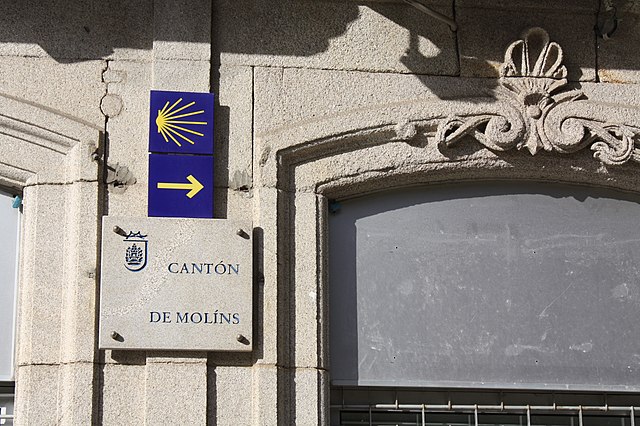
The Camino Inglés is generally well waymarked with the familiar yellow arrows and stone markers. You are unlikely to become genuinely lost. Slightly confused, occasionally; briefly uncertain at a junction, certainly. But the route finds you back fairly quickly.
That said, there are a few places where waymarking thins out or becomes ambiguous:
- Leaving Ferrol, where urban development can obscure the path
- Between Betanzos and Hospital de Bruma, where the route crosses open countryside with fewer landmarks
- Approaching Santiago through suburban areas
Recommended resources
- Wise Pilgrim app: Detailed maps, elevation profiles, accommodation listings. Works offline, which matters in rural areas with patchy signal.
- Buen Camino app: Good community-sourced information on albergue availability and current conditions along the Camino Inglés.
- GPX tracks: Download these before you leave. They are invaluable when arrows become scarce. Most camino apps include them, or download from Wikiloc.
- John Brierley’s guidebook: The standard English-language reference. Clear stage maps, useful practical information, the occasional moment of spiritual reflection that you can take or leave.
A smartphone with offline maps and a downloaded GPX track is, honestly, all you need. But carry the guidebook if you like the reassurance of something that does not need charging.
Accommodation, Food and Services

Where to sleep
Accommodation along the Camino Inglés falls into three broad categories:
- Albergues (pilgrim hostels): Dormitory beds, typically 8–15 euros per night. Some are municipal (first come, first served), others private (bookable). Quality varies from spartan to surprisingly pleasant.
- Pensiones and casas rurales: Private rooms, usually 30–60 euros. A good middle ground between budget and comfort.
- Hotels: Available in Ferrol, Pontedeume, Betanzos, and Santiago. Rarely necessary but sometimes very welcome.
In peak season (July and August), the busier albergues can fill by early afternoon. If you are walking in summer, either start early or book ahead for private accommodation. In spring and autumn, you will usually find a bed without difficulty.
One important note: between Betanzos and Hospital de Bruma, accommodation options thin out considerably. Hospital de Bruma itself has limited beds. Plan this stage carefully, especially in busy periods.
What to eat
Galician food is honest, generous and deeply satisfying after a day’s walking. You will encounter:
- Pilgrim menus (menú del peregrino): A three-course meal with bread and wine, typically 10–13 euros. The quality ranges from institutional to genuinely excellent.
- Pulpo a feira: Galician-style octopus with paprika and olive oil. A regional obsession.
- Empanadas: Filled pastry, often with tuna or meat. Perfect trail food.
- Café culture: Even tiny villages often have a bar serving strong coffee and a tortilla. These stops are sacred.
Carry snacks for the remote stretches, particularly between Betanzos and Hospital de Bruma. A handful of nuts, a piece of fruit, and a chocolate bar can transform your entire outlook on life when the next village is still an hour away.
Where services thin out
The Camino Inglés is not the Francés, where you are never more than a few kilometres from a café. Between Betanzos and Sigüeiro, the route passes through genuinely rural territory. Carry water, carry food, carry the mild paranoia of someone who once ran out of both.
What to Pack for the Camino Inglés

The golden rule of camino packing: take half of what you think you need, then remove another item. Your pack should weigh no more than 10% of your body weight. Ideally less. Every unnecessary gram will have a conversation with your shoulders by day three.
Essentials
- Footwear: Trail shoes or lightweight hiking boots, broken in thoroughly. Trail runners are increasingly popular. Whatever you choose, make sure your feet and the shoes are already on speaking terms.
- Rain gear: A proper waterproof jacket (not a poncho that turns into a sail in wind). Waterproof pack cover. Rain trousers if you are walking in spring or autumn.
- Layers: Temperatures in Galicia can swing from 10°C in the morning to 25°C by midday. Merino wool base layers, a fleece or light insulating layer, and your waterproof shell.
- Blister kit: Compeed patches, needle and thread, antiseptic. Prevention is better: wear moisture-wicking socks, apply Vaseline to hotspots, stop at the first hint of rubbing.
- Sun protection: Hat, sunscreen, sunglasses. Even in Galicia, even when it is overcast, UV exposure accumulates.
Often forgotten, always useful
- Headtorch (for early starts and late arrivals at albergues)
- Earplugs (for the snorer in every dormitory, and there is always one)
- Quick-dry towel
- Refillable water bottle (1 litre minimum)
- Basic first aid: ibuprofen, antihistamines, any personal medication
Leave the “just in case” items at home. You will not need the emergency bivvy bag. You will not read that second book. The towns along the way have pharmacies if you forget something essential.
Budget: How Much Does the Camino Inglés Cost?

One of the genuine pleasures of the Camino Inglés is that it does not have to cost much. Galicia is not expensive by Western European standards, and the pilgrim infrastructure is designed to be accessible.
|
Style |
Daily budget (approx.) |
Includes |
|
Budget pilgrim |
25–35 euros |
Municipal albergues, self-catering, pilgrim menus |
|
Mid-range |
50–80 euros |
Private albergues or pensiones, restaurant meals |
|
Comfortable |
100–150 euros |
Hotels, full restaurant dining, occasional taxi for bags |
Over five walking days from Ferrol, a budget pilgrim might spend 150 to 200 euros on accommodation and food, not including transport to the start or from Santiago. Mid-range walkers should budget 300 to 450 euros for the walking days alone.
Cash vs card
Carry cash. Small villages and municipal albergues often do not accept cards, and ATMs are available in Ferrol, Pontedeume, Betanzos, and Santiago, but not reliably in between. Withdraw enough for two to three days at a time. A money belt or ziplock bag keeps euros dry when Galicia does what Galicia does.
Getting There from the US and Getting Home from Santiago

Getting to Ferrol
There are no direct flights from the US to Ferrol. The most common approach is to fly into Madrid, then take a connecting flight or train to A Coruña or Ferrol. Alternatively, fly into Santiago de Compostela airport (which has connections via Madrid, Barcelona, or London) and take a bus or train to Ferrol.
- Fly to Madrid: Then a domestic flight to A Coruña (1 hour) or a train to Ferrol via A Coruña (5–6 hours by fast train to A Coruña, then regional train to Ferrol).
- Fly to Santiago: Then bus to Ferrol (approximately 1.5 hours via ALSA or Monbus).
- Fly to A Coruña: Domestic connections from Madrid or Barcelona. Then regional train or bus to Ferrol (approximately 1 hour).
If starting from A Coruña, simply fly or travel there and begin walking. The city is well connected.
Getting home from Santiago
Santiago de Compostela has an international airport with connections to major European hubs. Direct flights to London, Paris, Frankfurt, and other cities. For US-bound pilgrims, connecting through Madrid or Lisbon is typical. The airport is a short bus or taxi ride from the city centre.
Give yourself at least one rest day in Santiago before flying. Your legs will thank you. The city deserves more than a rushed cathedral visit and a dash to the airport.
Pilgrim Credential and Compostela Certificate

What is the Credential?
The Credential (credencial del peregrino) is your pilgrim passport. It is a folding card that you carry with you and get stamped at albergues, churches, cafés, and municipal offices along the way. Each stamp proves you were there. It is both a practical document and, by the time you arrive in Santiago, a surprisingly emotional one.
Where to get it
You can obtain your Credential before departure from your national confraternity of St James (in the US, that is American Pilgrims on the Camino). Alternatively, you can pick one up at the start of your walk in Ferrol or A Coruña, typically from the local pilgrim association, the tourist office, or your first albergue. Cost is usually 2 to 3 euros.
Stamping rules
To qualify for the Compostela, you need at least two stamps per day for the final 100 kilometres. Collect stamps at albergues, churches, bars, restaurants, and municipal buildings. Most places are happy to oblige. Some stamps are quite beautiful; collecting them becomes a quiet pleasure of the walk.
The 100-kilometre rule
The Compostela certificate is awarded to pilgrims who have walked at least the final 100 kilometres to Santiago for religious or spiritual reasons (or 200 kilometres by bicycle). The Ferrol route at 119 kilometres comfortably qualifies. The A Coruña route at 75 kilometres does not, unless you meet the special exception conditions described earlier.
When you arrive in Santiago, take your Credential to the Pilgrim Office (Oficina del Peregrino), near the cathedral. There will be a queue, but it moves reasonably quickly. The volunteers will check your stamps, ask about your motivation, and present you with a Compostela.
It is printed on parchment-style paper, in Latin, and feels like something from another century. Which, in a sense, it is.
Highlights and Key Destinations

Ferrol
A naval town with an enormous natural harbour, Ferrol has a workmanlike charm. The old quarter, Barrio de la Magdalena, has neoclassical architecture and a pleasantly faded grandeur. It is not a tourist destination; it is a place where people live and work. This gives it a grounding honesty that feels right for the start of a pilgrimage.
Visit the Co-Cathedral of San Julián. Walk the harbourfront in the evening light. Eat well, because you are about to burn a lot of calories.
Pontedeume
The medieval bridge at Pontedeume is one of the defining images of the Camino Inglés. It stretches across the Eume estuary, stone arches reflected in the water, and has been carrying pilgrims for centuries. The town itself is compact and attractive, with good albergues and restaurants strung along the waterfront.
If you have energy after the first day’s walk (unlikely, but admirable), the Fragas do Eume natural park is nearby. It contains one of the last Atlantic coastal forests in Europe. Ancient, dense, and worth a visit if your legs permit.
Betanzos
Betanzos is often called one of the most beautiful small towns in Galicia, and for once the label is deserved. Three Gothic churches, a medieval old town built on a hill, stone arcades, and a tradition of gastronomy that takes itself seriously. The Church of San Francisco, with its carved stone bears and wild boar, is a particular delight.
Try the tortilla. Not the Mexican kind; the Betanzos version of the Spanish omelette, famously soft and slightly liquid in the centre. It is divisive. It is wonderful.
The rural heart
Between Betanzos and Sigüeiro lies the quiet centre of the Camino Inglés. This is Galicia at its most authentic: small farms, granite villages, hórreos standing in fields like miniature cathedrals, dogs that watch you pass with mild curiosity. The landscape is not dramatic; it does not need to be. It is simply, persistently beautiful.
Hospital de Bruma, the hamlet where the Ferrol and A Coruña routes merge, has the atmosphere of a place that exists specifically to give pilgrims somewhere to sleep. It is functional. It is oddly memorable. You will develop an unlikely fondness for it.
Arriving in Santiago
The approach to Santiago de Compostela through its outer suburbs is not beautiful. This is true of almost every camino route; the final kilometres involve industrial estates, roundabouts, and the gradual realisation that the Middle Ages have ended. But then the old town appears, and the streets narrow, and suddenly you are walking on granite and the cathedral towers are visible above the rooftops.
The Praza do Obradoiro, when you finally reach it, is enormous and overwhelming. Pilgrims sit on the ground, some crying, some laughing, some simply staring. You will probably do all three.
The cathedral itself is baroque magnificence, centuries of devotion made stone. Attend the Pilgrim Mass if you can. Even if you are not religious, the botafumeiro (the giant swinging incense burner, on days when it is used) is something you will not forget.
Frequently Asked Questions
Can I walk the Camino Inglés alone?
Yes, and many people do. The route is safe, well-waymarked, and passes through populated areas regularly enough that you are never truly isolated. Solo walking is one of the great pleasures of any camino; it gives you time with your own thoughts, which is either the point or the problem, depending on the day. You will likely meet fellow pilgrims at albergues in the evenings, so solitude and company tend to alternate naturally.
Do I need to speak Spanish?
It helps, but it is not essential. Basic phrases for food, accommodation, and directions will cover most situations. In larger towns, some English is spoken; in smaller villages, you may rely on gestures, goodwill, and the universal language of pointing at a menu.
Download a translation app for your phone. Learn “por favor” and “gracias” at minimum. Politeness transcends all language barriers.
Is the Camino Inglés too short to be a real pilgrimage?
A pilgrimage is defined by intention, not distance. Five days of walking, sleeping simply, eating when hungry, carrying what you need, and arriving somewhere meaningful: that is a complete camino. The Camino Inglés may be a short camino by the standards of the Francés, but it is no less legitimate. Some of the most transformative experiences happen not because you walked eight hundred kilometres, but because you walked quietly for five days and listened to what came up.
What if I get injured on the trail?
Blisters are the most common complaint, and a good blister kit (Compeed, needle, antiseptic) handles most cases. For more serious issues, the towns along the route have pharmacies and medical centres. Pontedeume and Betanzos both have health services, and in an emergency, call 112 (the European emergency number).
Travel insurance that covers medical evacuation is strongly recommended. Some pilgrims carry trekking poles to reduce joint strain, which is sensible if your knees have opinions about downhill walking.
Can I send my bag ahead each day?
Yes. Several baggage transfer services operate along the Camino Inglés, carrying your pack from one accommodation to the next for a few euros per stage. This is not cheating; it is pragmatism.
Walking with a light daypack instead of a full rucksack transforms the experience, particularly on the longer stages. Ask at your albergue or check with Jacotrans or other camino luggage services for current availability along the Camino Inglés.


