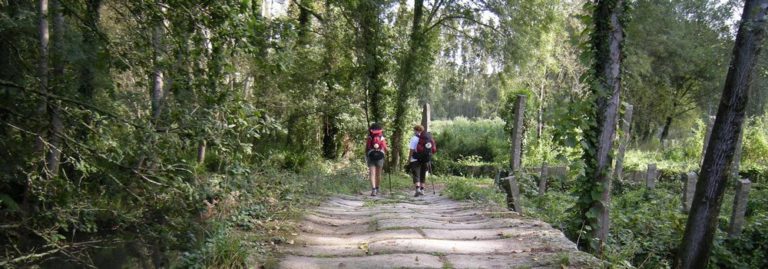
Most people do not have a month for walking the Camino de Santiago. Two weeks, sometimes. A week, often. The good news is that a one week Camino is not a watered-down version of the route; it is a perfectly legitimate pilgrimage in itself, and one that still earns you the Compostela certificate at the Pilgrim's Office at the end. You just have to pick the right starting point.
This guide covers the two most popular 7-day Camino routes for time-limited pilgrims: walking the last 100km of the Camino Frances from Sarria to Santiago de Compostela, and walking the Camino Portugues from Tui to Santiago de Compostela. It also touches on the Camino Inglés from Ferrol and shorter sections of the Camino del Norte, the Camino Primitivo, and the Via de la Plata for pilgrims who already know what they are looking for. Day-by-day stages, what each town is like, how crowded the trail gets, and how to qualify for the Compostela certificate when you walk in.
Is one week enough for a real Camino experience?
Yes. A 7-day Camino covers between 100 and 130 km, which is long enough to find a rhythm, learn the pilgrim routines, and walk into Santiago with a sense of having earned the arrival. The Compostela certificate, the official Pilgrim's Office document that confirms you have walked the route, requires a minimum of 100 km on foot or 200 km by bicycle to be eligible. The classic one-week itineraries are designed around exactly that minimum.
What you do not get in one week that you would get in a month: the long Meseta walk across central Spain, the climb over the Pyrenees, the Bierzo mountains, the layered cities of Burgos and León. But many pilgrims who later walk the full route start with a one-week section first, and almost none regret it. A week is the natural way to find out whether you like long-distance walking.
Which 7-day Camino route is best: Sarria or Tui?
The choice for most one-week pilgrims comes down to two options. The Sarria to Santiago section of the Camino Frances is the busiest, easiest to plan, and the most service-rich; the Tui to Santiago section of the Camino Portugues is quieter, has a cross-border feel, and lets you finish at the same cathedral with a different journey behind you.
|
Comparison |
Sarria to Santiago (Camino Francés) |
Tui to Santiago (Camino Portugués) |
|
Distance |
~115 km |
~115 km |
|
Number of stages |
5 to 7 typical |
5 to 7 typical |
|
Terrain |
Rolling Galician hills, eucalyptus woods, hamlets |
Gentler, with a mix of villages and small towns |
|
Crowds |
The busiest section of the entire Camino, especially in summer |
Busy but less so than Sarria; growing in popularity |
|
Lodging |
Most beds; book ahead in peak season |
Fewer beds; book ahead in peak season |
|
Best for |
First-time pilgrims who want classic Camino infrastructure |
Pilgrims who have walked Sarria before, or want a quieter route |
|
Getting there |
Train or bus from Madrid via Lugo or directly to Sarria |
Train or bus from Porto in Portugal, or from Vigo in Galicia |
For a first one week Camino, most pilgrims start with Sarria. For a second one-week trip, Tui makes a strong case. The Camino Inglés from Ferrol and a section of the Camino Primitivo from Lugo are also valid one-week alternatives covered later in this guide.
How do you walk the Camino Frances from Sarria to Santiago in 7 days?
The Sarria to Santiago section of the Camino Frances is by far the most popular one-week Camino itinerary. It is the last 100km of the route to Santiago de Compostela, walked by tens of thousands of pilgrims each year. Many pilgrims arrive in Sarria having flown into Madrid, taken a bus or train north to Lugo or directly to Sarria, and spent their first night in a small hotel before walking out the next morning.
A typical 7-day Sarria to Santiago itinerary:
|
Day |
From |
To |
Distance (km) |
What to expect |
|
1 |
Sarria |
Portomarín |
22 |
Rolling farm country; an arrival across a long bridge into the elevated town of Portomarín |
|
2 |
Portomarín |
Palas de Rei |
25 |
Eucalyptus woods, small hamlets, a gentle climb |
|
3 |
Palas de Rei |
Melide |
15 |
Short walking day; Melide is famous for octopus served at the local pulperías |
|
4 |
Melide |
Arzúa |
14 |
Another short walking day; arrival in the cheese-making town of Arzúa |
|
5 |
Arzúa |
O Pedrouzo |
19 |
Eucalyptus forest, smaller villages, a quieter stage |
|
6 |
O Pedrouzo |
Monte do Gozo |
15 |
The first view of the Santiago cathedral spires from Monte do Gozo |
|
7 |
Monte do Gozo |
Santiago de Compostela |
5 |
The final morning into the city; arrival at the Pilgrim's Office |
Faster walkers often combine days 3 and 4, walking 29 km from Palas de Rei to Arzúa in a single day. Some also combine days 6 and 7, walking from O Pedrouzo directly into Santiago in around 19.5 km, which gives them more time in Santiago de Compostela on arrival day. The schedule above is a balanced version that suits most pilgrims walking 100 km for the first time.
What are the key towns between Sarria and Santiago?
A short summary of the towns you will pass through:
- Sarria. The start. A small town with a long pilgrim history and plenty of overnight options for the night before you start. Get your Pilgrim's Credential (credencial) here if you have not already.
- Portomarín. A striking arrival across a long bridge over the Belesar reservoir. The town itself was rebuilt on higher ground in the 1960s when the original Portomarín was flooded for the reservoir.
- Palas de Rei. A classic stage-end town with a good range of albergues and small restaurants. Quiet by day, busier as pilgrims arrive in the afternoon.
- Melide. Famous for pulpo á feira, the Galician fair-style octopus. Try it for lunch at one of the traditional pulperías before walking on.
- Arzúa. The cheese-making town where the Camino del Norte joins the Camino Francés. A common overnight stop with a good selection of accommodation.
- O Pedrouzo. The last large overnight before Santiago for most pilgrims; small, friendly, with several pilgrim restaurants.
- Monte do Gozo. The hill from which pilgrims have, since the medieval period, caught their first glimpse of the Santiago de Compostela cathedral spires.
- Santiago de Compostela. The end. The cathedral, the Pilgrim's Office, the queue for the Compostela certificate, and the long, slow first meal in town.
How do you walk the Camino Portugues from Tui to Santiago in 7 days?
The Tui to Santiago section of the Camino Portugues is the most popular one-week alternative to Sarria. Tui sits on the Spanish bank of the Miño river, directly opposite the Portuguese town of Valença. You can walk across the bridge to Portugal in five minutes, which gives the start of the route a cross-border, cross-cultural character that the Sarria start does not have. Many pilgrims fly into Porto in northern Portugal, spend a night there, take a bus or train to Tui, and start walking the next morning.
A typical 7-day Tui to Santiago itinerary:
|
Day |
From |
To |
Distance (km) |
|
1 |
Tui |
O Porriño |
18 |
|
2 |
O Porriño |
Redondela |
16 |
|
3 |
Redondela |
Pontevedra |
20 |
|
4 |
Pontevedra |
Caldas de Reis |
22 |
|
5 |
Caldas de Reis |
Padrón |
19 |
|
6 |
Padrón |
O Milladoiro |
17 |
|
7 |
O Milladoiro |
Santiago de Compostela |
10 |
Distances are gentler than on the Sarria itinerary. The Camino Portugués from Tui crosses through small towns, vineyards, eucalyptus forest, and the historic Galician centre of Pontevedra. The Padrón to Santiago stage passes the legendary spot where the body of Saint James is said to have arrived in Galicia by sea, which gives the final two days a particular significance for the pilgrim community.
An alternative on the Camino Portugues is the coastal variant, the Camino Portugues by the beach, which runs along the Atlantic coast from Porto north before joining the inland route. The full coastal section to Santiago is longer than a week; the standard one-week version stays on the inland route from Tui.
Other one-week Camino routes worth knowing about
Two other 7-day Camino itineraries deserve a mention for pilgrims who want something quieter than Sarria or Tui.
The Camino Inglés from Ferrol to Santiago
The Camino Inglés (also written Camino Ingles in English) is the short route walked historically by English and Irish pilgrims who arrived by sea at the Galician ports. The full route from Ferrol is around 115 km, qualifying for the Compostela certificate, and is usually walked in 5 to 7 days. The trail is well marked but quieter than Sarria or Tui; in places you can walk for an hour without seeing another pilgrim. The terrain is more varied, with several rolling climbs through woodland and one or two longer stages. A good choice for pilgrims who want a quieter walking week.
A section of the Camino del Norte (Bilbao to Santander, for example)
The Camino del Norte, the coastal Camino along the northern Spanish coast, is one of the most beautiful routes on the entire Camino de Santiago network. It is too long to finish in one week (the full route from Bilbao to Santiago de Compostela is around 800 km), but several one-week sections work well as a stand-alone walk. The Bilbao to Santander section, roughly 130 km along the Basque coast, is one of the more popular options; it does not end in Santiago de Compostela, so it does not qualify you for the Compostela certificate on its own, but it gives you a serious week of coastal walking with beach stops and a different feel from the inland routes.
How crowded is a one-week Camino?
The Sarria to Santiago section of the Camino Frances is the busiest stretch of the entire Camino network. In July and August, the path is shared with many pilgrims arriving from every direction; the queues for the Pilgrim's Office on arrival day can be over an hour. This is a function of the 100 km minimum requirement for the Compostela certificate; tens of thousands of short-walk pilgrims choose Sarria each year for precisely this reason.
Practical strategies to reduce the crowd impact on a Sarria-based one week Camino:
- Walk in May, June, late September, or October instead of July and August.
- Start each day early. Out of Sarria by 6.30 am gives you the first two hours with most of the path to yourself.
- Book accommodation ahead, especially in private albergues and small hotels. Walk-ins still work but you spend the late afternoon hunting for a bed.
- Consider the alternative split-stage overnight towns (Ventas de Narón instead of Palas de Rei; Boente or Salceda instead of Arzúa) where the standard guidebook overnight is fully booked.
- If you are flexible, start in Tui on the Camino Portugues instead; it is half as crowded.
The shoulder months (April to early June, mid-September to October) are the sweet spot. Warm enough to walk in shorts most days, cool enough to sleep without air conditioning, quiet enough to find a bed without booking ahead, and busy enough that the pilgrim community feel is still there.
How do you qualify for the Pilgrim Certificate (the Compostela)?
To receive the Compostela certificate from the Pilgrim's Office in Santiago de Compostela, you need to meet three requirements:
- Distance. Walk at least the last 100km of the Camino to Santiago, or cycle at least the last 200 km.
- Credential. Carry a Pilgrim's Credential (credencial del peregrino), the small paper passport stamped at albergues and churches along the way. Get it before starting, or pick one up at the cathedral office in Sarria, Tui, Ferrol, or several other Camino starting points.
- Spiritual or religious motivation. You will be asked at the Pilgrim's Office why you walked. The answer can be religious, spiritual, or simply personal; it does not need to be Catholic. A "for spiritual reasons" answer is enough.
The credential needs at least two stamps per day on the final stages (Sarria onwards on the Frances, Tui onwards on the Portugues). Stamps come from albergues, churches, cafés, restaurants, and the tourist offices in each town. Collecting them becomes a small daily ritual, and the credential itself is a keepsake of the journey.
Practical planning notes for a 7-day Camino
A few items worth knowing about before you book your trip:
- The Camino works best with a small pack of 7 to 9 kg. Take less than you think you need.
- Trail running shoes or light hiking shoes are the standard footwear; heavy hiking boots are unnecessary for a Galician one-week route.
- Luggage transfer services exist on both the Sarria and Tui routes for 5 to 8 euros per bag per stage, if you would rather walk with just a daypack.
- Cash is useful for smaller bars and rural albergues; carry 50 to 100 euros in notes.
- Mobile coverage is good across both routes; you do not need a paper map but a GPS-enabled Camino app is worth installing.
- The weather in Galicia is wetter than the rest of Spain; pack a lightweight waterproof even in summer.
- Galicia has its own regional language (Galician); Spanish works everywhere, but a few Galician greetings (bos días, gracias) are welcomed.
- Allow a full day in Santiago de Compostela after walking in. The cathedral, the Pilgrim's Mass, the queue for the Compostela certificate, and a slow first dinner all benefit from time.
What about getting back from Santiago de Compostela?
After walking the Camino into Santiago de Compostela, the practical question is how to get home. Most one-week pilgrims fly out from one of three airports:
- Santiago de Compostela Airport. The closest, around 15 minutes by bus from the city. Direct flights to several European hubs.
- Vigo Airport. About 90 minutes by bus south. Direct flights to Madrid and several European cities.
- Porto Airport. About 3 hours by bus south, but with the widest range of international connections, including direct flights to the US.
If your one-week walk was Tui to Santiago on the Camino Portugués and you flew into Porto at the start, the easiest return is the same: bus or train back to Porto and fly home.
Frequently asked questions about a one week Camino
Can you really do the Camino de Santiago in one week?
Yes. The Sarria to Santiago section of the Camino Frances and the Tui to Santiago section of the Camino Portugues are both around 115 km and walkable in 5 to 7 days. Both qualify for the Compostela certificate at the Pilgrim's Office. A one-week Camino is a complete, valid pilgrimage and one of the most common ways to walk the Camino for the first time.
Which is better for first-time pilgrims: Sarria or Tui?
Sarria for ease of planning, lots of infrastructure, and the social pilgrim experience. Tui for a quieter walk and a cross-cultural feel between Spain and Portugal. Most first-time pilgrims choose Sarria because the logistics are simpler and the pilgrim community is at its busiest along this section of the Camino Frances; many pilgrims who walk Sarria once go back later to walk Tui as a second one-week Camino.
Will I get the Compostela certificate if I walk just 100 km?
Yes, provided you walk at least the last 100km of the route on foot (or 200 km by bicycle), carry a stamped Pilgrim's Credential, and answer the spiritual or personal motivation question at the Pilgrim's Office. Both the Sarria and Tui itineraries are designed around this minimum.
How many pilgrims walk the last 100km from Sarria each year?
Many pilgrims, and the number has been growing. The Sarria to Santiago section is the busiest part of the entire Camino de Santiago network. Recent statistics from the Pilgrim's Office show that the majority of all Compostela certificates issued each year are for walks of 100 to 115 km, most starting in Sarria. For up-to-date figures, the Pilgrim's Office publishes annual statistics on its website.
What is the best time of year for a one-week Camino?
Late April to early June and mid-September to October are the sweet spot. Weather is mild, the path is busy enough to feel sociable but not crowded, and accommodation is easier to secure without long-range booking. July and August are the busiest months, with the most heat and the most pressure on beds.




Leave a Reply