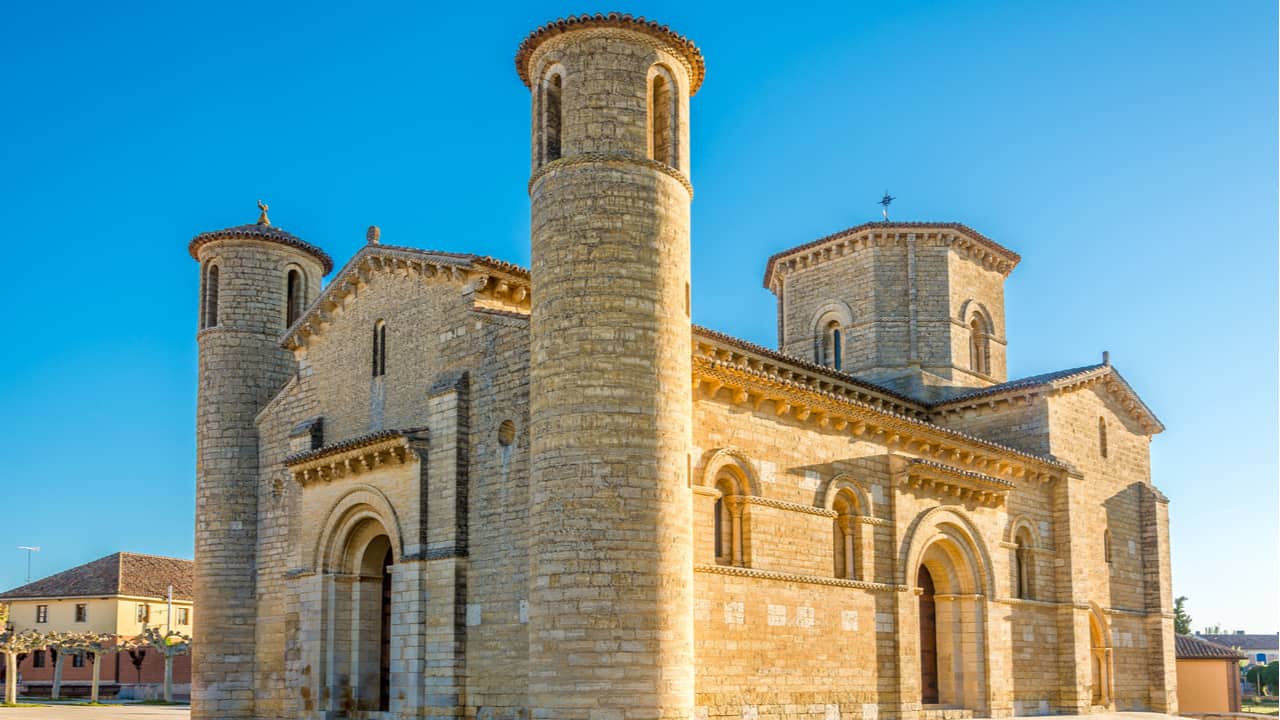
I wasn't expecting much from Frómista. A small meseta town, around 800 residents, a dot on the map between Burgos and León. My feet were hot. The sun had been doing that thing where it just sits on your shoulders like a drunk friend who won't let go. Then I turned a corner and saw the Church of San Martín de Tours, and something in the day shifted. The stone was golden. The carvings were impossibly fine. And I thought: this is why you don't skip the small towns.
Frómista is a small town in the province of Palencia, in the autonomous community of Castilla y León, and it sits right on the Camino Francés at a point where pilgrims are deep into the meseta and often deep into their own heads. It's one of those places that could so easily be a blur between stages, yet it holds some of the finest Romanesque architecture on the entire Camino de Santiago. Its roots stretch back through Celtic and Roman eras, though what you see today is shaped by medieval pilgrimage and the agricultural rhythms of Castile.
What Makes Frómista a Must-Stop Town on the Camino Francés?
Frómista earns its place on every Camino Francés stage plan for three simple reasons: a world-class Romanesque church, reliable pilgrim services, and a compact town centre you can explore in an afternoon without feeling rushed. It's a stopping point that rewards the curious without punishing those short on time.
- Standout architecture: The Church of San Martín de Tours is considered one of the purest Romanesque buildings in all of Spain.
- Easy walking stages in both directions: The flat terrain before and after Frómista makes it a natural rest point or an easy split between longer days.
- Compact and walkable: Everything a pilgrim needs, from albergues to pharmacies to dinner, sits within a few minutes' walk along the Calle Real.
- Historical depth: This isn't a town that appeared when the Camino became popular. Its historical heritage runs through Roman occupation, medieval pilgrimage, and centuries of Castilian agricultural life.
Pilgrims remember Frómista because it offers relief. Not just for the feet, though the flat approach helps, but for the eyes and the mind. After hours of open meseta walking, the concentrated beauty of its churches feels almost startling.
Where Is Frómista on the Camino Francés and How Do Pilgrims Typically Arrive?
Frómista sits approximately 207 kilometres from Santiago de Compostela along the French Way. It falls within what many guidebooks call Stage 15 of the Camino Francés, though stage numbering varies depending on which guide you follow. The town lies in the province of Palencia, firmly in the meseta section that stretches between Burgos and the approach to León.
|
Detail |
Information |
|
Region |
Castilla y León, Province of Palencia |
|
Approximate distance to Santiago |
207 kilometres |
|
Typical arriving stage |
From Castrojeriz or Boadilla del Camino |
|
Terrain on approach |
Flat, open meseta with canal paths |
|
Elevation |
Approximately 780 meter above sea level |
Most pilgrims arrive from the direction of Castrojeriz, having crossed the Alto de Mostelares and walked through Itero de la Vega and Boadilla del Camino. The walk from Castrojeriz to Frómista is around 25 kilometres, which is why many split it, stopping in Boadilla or Itero. From the hilltop above Castrojeriz, you're just a short walk from Boadilla del Camino, where you'll need to choose: do you stay here or push on to Fromista?
When you enter Frómista, the signage is clear and the layout is pilgrim-friendly. The route leads you straight through the municipality towards the churches and central services. There's no scrambling around looking for yellow arrows. The town knows you're coming.
What Are the Top Things to See in Frómista?
For a town of its size, Frómista packs in a remarkable amount. You could see the essentials in ninety minutes, but giving yourself an afternoon is better. Here's what not to miss:
- The Church of San Martín de Tours (Romanesque masterpiece)
- The Church of San Pedro (Gothic, with a pilgrim sculpture)
- Santa María del Castillo (Plateresque/Renaissance style, major altarpiece)
- The Canal de Castilla (industrial heritage, good for a short stroll)
- San Telmo Square (central rest point)
What Should You Know Before Visiting the Church of San Martín de Tours?
This is the one. If you see nothing else in Frómista, see the Church of San Martín. Built in the mid-11th century and modelled partly on Jaca Cathedral in Aragón, it's regarded as one of the most perfect examples of Romanesque architecture in Spain. The proportions are clean. The stonework is precise. It has the quiet authority of a building that knows exactly what it is.
What to look for: the carved capitals and corbels. There are over 300 carved corbels on the exterior alone, depicting animals, human figures, acrobats, and fantastical beasts. Inside, the capitals on the columns show biblical scenes and decorative motifs. Some are funny. Some are unsettling. All are worth looking at slowly. The triple apses at the east end are beautifully symmetrical, and the bell tower sits with a kind of stubborn grace.
On a Camino schedule, you can walk through in fifteen minutes and still feel the impact. If you have an hour, bring the guidebook and try to identify specific capitals. It rewards both the quick glance and the lingering look.
What Can You See at the Church of San Pedro?
The Church of San Pedro stands in deliberate contrast to San Martín's Romanesque restraint. It's a Gothic structure, later in date, taller and more angular. The interior has a different weight to it, cooler and more vertical.
For Camino walkers, the key highlight is the figure of Santiago Peregrino, a sculpture of Saint James as a pilgrim. It's one of those moments that catches you: here you are, walking this route, and here he is, carved in stone, doing the same thing. The church also houses some notable Renaissance-era artwork. It's a quieter visit than San Martín, and worth the five-minute walk.
Why Is Santa María del Castillo Important (and What's Inside)?
Santa María del Castillo represents yet another architectural style in Frómista's small collection. The exterior is Plateresque, a late Gothic/early Renaissance style characterised by ornate surface decoration. Inside, the main draw is the retable attributed to Fernando Gallego, a 15th-century Castilian painter. The altarpiece is a remarkable work across multiple painted panels on canvas and panel, depicting scenes with the intensity and rich colour typical of late medieval Castilian art.
If you can only choose one interior visit, San Martín wins for sheer architectural purity. But if you have an hour and an interest in painted altarpieces and the shift from medieval to Renaissance style, Santa María del Castillo adds real depth to your understanding of the town's cultural interest.
What Other Quick Stops Are Worth Adding (If You Have Extra Time)?
Beyond the three churches, Frómista has a handful of spots worth knowing about.
- Canal de Castilla: An 18th-century waterway (construction began around 1753) that was once an important civil engineering project for transporting grain across Castile. The towpath near Frómista makes for a pleasant stroll, and it's a good spot for photographs with the flat water reflecting the meseta sky. The canal's significance as a piece of industrial heritage is easy to overlook, but history lovers find it rewarding.
- San Telmo Square: The main plaza and a natural rest area. There's usually a bar open, and it's a good place to sit and watch other pilgrims arrive. Nothing dramatic. Just a bench, maybe a coffee, the sound of walking poles on stone.
- "Miracle Stone": Commonly referenced in Camino guides, this marker near the town relates to a local legend. It's the kind of stop that takes thirty seconds but gives you a small story to carry forward.
- Local museums and ethnographic collections: Some guides mention small museums in or near Frómista. These are worth it on a rest day or if rain has driven you indoors, but most walking pilgrims won't have the time or energy.
Who Was San Telmo, and What's His Connection to Frómista?
Frómista claims the birthplace of San Telmo (also known as Pedro González Telmo), a 13th-century Dominican friar who became the patron saint of sailors. It's a lovely irony that a saint associated with the sea came from one of the driest, flattest parts of Spain. The municipality honours him with place names and the central square.
- San Telmo was born in Frómista around 1190.
- He became a prominent preacher and confessor to King Ferdinand III of Castile.
- After his death, sailors adopted him as their protector, and "St. Elmo's fire" (the atmospheric phenomenon seen on ship masts) is linked to his name.
For pilgrims, the connection is mostly atmospheric. You won't find a major shrine. But knowing that this quiet meseta town produced a saint whose fame reached the open ocean adds a small, pleasing layer to the walk. The Castilian plains have always sent people outward.
Where Can Pilgrims Stay in Frómista (and How Do You Choose)?
Accommodation in Frómista covers the range most Camino walkers need. The town is well set up for pilgrims, and you won't struggle to find a bed, though high season (June through September) can fill places by early afternoon.
|
Lodging Type |
Who It Suits |
What to Expect |
|
Municipal/public albergue |
Budget pilgrims, solo walkers, those wanting the communal experience |
Dormitory beds, shared bathrooms, basic kitchen. Typically first-come, first-served. Expect the familiar symphony of zips and snoring. |
|
Private albergues (e.g., Albergue de Peregrinos de Fromista, Albergue Luz de Fromista) |
Pilgrims wanting a bit more comfort or smaller dorms |
Often offer private rooms alongside dorms. Some accept reservations. Slightly higher price but quieter. |
|
Pensions, hostals, hotels (e.g., options along Calle Real and near San Pedro) |
Couples, injured pilgrims, those needing a rest day, remote workers |
Private rooms with en-suite bathrooms. Prices vary from around 35 to 70 euros. Worth it when your body is asking for a proper night's sleep. |
A few decision factors worth considering when you choose where to stay in Frómista:
- Arrival time: If you're arriving after 2pm in peak season, municipal albergues may be full. Private albergues and pensions with reservations give you security.
- Next-day plan: If you're walking to Carrión de los Condes the following morning, a good night's rest matters more than saving five euros.
- Comfort needs: The meseta is tiring in ways that aren't always about distance. Heat, wind, and the psychological weight of flat horizons can drain you. An upgrade is not a failure. It's a tactic.
- Practical services: Pilgrims usually want dinner options, laundry facilities, a pharmacy for blister supplies, and early breakfast. Most albergues and pensions near the town centre have these within a short walk.
What Is the Walk from Frómista to Carrión de los Condes Like?
The stage from Frómista to Carrión de los Condes is approximately 19 kilometres of flat, open meseta terrain. By Camino Francés standards, it's considered an easy stage, and for good reason. The elevation change is negligible. The path is well marked. Your biggest challenge will not be your legs.
|
Stage Detail |
Information |
|
Distance |
Approximately 19 km |
|
Terrain |
Flat, open meseta; mix of paths alongside roads and farm tracks |
|
Difficulty |
Easy (physically); mentally can feel monotonous |
|
Typical walking time |
4 to 5.5 hours depending on pace and stops |
|
Key intermediate villages |
Población de Campos, Villarmentero de Campos, Villalcázar de Sirga |
|
Services en route |
Limited; carry water and snacks |
Who is this stage best for? Honestly, everyone. If you've been grinding through long days, the 19 kilometres to Carrión de los Condes is a recovery walk. If you're feeling strong, you could push further. The flat terrain is kind to sore joints and blistered feet, though the sun and wind exposure can be relentless.
The route feel is distinctly meseta. Long straight stretches. Wheat fields. A sky so big it makes you feel very small and not entirely in a bad way. Some pilgrims find it monotonous. Others find it meditative. The villages between Frómista and Carrión, places like Villalcázar de Sirga with its remarkable Church of Santa María la Blanca, break up the walk and offer rest stops with water and sometimes coffee.
What Should You Pack or Plan for on This Meseta Stage?
The meseta has its own requirements, even on an easy day.
- Sun protection: A hat with a brim, sunscreen (reapply), and sunglasses are essential. Shade is rare. There are stretches where the only shadow is your own.
- Water: Carry at least 1.5 litres. Fill up in Frómista before you leave. The villages en route have fountains, but don't assume they'll all be flowing.
- Foot care: Flat terrain doesn't mean blister-free terrain. The repetitive, even surface can actually create friction patterns that hillier stages don't. Check your feet at any rest stop.
- Navigation: The route is well marked with yellow arrows and shell markers. Keep awareness at road crossings and junctions, but this isn't a stage where people get lost. It's a stage where people zone out, which is mostly fine but occasionally means missing a turn.
What Are the Most Common Challenges and Tips for Enjoying Frómista and the Next Stage?
The meseta has a reputation, and not all of it is undeserved. Here's what pilgrims actually struggle with around Frómista and on the walk to Carrión de los Condes.
- Bed availability: Frómista is a popular stopping point, and in peak months (July and August especially), beds fill fast. Arriving before 2pm or booking a private room removes the stress.
- Heat and exposure: Meseta temperatures can exceed 35°C in summer. Start early. Aim to be walking by 6:30 or 7:00am. The first hours are cooler and the light is beautiful.
- Mental monotony: Some pilgrims find the flat, open walking boring. This is the meseta's gift and its test. If you find yourself struggling, try walking with another pilgrim for conversation, or switch to music or a podcast for a stretch. Alternatively, lean into the emptiness. It has things to teach you, even if it takes a while to hear them.
Tips for making your Frómista stop memorable:
- Do a self-guided churches loop before dinner: San Martín, then San Pedro, then Santa María del Castillo. It takes about an hour at a comfortable pace and gives you a miniature education in Spanish architectural history, from Romanesque to Gothic to Renaissance style.
- Start early the next morning: Leave Frómista with the first light for the walk to Carrión de los Condes. The meseta at dawn is a different landscape, soft and pink, and you'll arrive in Carrión with the whole afternoon ahead of you.
- Visit the Canal de Castilla in the evening: The towpath is flat and easy, and the canal catches the sunset in a way that justifies the short detour.
What Apps, Books, or Resources Help Most Around Frómista?
Pilgrims walking the Camino de Santiago today have more tools than any previous generation. Around Frómista and the meseta stages, a few types of resources consistently prove their worth.
|
Resource Type |
What It Offers |
When It's Most Useful |
|
Navigation apps (e.g., Wise Pilgrim, Buen Camino) |
Offline maps, elevation profiles, accommodation directories, water source locations |
Daily stage planning; finding services in small villages between Frómista and Carrión |
|
Guidebooks (e.g., Brierley, Michelin cultural guides) |
Church history, architectural context, cultural background |
Understanding what you're seeing at San Martín, San Pedro, and Santa María |
|
Albergue and accommodation websites |
Updated opening status, reservation options, reviews from recent pilgrims |
Booking ahead in peak season; checking which albergues accept reservations |
What to look for in a good resource: recent information (accommodation changes year to year), clear stage breakdowns with realistic distance and timing, and offline access. Mobile data coverage on the meseta is patchy. Download everything before you leave Frómista in the morning. Trust me on this.
FAQ: What Do Pilgrims Want to Know About Frómista on the Camino Francés?
Is Frómista worth stopping in if I'm trying to cover more miles?
Yes. Frómista's compact layout means you can see the main Romanesque churches, resupply, and eat well in under two hours. Combined with the easy 19 km stage to Carrión de los Condes the next day, it's a strategic stop that doesn't slow your overall pace. You can even visit San Martín de Tours and grab a coffee without breaking stride if you're truly in a hurry.
How long do you need to see Frómista's main churches?
For a quick highlights visit, allow 60 to 90 minutes. You can walk between all three churches (San Martín, San Pedro, and Santa María del Castillo) in that time with brief stops inside each. For a deeper architectural look with time to study the carved capitals and the Gallego altarpiece, plan for a full afternoon. Most pilgrims arrive mid-day and fit the churches into the hours before dinner.
Is the Frómista to Carrión de los Condes stage good for beginners?
It's one of the most beginner-friendly stages on the Camino Francés. The terrain is flat, the distance is manageable at around 19 km, and the path is well marked. The main thing beginners should plan for is sun and wind exposure. Start early, carry enough water, and wear a hat. The walking itself is straightforward.
What's the single can't-miss landmark in Frómista?
The Church of San Martín de Tours. It's one of the finest Romanesque churches in Europe, and the carved corbels and capitals are extraordinary. Even if you're not particularly interested in architecture, the building has a presence that stops you. Walk around the exterior slowly and look up at the corbel figures. They're strange, funny, and over 900 years old.
What's the best time of day to walk the meseta from Frómista?
Early morning. Aim to leave Frómista by 6:30 to 7:00am, especially in summer. The first few hours are cooler, the light is gentler, and you'll arrive in Carrión de los Condes before the midday heat peaks. If you're walking in spring or autumn, you have more flexibility, but morning starts remain the pilgrim consensus for the meseta. Carry water regardless of the season.
Planning Your Frómista Stop on the Camino Francés
Frómista is the kind of place that teaches you something about walking the Camino de Santiago. Not every town needs to be a destination. Some of the best stops are the ones that simply do their job well: a clean bed, a remarkable church, a plate of food that tastes better than it has any right to because you walked 25 kilometres to earn it.
If you're planning your Camino Francés stages, here's how to make the most of Frómista:
- Add it as a highlight stop, especially if Romanesque architecture interests you. The Church of San Martín alone justifies the pause.
- Plan your arrival so you have time to see San Martín, San Pedro, and Santa María del Castillo without rushing. An afternoon arrival works well.
- Map out the approximately 19 km stage to Carrión de los Condes and choose your lodging based on your pace and comfort needs.
- Use a reliable Camino navigation app or guidebook to check albergue availability and water sources along the meseta stages.
Are you walking the Camino Francés? If you're in the early planning stages, explore our Camino Francés route planning resources for stage-by-stage breakdowns, pacing suggestions, and accommodation guidance. Frómista is one of those quiet splendour towns that makes the meseta worth every flat, sun-drenched kilometre.


