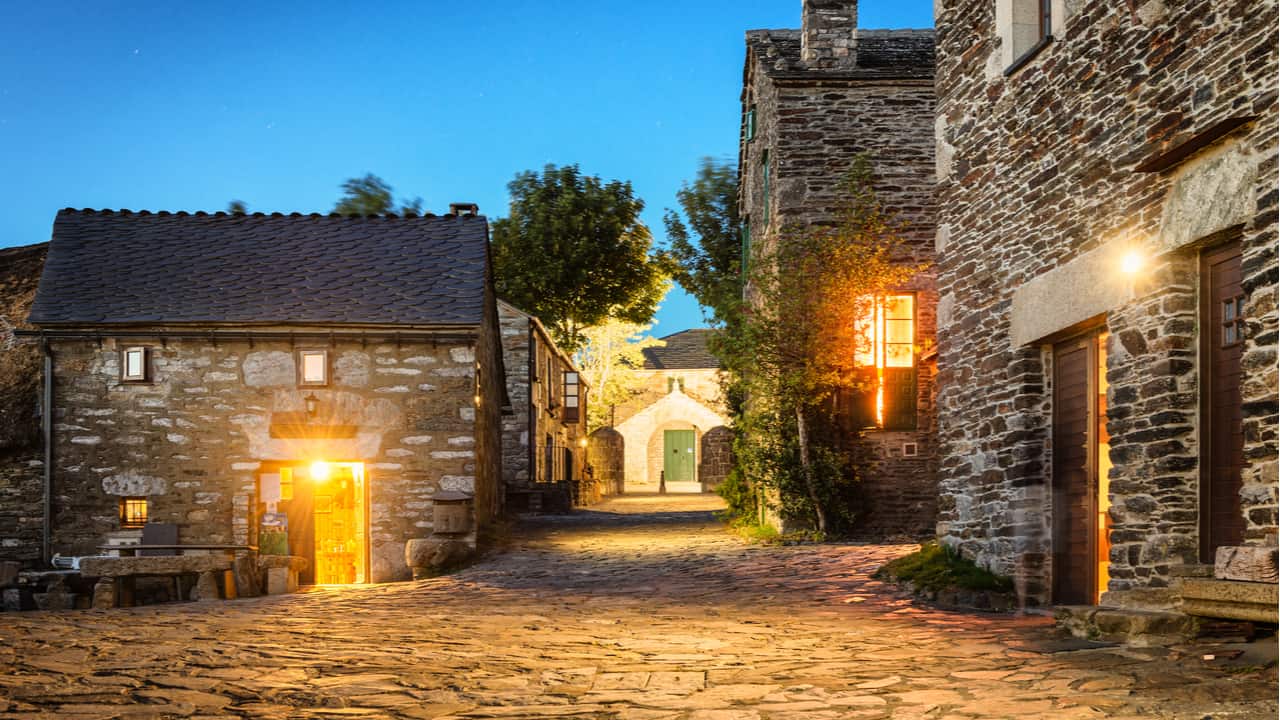
You smell O Cebreiro before you see it. Woodsmoke, wet stone, the green closeness of Galicia after the dry leagues behind you. I climbed up out of the Bierzo valley on a morning when the cloud sat on the ridge like a lid, and the village appeared in pieces: a low thatched roof, then a church tower, then the whole huddle of grey stone leaning into the wind. After the effort of the ascent it felt less like arriving at a place and more like being let in on a secret the mountain had been keeping.
This is a guide to O Cebreiro for pilgrims planning their stages, for history and culture lovers, and for first-timers trying to work out why a hamlet of barely a few buildings carries such weight on the Camino Frances. We will walk through where it sits, what the climb is like, the pallozas and their Celtic heritage, the church of Santa Maria la Real, the miracle that made the village famous, and the practical business of fitting it into a route to Santiago de Compostela.
What makes O Cebreiro a must-stop village on the Camino Frances?
O Cebreiro is the first proper village in Galicia on the Camino Frances, and that fact alone gives it outsized significance. Cross the threshold here and you have entered the final region of the walk, the home stretch toward Santiago. Pilgrims who have ground their way across the heat of the meseta and the climbs of the Bierzo feel the change in the air, literally; the temperature drops, the mist gathers, and the landscape turns to oak trees, gorse, and grazing cattle.
The village is tiny. You can walk its single lane in a couple of minutes. Yet it holds a 9th century church, a cluster of pre-Roman dwellings, and one of the oldest miracle legends on the whole pilgrimage. That density of meaning in such a small space is exactly why guidebooks reach so quickly for the word “iconic.” It is one of those places on the Camino where the cultural and spiritual weight feels disproportionate to the number of front doors.
If you are the kind of pilgrim who plans stages on a spreadsheet, O Cebreiro is a logical overnight. If you are the kind who walks for the history, it is a small museum of Galician rural life you happen to be allowed to sleep in. Either way, slowing down here pays off.
Where is O Cebreiro, and how does it fit into your Camino Frances route plan?
O Cebreiro is a mountain village in the province of Lugo, in eastern Galicia, perched at roughly 1,300 metres in the Os Ancares range near the border with Castilla y Leon. The Camino Frances climbs to it from the hamlet of Las Herrerias and the valley below, which is why so many itineraries treat the day as a milestone rather than just another stretch of the walk. This is the gateway into Galicia, and many pilgrims mark it as the moment the end starts to feel real.
On official route planning, the stage is usually written as “O Cebreiro to Triacastela.” That is the leg that carries you onward and down off the high ground, through small Galician settlements, toward the lower country that eventually leads to Sarria. The full guide to the Camino Frances route and its stages sets the village in its wider context, but for planning purposes here are the practical points worth holding in mind.
- O Cebreiro is a common overnight stop, both for the views and to break the long climb from the valley.
- It sits high and exposed, so weather can differ sharply from the warmer towns below in the Bierzo.
- The next stage heads toward Triacastela, then on to the town of Sarria, the usual starting point for the last 100km.
- Time your day to allow for the ascent plus a proper look at the church and the pallozas, not just a passing glance.
For pilgrims walking the full French Way, this is the deep middle-to-late section of the journey on the Camino. For those joining later, it is worth knowing that O Cebreiro lies before Sarria, so a walker starting at Sarria will not pass through it. That distinction matters when you are deciding whether to build the village into your plan or simply read about it afterward.
What are the key stops between O Cebreiro and Triacastela?
The stage from O Cebreiro to Triacastela runs along rolling ridgelines before dropping into the valley, and it passes a handful of small hamlets that appear in most route breakdowns. You climb a little further to the high ground at the Alto do Poio, the highest point of this section, before the long descent begins. The settlements are spaced for a coffee and a stamp rather than a full stop.
- Liñares, a short walk on from O Cebreiro, with its own small Romanesque church.
- Hospital da Condesa, named for an old pilgrim hospital, a reminder of how long this road has carried walkers.
- Alto do Poio, the high pass, often windswept, with a bar that feels well earned.
- Fonfría and Biduedo on the descent, where the path softens into farmland.
Expect changing conditions across the day: bright on the tops, then sudden cloud, then the green hush of the lower oak woods. This is high-level orientation rather than a step-by-step trekking guide, but it gives you the shape of the walk down to Triacastela. Detailed notes on Triacastela and the onward stretch toward Sarria fill in the rest.
What is the climb to O Cebreiro like, and what should pilgrims expect?
The ascent to O Cebreiro has a reputation, and it earns it. From Las Herrerias the path rises steeply, gaining several hundred metres over a few kilometres, much of it on a narrow track that winds up through chestnut and oak. It is not technical. It is simply long and steady and, on a wet day, slippery underfoot. Most pilgrims I have spoken to remember it less as a hardship than as a threshold they had to push through to feel they had reached Galicia properly.
The weather is the variable that catches people out. You can leave the valley in warm sun and arrive at the top in a cold sideways drizzle, the mountain air sharp in your lungs. Fog can swallow the path entirely. The detailed account of the leg from Villafranca del Bierzo up to O Cebreiro captures how quickly conditions shift on this part of the Camino. A few things help.
- Set a steady, slow pace rather than charging the steep sections; the climb rewards patience over effort.
- Carry water and a snack, since the gaps between bars are longer on the ascent.
- Pack a waterproof within reach even on a clear morning, because the cloud arrives without warning.
- Start early for better visibility and to leave time at the top before the afternoon mist rolls in.
Season changes the character of the climb. Spring brings mud and rain and a riot of green. Summer offers warmth but also sun exposure on the open stretches. Autumn is often foggy, the woods turning, the air smelling of leaf mould. Winter is cold and sometimes snowbound up here, beautiful and quiet, but a serious proposition that needs proper gear. Whatever the season, the arrival at the village tends to feel earned, which is part of why it stays with people.
What are the pallozas in O Cebreiro, and why do they matter?
The pallozas are the strangest and oldest thing about O Cebreiro, and the reason the village feels like a step back in time. A palloza is a circular or oval dwelling built of low stone walls under a steep conical roof of rye thatch, with no chimney; the smoke from the hearth simply filtered up through the straw. They look more like something from an Iron Age settlement than a place people lived in within living memory, which is precisely what makes them remarkable.
Their design points to deep Celtic heritage in this corner of Galicia, a region that shares cultural roots with other Atlantic Celtic areas of Europe. The circular form was not decoration. It was a practical answer to a hard climate: the round walls shed wind, the thick thatch held heat, and families lived under the same roof as their livestock, the animals’ warmth helping to take the edge off the mountain cold. Form followed function in the most literal way.
What makes them genuinely moving is how recent their use was. People lived in O Cebreiro’s pallozas until the 1960s, cooking, sleeping, and keeping cattle inside them the way their ancestors had for centuries. When you stand beside one now, you are looking at a way of life that ended not in some distant past but within the memory of people still alive. When viewing them, a few details reward attention.
- The stonework: low, thick, dry-laid walls built to hold heat and resist wind.
- The thatched roofs: steep cones of rye straw, shaped to shed Galicia’s heavy rain.
- The single low profile: doorways and windows kept small to conserve warmth.
- The shared layout: space divided between human living quarters and a byre for animals.
Can you visit a museum or interpretation space about traditional life here?
Yes. One of the pallozas in O Cebreiro is set up as an ethnographic museum, fitted out to show how a family actually lived inside one of these dwellings. Stepping in from the daylight, you find the hearth at the centre, the smoke-darkened roof above, the simple tools and furniture of a rural Galician household, and the partition where animals were once kept. It is small, but it does something that a plaque never could: it lets you stand inside the past.
If you want the visit to mean more than a quick look, pay attention to the architecture details, the rural economy the building supported, and the sense of community life it implies. These were not isolated huts but part of a working village where survival depended on neighbours. Spend a few quiet minutes and the building stops being a curiosity and becomes a record of how people endured up here, in the mist, for a very long time.
What is the Santa Maria la Real church in O Cebreiro, and why is it famous?
The Romanesque church of Santa Maria la Real sits at the heart of the village and is one of the oldest surviving churches associated with the Camino de Santiago. Its roots reach back to the 9th century, making it a sacred site for pilgrims long before many of the grander cathedrals further along the route were built. Low, solid, and unshowy, it matches the village: built to last and to keep the weather out.
Inside, the atmosphere is the point. The Santa Maria church is dim and plain, the stone close around you, the light filtered and soft. There is none of the theatre of the great pilgrimage cathedrals, and that is its strength. It feels like a place for catching your breath after the climb, a quiet stop in a pilgrim’s day rather than a grand spectacle. Several things are worth noticing.
- The Romanesque simplicity: thick walls, small windows, an interior shaped for shelter and prayer.
- The font and the chalice associated with the village’s central legend, which we come to next.
- The image of Santa Maria la Real, the figure of the Virgin tied to the local devotional tradition.
- The general sense of age, of a building that has sheltered walkers for over a thousand years.
A church visit here need take only ten minutes, but it tends to land differently than the others on the Camino. Perhaps it is the altitude, or the effort of the climb, or simply the plainness of the place. Pilgrims often sit longer than they meant to.
What is the Miracle of O Cebreiro, and what’s the story pilgrims hear?
The Miracle of O Cebreiro is the story that turned a remote mountain church into a place of pilgrimage in its own right. The version pilgrims hear runs roughly like this. One brutal winter morning, with snow heavy on the pass, a local peasant from a nearby hamlet trudged up to the church to hear Mass. The priest celebrating that day thought the man a fool for risking the storm over a little bread and wine, and privately doubted the whole sacrament.
As the story goes, at the moment of consecration the bread and wine were said to have visibly become flesh and blood, a sign rebuking the priest’s doubt and honouring the peasant’s plain faith. The relics linked to this event, a chalice and paten, have been kept at the church ever since, and the legend has drawn the devout to O Cebreiro for centuries.
It is easy to see why the story resonates on the Camino. After a hard climb, themes of faith, humility, and perseverance feel close to the bone. The peasant who walked through snow for something he could not see, the doubter shown up by simple devotion: these are not abstractions to a pilgrim with aching legs and wet boots. The miracle gave O Cebreiro a reputation as more than a scenic viewpoint, and it is a large part of why the village kept drawing walkers long after the old trade roads faded.
How is O Cebreiro connected to Holy Grail lore?
The chalice tied to the miracle is sometimes linked, loosely, to Holy Grail legend, and it is worth being careful here. There is no serious historical claim that the cup at O Cebreiro is the Grail of Arthurian or biblical tradition. What happened is more interesting and more human: the eucharistic miracle, centred on a chalice that held what was believed to be real blood, gathered Grail-like symbolism around it over the centuries. Some say the chalice on the coat of arms of Galicia echoes this story, though that connection is debated.
For visitors, the lore is part of the texture rather than a treasure hunt. People come to see the church artifacts, the iconography, and to hear the local storytelling that ties the village to a wider tradition of sacred cups. Treat it as folklore layered onto fact, and the place becomes richer rather than diminished.
What are the best things to do in O Cebreiro besides walking through?
O Cebreiro is small enough that you might fear running out of things to do, but the opposite tends to be true: it rewards the walker who lingers. Beyond simply passing through on the way to Santiago, here is a pilgrim-friendly checklist of what the village offers.
- See the pallozas up close, both from the lane and inside the ethnographic museum.
- Visit Santa Maria la Real and learn the miracle story behind its chalice.
- Take in the viewpoints over the Os Ancares range, especially if you stay overnight for sunrise or sunset.
- Try the local Galician food, which is where the cold mountain setting starts to pay you back.
The food deserves its own mention. This is the start of Galician cooking on the Camino: caldo gallego, the hearty soup of greens and beans that tastes like exactly what a wet climb deserves, and the famous local cheese, the cone-shaped queixo do Cebreiro. A bowl of that soup in a warm bar with the rain on the window is one of the quiet pleasures of the walk. There is more on these dishes in the round-up of the most delicious Galician dishes you will meet on the Camino.
If your timing is lucky, you may catch a local festival or seasonal event, often tied to the church calendar. As with any sacred space, the kind thing is to engage respectfully: keep quiet in the church, ask before photographing people, and remember that for some this is a place of devotion rather than a tourist stop. The village is at its best when you treat it as someone’s home that happens to be very old.
How long does it take to walk from O Cebreiro to Santiago de Compostela?
From O Cebreiro, the city of Santiago de Compostela lies roughly 150 kilometres ahead, which most pilgrims cover in six to eight days of walking depending on pace and how many rest stops they build in. The route runs down through Triacastela, on to the town of Sarria, then through Portomarin, Palas de Rei, and Arzua before the final approach. Here is a rough shape of the stages from O Cebreiro onward, useful for budgeting your time on the way to the city of Santiago.
|
Stage |
Approximate distance |
What to expect |
|
O Cebreiro to Triacastela |
About 21 km |
High ridgelines, the Alto do Poio, then a long descent into Galician farmland. |
|
Triacastela to Sarria |
About 18 km |
Choice of routes, one passing the Monastery of Samos; oak and chestnut woods. |
|
Sarria to Portomarin |
About 22 km |
The busy last-100km starting point; gentle hills, the crossing of the Miño. |
|
Portomarin to Palas de Rei |
About 25 km |
Rolling country past Castromaior and the Sierra de Ligonde near Ligonde and Poio. |
|
Palas de Rei to Arzua |
About 29 km |
Through Ribadiso and its old bridge into the town of Arzua, cheese country. |
|
Arzua to Santiago |
About 39 km (often split) |
Eucalyptus woods, then Monte del Gozo and the first sight of the city of Santiago de Compostela. |
The last stretch into Santiago, over Monte del Gozo, the Mount of Joy, is where pilgrims traditionally first glimpse the cathedral spires. The name says everything. To obtain your Compostela certificate at the Pilgrim’s Office, you need to have walked at least the final 100km, which any walker passing through O Cebreiro comfortably exceeds. The stage from Sarria, the start of that final 100km, is where the trail grows busier as new walkers join for the last leg to Compostela.
Where to stay and how to plan your O Cebreiro stop
Accommodation in O Cebreiro is limited, which is part of its charm and also a reason to plan ahead, especially in summer or a Holy Year. The village has a municipal albergue, a handful of private hostels and small B&Bs, and a couple of guesthouses, but beds fill quickly because everyone wants to sleep at this famous spot. Booking ahead in peak season saves you a cold, disappointed walk onward in the dark.
How long to spend depends on what you came for. A quick stop of an hour covers the church and a look at the pallozas. An overnight, which I would recommend if your stages allow, gives you the museum, the food, a quiet evening, and the chance to see the mist lift off the valley at dawn. Getting here without walking the whole Camino is possible too: the nearest practical approaches involve a bus with Alsa to nearby towns such as Pedrafita do Cebreiro and a taxi up the final climb, since the village itself has no direct long-distance service.
- Quick stop: church, pallozas exterior, a coffee, then on toward Triacastela.
- Half day: add the ethnographic museum and a proper bowl of caldo gallego.
- Overnight: book a bed, watch the sunset over Os Ancares, and start the descent fresh.
Whether you walk it self-guided, following the yellow arrows up from the valley, or join an organised walking holiday that handles the bookings, the experience of the village is the same. O Cebreiro does not change for you. You change a little by passing through it, which is rather the point of the whole walk.
Frequently Asked Questions about O Cebreiro on the Camino Frances
Is O Cebreiro in Galicia, and why is entering Galicia a big Camino milestone?
Yes, O Cebreiro is the first village in the Galicia region as you walk west on the Camino Frances, sitting high in the Os Ancares mountains in the province of Lugo. Entering Galicia matters because it is the final region before Santiago, so crossing into it signals that the end of your pilgrimage is genuinely near. The landscape and weather change here too, turning greener, mistier, and cooler, which makes the milestone feel physical as well as symbolic.
How hard is the climb to O Cebreiro on the Camino Frances?
The climb from the valley near Las Herrerias up to O Cebreiro gains several hundred metres over a few kilometres and is steady rather than technical, though it can feel long after a full day’s walking. The real challenge is the weather, which shifts fast at this altitude, with fog, wind, and rain possible even when the towns below are warm. A slow pace, water, and a waterproof within reach make the ascent manageable for most reasonably fit pilgrims.
What are pallozas, and can you go inside them?
Pallozas are circular or oval stone dwellings with steep thatched roofs, a building style rooted in the Celtic heritage of Galicia and lived in at O Cebreiro until the 1960s. You can view several from the village lane, and one is fitted out as an ethnographic museum that you can step inside to see how a rural family lived, complete with central hearth and space once shared with livestock. It is one of the easiest ways on the whole Camino to stand inside the past.
What is the Miracle of O Cebreiro in simple terms?
The Miracle of O Cebreiro tells of a peasant who climbed to Mass through a winter storm, watched by a priest who doubted the value of the sacrament. According to the legend, the bread and wine visibly turned to flesh and blood at the consecration, rebuking the priest’s doubt and honouring the peasant’s faith. The chalice and paten linked to the story are kept in the church of Santa Maria la Real and gave the village its lasting reputation.
How long should I plan to spend in O Cebreiro?
For a quick visit, an hour covers the church and a look at the pallozas before you walk on toward Triacastela. If you can spare the time, an overnight lets you add the museum, a bowl of Galician soup, and the quiet of the village once the day-walkers have gone, plus sunrise over the mountains. Most pilgrims who stay the night say they were glad they did.


