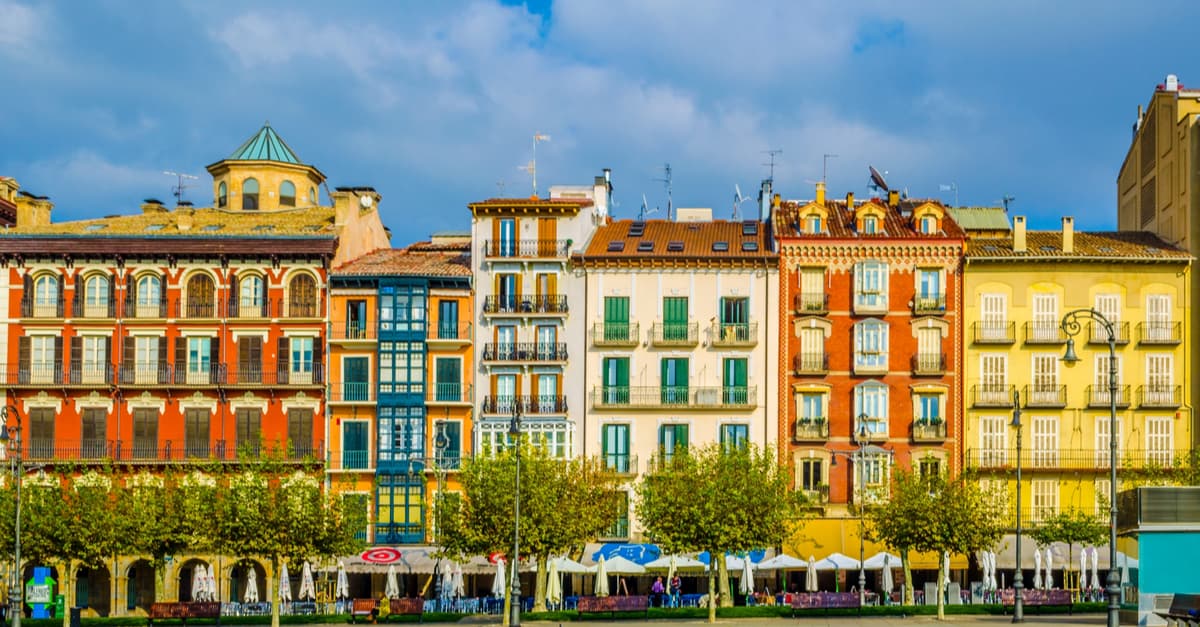
You come down off the hills tired, a little proud of yourself, and then a city simply opens up in front of you. That is Pamplona. After the high quiet of the first days, the noise of traffic and the smell of frying garlic feel almost shocking. I remember sitting on a bench near the walls, boots off, watching ordinary people carry shopping bags, and thinking how strange it was to be a pilgrim in a place where most people were just getting on with their Tuesday.
Pamplona is the capital of Navarre, the first proper city most walkers reach on the Camino Francés, and one of the most useful stops on the whole route. This guide covers where it sits on the path, what to see, where to sleep, where to get your credential stamped, and how to walk back out again toward Santiago de Compostela. Practical, mostly. A little reflective, because the place earns it.
Why is Pamplona a must-stop city for Camino Francés pilgrims?
Pamplona matters because it is the first big city encountered on the Camino Francés, arriving after the demanding Pyrenees stages that begin in France. If you started at Saint-Jean-Pied-de-Port and crossed into Spain at Roncesvalles, by the time you reach Pamplona you have already walked roughly 65 km and earned the right to a rest. The body knows it. The feet certainly know it.
It is also where the romance of the trail meets the convenience of modern life. The old town is genuinely medieval, with narrow winding streets and shaded squares, yet a five-minute walk takes you to pharmacies, banks, outdoor shops, supermarkets, and a proper hospital. For many pilgrims this is the first real chance to fix what is going wrong: a sore knee, a worn-out insole, a pack that needs lightening.
This guide is written with U.S.-based travellers in mind, the sort who are mapping a Camino months ahead from a kitchen table thousands of miles away. It covers the city's architecture, its cultural highlights, and the practical pilgrim details that rarely make the glossy photos. Who walks through here? Just about everyone on the French Way, which is part of what makes Pamplona feel like a crossroads rather than a stop.
- First major full-service city on the route, ideal for resupply and repairs
- Easy transport links for those flying in to start their pilgrimage here
- Rich history dating back to Roman times, with layers of medieval building
- A natural place to take a rest day after the climb over the mountains
Where is Pamplona on the Camino Francés, and what is it like to arrive?
Pamplona sits in the early third of the Camino Francés, after the Pyrenees and before the long push west toward Puente la Reina, Logroño, and eventually Burgos. In rough terms, you are still in the opening act: the mountains behind you, the meseta and Galicia a long way off. It is the capital of the region the Spanish call Navarra, and the gateway into the rolling Navarrese countryside that follows.
Most walkers arrive from the small village of Larrasoaña or nearby Zubiri, having descended steadily along the river valley. The final approach is gentle on the legs but odd on the spirit. You cross the medieval Magdalena bridge, pass through a gate in the old fortifications, and the trail you have followed across northern Spain suddenly becomes a cobbled city street. The yellow arrows keep going, threading between buildings, which always made me smile. Even here, in a city of nearly 200,000 people, somebody had thought to paint the way.
Being the first bigger city has real advantages. You can rest properly, restock food, see a doctor or pharmacist, and reach trains, buses, and an airport if plans change. After days of villages with one bar and a closed shop, the sheer abundance of Pamplona feels almost decadent.
What should you do first when you reach Pamplona as a pilgrim?
The first hour in any city sets the tone, so it pays to be a little organised. Find your bed, deal with your body, then deal with tomorrow. In that order, ideally before you let yourself sit down and seize up.
- Check into your accommodation and claim a bunk or room before the afternoon rush
- Shower, then sort laundry; many albergues have machines or a sink and a line
- Eat something proper, ideally a tapa or two and a long drink of water
- Confirm the next day's distance, elevation, and where to refill water
- Find somewhere to stamp your credential and check the waymarking out of town
None of this is glamorous. But a pilgrim who has eaten, washed, and knows where the morning arrows lead sleeps far better than one who has not.
What is Pamplona's climate and the best time of year for Camino walkers?
Pamplona has a climate that punishes the unprepared at both ends of the year. Summers can be hot and dry, with afternoon temperatures climbing uncomfortably high for anyone carrying a pack uphill. Winters are cold, grey, and often wet, with the Pyrenees stages above the city sometimes closed by snow. Spring and autumn sit in the sweet spot: milder days, cooler nights, and a lower chance of heatstroke on the climb out toward Alto del Perdón.
Rain is the variable that catches people out. It can arrive without much warning in any season, and a wet entry into the city, or a wet departure, is common enough that a good waterproof earns its weight. I have walked into Pamplona in bright sun and out of it under a sky like wet slate two days later. Northern Spain does that.
For most pilgrims, late spring and early autumn offer the best balance of comfort and daylight. If you want to think this through properly before booking flights, our guide on choosing the best time to walk the Camino de Santiago breaks it down month by month. The short version: avoid the deep heat of high summer if you can, and respect the mountains in winter.
|
Season |
Conditions in and around Pamplona |
Notes for walkers |
|
Spring (Mar to May) |
Mild days, cool nights, green countryside, some rain |
Comfortable walking; popular and pleasant |
|
Summer (Jun to Aug) |
Hot and dry, busy, San Fermín in early July |
Start early to beat the heat; book ahead |
|
Autumn (Sep to Nov) |
Warm fading to cool, harvest light, occasional rain |
Often the quietest comfortable window |
|
Winter (Dec to Feb) |
Cold, wet, short days, possible snow on the Pyrenees |
Quiet but demanding; check mountain conditions |
How does San Fermín, the Running of the Bulls, affect your stay?
San Fermin, written San Fermín with the accent, is the festival that made Pamplona famous, and the Running of the Bulls is its loudest moment. It runs for roughly a week each July, traditionally from the 6th to the 14th, and during those days the city is a different animal entirely. Crowds swell, prices climb, beds vanish, and the noise carries deep into the night. For a tired pilgrim hoping for sleep, it can be a rude surprise.
If your Camino passes through during the festival of San Fermín, plan around it rather than against it. The energy is genuinely something to witness once, white shirts and red scarves everywhere, but the logistics are brutal. A few sensible moves help.
- Book accommodation far in advance, weeks or months, not days
- Consider timing a rest day just before or after the festival, not during
- Stay slightly outside the old town centre if you value quiet sleep
- Keep your valuables close in the busiest streets and squares
Many walkers deliberately schedule their stop to miss the chaos. Others walk straight into it and never forget the experience. Neither choice is wrong; just go in knowing which one you are making.
What are the top historic sights in Pamplona that pilgrims should not miss?
The heart of Pamplona is its old town, a compact tangle of narrow winding streets that you can loop in a couple of hours on tired legs. You do not need a plan so much as a willingness to wander and let the squares find you. Start at the grand Plaza del Castillo, the city's living room, and let it pull you outward.
For pilgrims, a few sights carry particular weight, partly for their beauty and partly because they have watched walkers pass for centuries. The Gothic cathedral, formally the Cathedral of Santa María la Real, hides a plain facade in front of a quietly magnificent interior and a famous cloister. The fortified city walls, among the best-preserved in Spain, give long views over the green countryside you walked in from and will walk out into. The Romanesque and Gothic churches scattered through the old town reward a slow look.
- Plaza del Castillo: the central square, cafés, and the city's social anchor
- The Gothic cathedral of Santa María: cloister, interior, and pilgrim history
- The city walls and citadel: ramparts, gates, and viewpoints over Navarre
- Church of San Saturnino: an old town landmark long tied to pilgrims
A pilgrim-friendly loop of two to four hours fits neatly between checking in and dinner. Walk the walls first while there is light, drop into a church or two, circle back through the squares, and end somewhere with a cold drink. The cathedral alone rewards a slow half hour, and stepping into its cool interior after a hot walk feels like a small mercy.
Where can pilgrims enjoy Pamplona's culture and food without overplanning?
Pamplona is a pintxos city, the Basque-Navarrese cousin of the tapa, and eating here is a low-effort pleasure once you understand the rhythm. You stand at the bar, you point at what looks good, you eat, you move on to the next bar. No reservation, no fuss, just a slow crawl through the old town with a glass of local wine in hand. Around Plaza del Castillo and the streets off it, the bars line up obligingly.
After the Pyrenees stages, this is exactly the meal you have been dreaming of. The food in Navarra is generous: grilled vegetables, cured meats, anchovies, little stacks of bread piled high with whatever the kitchen does well. A celebratory dinner here, surrounded by the murmur of three or four languages, is one of the genuine joys of the early Camino.
If you eat differently from the crowd, it is worth knowing how to ask. A few quiet words go a long way.
- Vegetarian: ask for "sin carne" (no meat); tortilla and grilled vegetables are common
- Gluten-free: "sin gluten" is widely understood; ask before assuming
- Budget: a couple of pintxos and a drink will not break the bank; portions add up fast
Where can you get Camino passport stamps in Pamplona?
Your pilgrim passport, the credential, is the small folded card that proves you walked. Each stamp, or sello, marks where you have been, and you collect at least one or two a day. They matter for staying in albergues and, eventually, for claiming your Compostela in Santiago. They also become a quiet keepsake, a paper map of the kindness of strangers.
Pamplona offers plenty of places to collect a stamp. The trick is simply asking politely and checking opening hours, because a stamp does you no good if the door is locked at dawn.
- The cathedral and parish churches, which often keep a stamp at the entrance
- Albergues and pilgrim hostels, where reception will stamp on check-in
- The tourist information office near the centre
- Some cafés and bars along the route through the old town
If you plan to leave before sunrise, get your stamp the evening before. Churches and offices keep daytime hours, and there is nothing more deflating than walking out of a city without proof you slept there. Keep the credential dry and flat too; a folded, rain-soaked card in a busy city pocket is easy to lose. For the full picture on where these passports come from and what they cost, our guide on getting a pilgrim passport for the Camino de Santiago covers it.
What are the best places to stay in Pamplona for Camino pilgrims?
Pamplona's accommodation runs the full range, from communal albergues to four-star hotels, which means almost any budget and mood is catered for. The right choice depends on what you need that night: cheap and social, private and quiet, or genuinely restorative for a planned rest day.
Each type suits a different pilgrim, and many of us switch between them depending on the day and the state of our feet.
|
Type |
Roughly suits |
What you get |
|
Municipal or private albergue |
Budget walkers, social types |
Dormitory beds, Camino atmosphere, low cost, early lights-out |
|
Hostal or pensión |
Those wanting privacy on a budget |
Simple private rooms, decent value, more quiet |
|
Hotel |
Rest days and recovery |
Comfort, laundry service, quieter sleep, sometimes a tub |
When you choose, weigh up location against price. A bed in the old town puts you steps from the squares and the morning arrows, but it can be noisier and dearer. A place on the outskirts is calmer and cheaper, yet adds a walk at each end. Check the small things too: check-in hours, whether there is laundry, and bike storage if you are cycling rather than walking.
What should you look for in a rest-day stay in Pamplona?
A rest day is not a wasted day; it is the thing that lets you keep walking. If you are pausing here to recover after the mountains, the priorities shift away from atmosphere and toward genuine comfort. You want sleep, ease, and everything you need within a short, slow stroll.
- A quiet room away from the festival or weekend street noise
- Late checkout or a flexible early breakfast, so you are not rushed
- Close to a pharmacy, a supermarket, and public transport
- Useful extras after a hard ascent: a lift, summer air conditioning, a bath for soaking feet
Spend a little more for one night and your legs will thank you for the next week. A genuine rest day, done well, is worth two grudging half-days of limping onward.
How do you walk out of Pamplona and what comes next on the Camino Francés?
Leaving a city is harder than leaving a village, mostly because the way is less obvious among buildings and traffic. In the morning, follow the brass scallop shells set into the pavement and the painted yellow arrows; they lead you out through the university campus and into open country surprisingly quickly. Within an hour the city falls away and the trail climbs toward Alto del Perdón, the ridge with its famous iron pilgrim sculptures and, often, a stiff wind.
The next classic stage runs toward Puente la Reina, the town where the Camino Francés and the Aragonés route merge at a beautiful medieval bridge. From there the path threads on through Estella, past the wine fountain at Irache, and eventually toward Logroño and the vineyards of La Rioja. None of it needs to be planned to the metre, but a rough sense of the rhythm helps.
|
Leg |
Approx. distance |
Character |
|
Pamplona to Puente la Reina |
About 24 km |
Climb to Alto del Perdón, then descent through countryside |
|
Puente la Reina to Estella |
About 22 km |
Rolling Navarrese farmland, medieval villages |
|
Estella to Logroño |
About 48 km over two days |
The Irache fountain, then into the Rioja region |
A good guidebook earns its place in the pack here, since the towns come thick and fast through Navarra and the small choices add up. The wine fountain at Irache, for instance, is a short detour many walkers make a point of, and a guidebook flags these little diversions along the camino before you walk straight past them.
Pamplona makes sense both as a stop on a longer walk and as a starting point for those with less time. If you fly into Spain and want to skip the Pyrenees, you can begin here and still reach Santiago de Compostela on foot, roughly 700 km and four to five weeks of walking away. Many pilgrims choose to start their Camino in Pamplona for exactly that reason. You trade the drama of the mountain crossing for a gentler beginning, which is a fair bargain if your knees prefer it.
What practical city-day advice helps pilgrims the most in Pamplona?
A city day is a logistics day, and a little forethought saves a lot of fuss. The big tasks are resupply, foot care, and money, with a side order of common sense in crowded streets.
- Resupply at a supermarket for the next stretch; stock blister care from a pharmacy
- Replace worn gear at one of the outdoor shops if you need to
- Stay aware of pickpockets in the busiest squares, especially during festivals
- Carry some cash; cards work widely, but small bars and rural stops may not take them
- Learn a few Spanish phrases, and expect early-morning coffee before most kitchens open
Above all, do not try to do everything. A pilgrim who walks out rested, fed, and resupplied has used Pamplona well. The cathedral will still be there next time, which is the kind of thought that makes leaving easier.
Frequently asked questions about Pamplona on the Camino de Santiago
Is Pamplona a good place to start the Camino Francés if I am short on time?
Yes, Pamplona is a sensible and popular place to start your Camino if time is tight. Starting here skips the demanding Pyrenees crossing from Jean Pied de Port and Roncesvalles, which some walkers are glad to avoid. You miss the mountain drama and the first sense of the route building, but you gain an easier start and good transport links. From Pamplona you still have roughly 700 km to Santiago de Compostela, so it is a substantial walk, not a shortcut.
How many nights should pilgrims stay in Pamplona?
Most pilgrims stay one night and walk on the next morning, which is plenty to see the old town and resupply. If you are tired after the Pyrenees, or you simply want to enjoy the city's food and history, a second night for a rest day is a worthwhile indulgence. Two nights lets you walk the walls, visit the cathedral without rushing, and sleep properly before the climb to Alto del Perdón.
Can you visit the Running of the Bulls as a pilgrim without derailing your Camino?
You can, but it takes planning. The Running of the Bulls happens during San Fermín in early July, when beds are scarce, prices rise, and sleep is hard to find in the centre. If you want to witness it, book accommodation months ahead, expect noise, and consider staying slightly outside the old town. Many walkers prefer to time their stop just before or after the festival to keep their Camino on track.
What are the best free things to do in Pamplona for Camino walkers?
The best things in Pamplona cost nothing. Walk the well-preserved city walls for long views over the countryside, wander the narrow winding streets of the old town, and sit a while in Plaza del Castillo. Stepping inside the Gothic cathedral and the old churches is generally free or very cheap, and the citadel park is a pleasant place to rest tired legs without spending a euro.
Where is the easiest place to get a credential stamp in Pamplona?
The easiest stamp is usually the one where you sleep, since albergues and pilgrim hostels stamp credentials at check-in. Beyond that, try the cathedral, the parish churches, or the tourist information office in the centre. Whichever you choose, check opening hours and stamp the evening before if you plan an early start, because most offices and churches keep daytime hours only.
Planning your Pamplona stop on the Camino
The simplest way to make Pamplona work is to picture the day before you arrive: walk in from Larrasoaña, cross the old bridge, find your bed, wash, eat a tapa, stamp your credential, loop the walls, sleep, and follow the arrows out toward Puente la Reina at dawn. Hold that shape loosely and the city looks after the rest.
If you are still piecing together the bigger picture, the early stages either side of here are worth reading about: the climb down from Roncesvalles in the Spanish Pyrenees, and the wider guide to walking the Camino Frances across northern Spain. Pamplona is only the third or fourth act of a very long story, but it is the one where the Camino stops feeling like a hike and starts feeling like a pilgrimage with a city's history wrapped around it. Walk in tired, leave a little lighter. That is rather the point of the whole thing.


