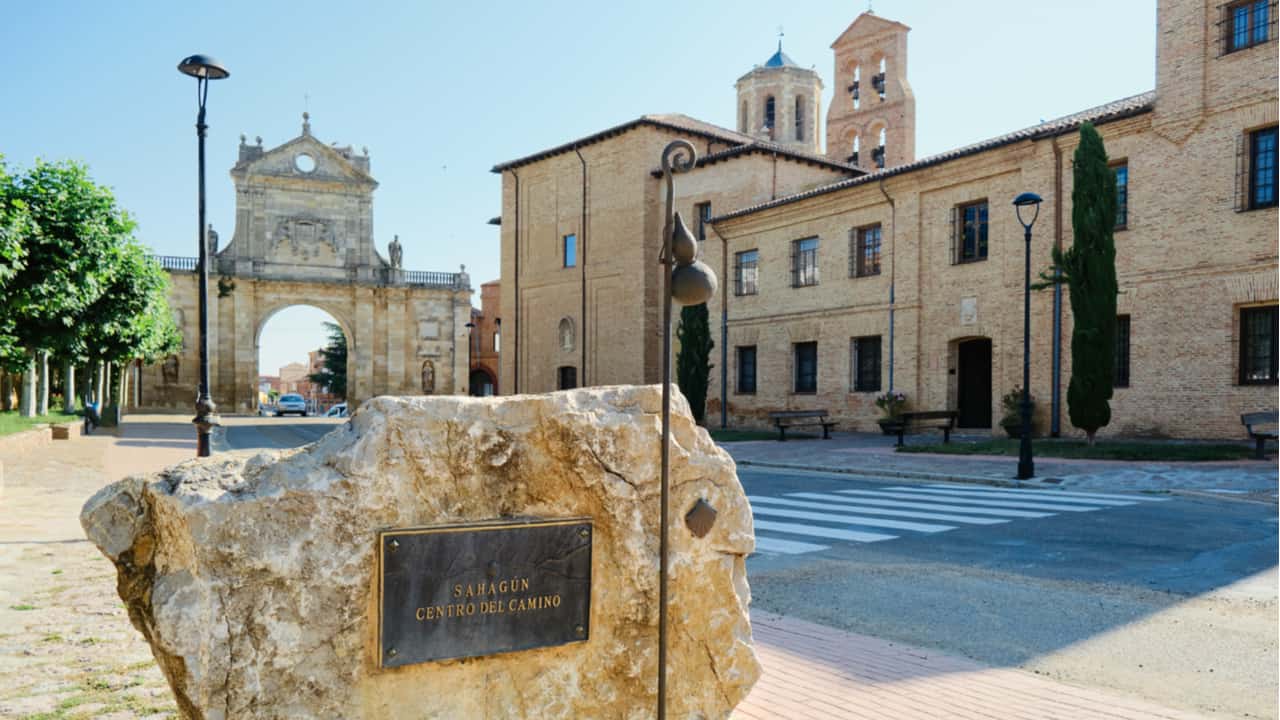
You smell Sahagún before you see much of it. Bread from a bakery somewhere off the main street, a faint tang of farmland on the wind, the dry warmth of brick that has been baking in the Meseta sun for the better part of a thousand years. After days of long, level walking, the town arrives the way most things on this stretch arrive: slowly, and then suddenly underfoot.
It is a small, dusty market town of fewer than three thousand residents, and yet it carries more weight on the Camino Francés than its size suggests. This is the rough halfway point of the French Way, the place where the Camino Madrid slips in from the south, and a town that once grew rich on the simple fact of pilgrims passing through. I want to walk you through what to see, where to sleep, and what the road out of here toward León actually feels like.
Why do pilgrims stop in Sahagún on the Camino Francés?
Sahagún sits in the heart of the Meseta, the high plateau that defines the middle third of the camino de santiago. For most walkers it lands as a logical stage break, a comma in a long sentence of flat, open days. You arrive with tired feet and the particular tiredness that the plateau breeds, which is less about the body and more about the eye running out of things to look at.
It is also a junction, and that matters. This is where the Camino Madrid joins the Camino Francés from the south, funnelling pilgrims who chose to start their walk in the capital rather than the Pyrenees. If you want to understand that southern approach in detail, our guide to the Camino de Madrid from Madrid to Sahagún covers its stages and quieter character.
Most of all, Sahagún is a good place to rest, resupply, and reset. There is something about reaching the official middle of a long pilgrimage that loosens the shoulders. Half the distance behind you, half ahead. A quick snapshot of the town tells the story: a population under three thousand, but a Camino importance that has outlasted kings.
- A natural stage break across the long, open Meseta walking days
- The point where the Camino Madrid meets the Camino Francés from the south
- A working market town with year-round pilgrim services and shops
- The traditional halfway marker of the full Camino Francés
- A quiet, reflective place to gather yourself before the push to León
Where is Sahagún and how do you get there?
Sahagún lies in the Province of León, within the wider region of Castile and León, on the Meseta stretch of the Camino Francés. It sits between Carrión de los Condes to the east and the city of León to the west, roughly in the long middle section of the route across northern Spain.
If you are travelling from the United States, you are almost certainly flying into Madrid or Barcelona first. From there the connections toward León province are straightforward, though they take a little patience. The table below sketches the common arrival pathways without pretending every train and bus runs to the same timetable, because they do not, and seasons change things.
|
From |
How pilgrims usually travel |
Notes |
|
Madrid airport |
Train or bus toward León, alighting at Sahagún |
Sahagún sits on the main León rail line; check current schedules before you commit |
|
Barcelona airport |
Onward flight or long-distance train to León, then local connection |
Slower than Madrid; better if your flights route through Catalonia |
|
León city |
Short regional train or bus back east to Sahagún |
Useful if you fly into León or want to start your camino mid-route |
|
On foot |
Walking in from Carrión de los Condes or El Burgo Ranero |
The traditional arrival, and the one your legs will remember |
Once you are in town, the Camino itself is easy to find. The waymarking through Sahagún follows the familiar yellow arrows and scallop shells, threading past the old churches and over the river. Pilgrims typically enter from the east near the railway, pass through the centre, and leave westward across the Puente del Canto on the road toward León. If you are starting a section here rather than passing through, give yourself an evening to find the route markers in daylight so the morning is not a guessing game.
What is the history of Sahagún on the Camino Francés?
Sahagún grew quickly from the 11th century, and it grew on the back of two things: the pilgrims who passed through, and the farmland that surrounded it. Bodies needed feeding, feet needed shoeing, and the wheat of the Meseta turned a religious waypoint into a genuine economic hub. For a few centuries this dusty town punched well above its weight.
Much of that wealth flowed through the Abbey of San Benito. At its height the Abbey was said to control a network of monasteries, with sources commonly citing more than ninety houses under its influence. Its power came partly from land, and the way it acquired that land was not always gentle; records describe holdings passing to the Abbey from farmers who had fallen into debt. Famed Spanish King Alfonso VI favoured the monastery, and his patronage helped make it one of the most powerful religious institutions in the kingdom.
Why does this matter to you, soaked in sweat and thinking mostly about your socks? Because it changes how you read the place. Old guidebooks still spell the town Sahagun without the accent, and that plain spelling suits it: this is not simply a stopover on the Camino Frances that happens to fall halfway along the Meseta. It is a faded capital of sorts, a reminder that the Camino was once a flow of money and power as much as faith.
What are the best things to see in Sahagún as a pilgrim?
The thing pilgrims come to look at, more than any single church, is the brickwork. Sahagún is one of the great homes of Mudejar architecture on the Camino, the brick Mudejar style of building that blends Moorish design with Christian church plans. Where other towns reach for stone, Sahagún builds in warm red brick, with blind arcading and patterned courses that catch the low light beautifully.
Go early or late if you can. The midday Meseta sun flattens everything, but in the soft light of morning or the hour before dusk the brick glows and the patterns stand out. It is a quieter kind of beauty than a Gothic cathedral, and it rewards the pilgrim who slows down to notice it.
Which churches and landmarks are worth visiting in Sahagún?
You do not need long here, but a handful of sites are worth the detour off the route. The Church of San Lorenzo is one of the most striking examples of Mudejar brickwork in the town, its tower a layered confection of arches. The Church of San Tirso, slightly older and much restored, shows the same tradition in an earlier form, and is often the first major Mudejar building pilgrims meet on the way in.
The Monasterio Real de San Benito carries the memory of the Abbey that once ran the town, though much of the medieval complex is long gone; what survives gives a sense of scale rather than splendour. The Puente del Canto, the long bridge on the western edge, is where most pilgrims pause for a photograph before walking out toward El Burgo Ranero and León.
- Church of San Lorenzo, for the finest Mudejar tower in town
- Church of San Tirso, the older brick church near the eastern approach
- Monasterio Real de San Benito, remnants of the once-mighty Abbey of San Benito
- Puente del Canto, the western bridge and traditional photo stop
- The Santuario de la Virgen Peregrina, home of the halfway certificate
If you only have sixty to ninety minutes, a tight loop works well: walk in past San Tirso, cut to San Lorenzo for the brickwork, take in whatever is open at San Benito, then drift toward the Santuario before crossing the Puente del Canto on your way out. It is a small town, and the key sites cluster close.
How do you get a halfway Compostela in Sahagún?
Here is the small ritual that draws many walkers to pause in Sahagún: the halfway certificate, often called the Carta Peregrina. It marks the rough midpoint of the full Camino Francés, the moment you can honestly say you have walked as far as you still have to go. It is commemorative rather than official, but on a long pilgrimage the commemorative things tend to matter more than the official ones.
The certificate is issued at the Santuario de la Virgen Peregrina, the hermitage of the Virgen on the southern edge of town. Bring your credential, the pilgrim passport you have been filling with stamps since you started your camino, because the stamp from here is half the point. The process is simple: you show your credential, you receive the certificate, and you carry on. To understand where this credential fits in the wider scheme of things, our guide on where to get a pilgrim passport for the Camino de Santiago explains how the document works from start to finish.
A word of honesty: opening hours can be seasonal and a little unpredictable, the way small religious sites on the Camino often are. If the Santuario is shut when you pass, it is no disaster. The Compostela that counts is the one you collect in Santiago de Compostela at the end. This halfway one is a souvenir of momentum, a little flag planted in the middle of the plateau to say you have come this far.
|
Certificate |
Where you get it |
What it marks |
|
Halfway Carta Peregrina |
Santuario de la Virgen Peregrina, Sahagún |
The midpoint of the full Camino Francés; commemorative |
|
The Compostela |
Pilgrim’s Office, Santiago de Compostela |
Completion of at least the final 100km on foot; official |
Where should you stay in Sahagún: albergues and pilgrim accommodations
Several albergues serve walkers in Sahagún year round, which is part of why the town works so well as a stop for pilgrims. You will find the usual Camino spread, from a municipal-style public albergue to private albergues, plus a handful of hostales and pensiones for nights when a dormitory feels like one bunk too many.
The choice tends to come down to mood and budget. A municipal or donation-based albergue gives you the full communal experience, the murmur of many languages at lights-out and the dawn chorus of zips and rustling. A private albergue or small pension buys you quiet, a door that closes, and sometimes a proper bed. After a long stretch of meseta, the second option starts to look very tempting.
What amenities should pilgrims look for in Sahagún lodging?
Most pilgrim accommodation along the Camino offers a similar core of comforts, and Sahagún is no exception. Before you commit to a bed, it is worth checking for the practical things that make the difference between a restful night and a fretful one.
- Laundry facilities or at least somewhere to wash and dry kit
- Kitchen access, or a nearby place serving a pilgrim menu in the evening
- Secure storage for packs and luggage, and bike storage if you are cycling
- Reasonable quiet hours, which matter more than you think on a rest night
- Proximity to the route, a pharmacy, a grocery shop, and a café for the morning
On timing: for much of the year you can walk up and find a bed without booking, which is the old rhythm of the Camino and part of its charm. In the busy months of late spring and early autumn, and especially around holy years, it is wiser to reserve ahead, particularly if you want a private room. Sahagún is rarely as pressured as Sarria or the last hundred kilometres, but a hot July afternoon with every pilgrim chasing the same shade can still fill the better beds quickly.
What is it like to walk from Sahagún to León across the Meseta?
The stage out of Sahagún is a classic piece of Meseta walking, and the Sahagún to León direction is one of the most walked sections of the camino in this part of Spain. It is flat, it is open, and it asks a particular kind of patience. The path runs long and straight, the horizon stays politely where it is, and the sky does most of the heavy lifting in terms of drama.
Common intermediate stops break the distance into manageable goals. El Burgo Ranero and Reliegos are typical resting points, and Mansilla de las Mulas makes a natural last stop before the city itself. From Mansilla the route closes the final stretch into León, and our guide to walking from Mansilla de las Mulas to León covers that last leg in detail.
People warn you about the meseta, and they are half right. The flatness and the exposure to sun and wind are real, and the long straight paths can grind on the spirit if you let them. But many pilgrims come to love this section precisely for what it lacks. There is little to distract you, so the walking turns inward; the solitude and the plain rhythm of footfall become the point rather than the price. If you want to understand that mindset before you reach it, the guide to walking the Meseta on the Camino Francés is worth reading.
What practical advice helps for the Sahagún area of the Meseta?
The practical demands here are about exposure rather than gradient. Towns can be spaced widely, shade is scarce, and the same flat path that soothes your mind will burn the back of your neck if you are careless. A little planning makes the difference.
- Carry enough water, since the gaps between villages can be long and fountains unreliable
- Start early in summer to walk the cool hours and dodge the worst midday heat
- Pack sun protection and a layer for the wind, which can be sharp even on warm days
- Mind your feet, because long flat stretches encourage a steady, blister-friendly pounding
- Break each long day into smaller goals: the next village, the next bench, the next coffee
Pace strategy is everything on this part of the camino de santiago route. Rather than fixing your eyes on León thirty or more kilometres away, walk to the next named place, sit for ten minutes, then choose the one after that. The plateau punishes ambition and rewards a plodding, almost stubborn rhythm. Section by section, the city arrives.
When is the best time to visit Sahagún on the Camino Francés?
The Meseta has opinions about the seasons, and Sahagún wears them plainly. Spring and autumn are the comfortable choices, with mild days, manageable nights, and the plateau at its most forgiving. These are also the busy months, so beds fill faster and the albergues hum with company, which you may want or may not.
Summer is the hard season here. The Meseta bakes, shade is rare, and the long open stretches that feel meditative in May feel punishing in July and August. Winter swings the other way: cold, sometimes bitter wind, short daylight, and fewer services open, but a stillness and solitude that some pilgrims travel a long way to find.
|
Season |
Conditions on the Meseta |
Who it suits |
|
Spring (Apr to Jun) |
Mild, green edges, busier paths |
Most pilgrims; good balance of weather and company |
|
Summer (Jul to Aug) |
Hot, exposed, little shade |
Early risers who can handle heat and crowds |
|
Autumn (Sep to Oct) |
Warm days, cooler nights, harvest light |
Those wanting comfort with slightly thinner crowds |
|
Winter (Nov to Mar) |
Cold, windy, some services closed |
Experienced pilgrims seeking solitude |
In the end, the best time depends on what you are chasing. If you want weather comfort and a social camino, aim for spring or autumn. If you want emptiness and silence on the plateau, and you do not mind the cold, winter has a strange beauty that the busy months never touch.
How does Sahagún fit into the wider Camino Francés?
It helps to zoom out. The Camino Francés runs roughly 780 kilometres from Saint-Jean-Pied-de-Port across the Pyrenees and northern Spain to Santiago de Compostela, passing through Pamplona, Burgos, and León along the way. Sahagún sits near the centre of that line, on the Meseta, which is itself the central act of the whole journey.
Plenty of pilgrims walk the entire camino in one go, from the crossing of the Pyrenees to the city of Santiago. Others walk it in sections over several years, and Sahagún makes a sensible hinge for that kind of plan, a place to stop one year and start the next. If you are still mapping out the full route, our guide to the Camino Francés pilgrimage in Spain lays out the stages from the French border to Galicia.
However you reach it, Sahagún occupies a quiet, important place in the story. It is the town where you cross from the first half of your camino experience into the second, where the Camino Madrid adds its travellers to the flow, and where, brick by warm red brick, the Meseta reminds you that the plainest stretches of the road can be the ones that change you most.
Frequently asked questions about Sahagún on the Camino Francés
Is Sahagún a good place to rest during the Meseta?
Yes, and it is one of the better ones. Sahagún offers year-round pilgrim services, a range of lodging from municipal albergues to private rooms, shops to resupply, and the psychological lift of reaching the halfway point. After long open days on the plateau, it is a sensible place to slow down, do laundry, eat well, and reset before the stage toward León.
Where does the Camino Madrid join the Camino Francés?
The Camino Madrid joins the Camino Francés at Sahagún, arriving from the south. Pilgrims who began their walk in Madrid merge here into the main French Way, which is one reason the town has long been an important junction on the route across northern Spain.
Can you really get a halfway Compostela in Sahagún?
You can. The halfway certificate, sometimes called the Carta Peregrina, is issued at the Santuario de la Virgen Peregrina. Bring your credential so it can be stamped. It is commemorative rather than the official Compostela, which you collect at the Pilgrim’s Office in Santiago de Compostela, but it is a popular and meaningful marker of reaching the midpoint of the Camino Francés.
What are the top sights in Sahagún if I only have a short stop?
Prioritise the Mudejar brickwork. The Church of San Lorenzo and the Church of San Tirso are the standout examples, the Monasterio Real de San Benito carries the memory of the old Abbey, and the Puente del Canto is the traditional photo stop on the way out. A quick loop linking these takes about an hour and shows the best of the town.
Are albergues in Sahagún open year-round?
Several albergues in Sahagún serve pilgrims throughout the year, which makes the town a reliable stop even outside the main season. That said, individual opening hours and which places are running can vary in winter, so it is worth checking current information before you arrive if you are walking in the colder months.


