I came down off the high ground above O Cebreiro with wet socks and an opinion about Galicia I would later have to revise. The opinion was that it rained here for sport. Triacastela proved me half right and half wrong, which is about the best a pilgrim can hope for on any given afternoon.
The town sits low in a green fold of the province of Lugo, a little huddle of grey stone and slate roofs with the smell of woodsmoke hanging over it. By the time most walkers arrive, legs are heavy from the long descent off the mountain and the only question that matters is where the next bed is. Triacastela answers that question kindly. It is small, it is old, and it asks nothing of you except that you decide, before morning, which way you mean to leave.
What is Triacastela, and why do Camino pilgrims stop here?
Triacastela is a small ninth century town of roughly 700 inhabitants on the Camino Francés, set in the eastern hills of Galicia where the path drops out of the mountains toward the river valleys. The name means "three castles," and there is a quiet joke in that: the three castles no longer exist. You will not find a single rampart. What survives is the coat of arms, the three towers stamped onto the town's shield, a memory of fortifications that may never have stood quite the way the legend insists they did.
Pilgrims stop here for plain reasons. After the climb to O Cebreiro and the rolling high ground that follows, the body wants rest, and Triacastela offers it. There is food, there is water, there are beds in a range of styles, and there is the small ceremony of getting your credencial stamped before you sleep. It is also a decision point, which matters more than it sounds. From Triacastela the Camino splits into two onward routes to Sarria, and the choice you make over breakfast shapes the whole of your next day.
If you are coming from the United States and used to the idea that a town will have something open whenever you turn up, recalibrate now. Services are real but modest. Kitchens close early. The mini-market keeps its own hours, and Sunday is Sunday. None of this is a problem if you plan a little ahead, and all of it becomes a problem if you do not.
What are the best things to see in Triacastela?
You will not need a full day here, and most pilgrims do not have one to spare. A slow loop of twenty minutes covers the essentials. The town is built along one main thoroughfare, and the highlights sit close to the path you are already walking.
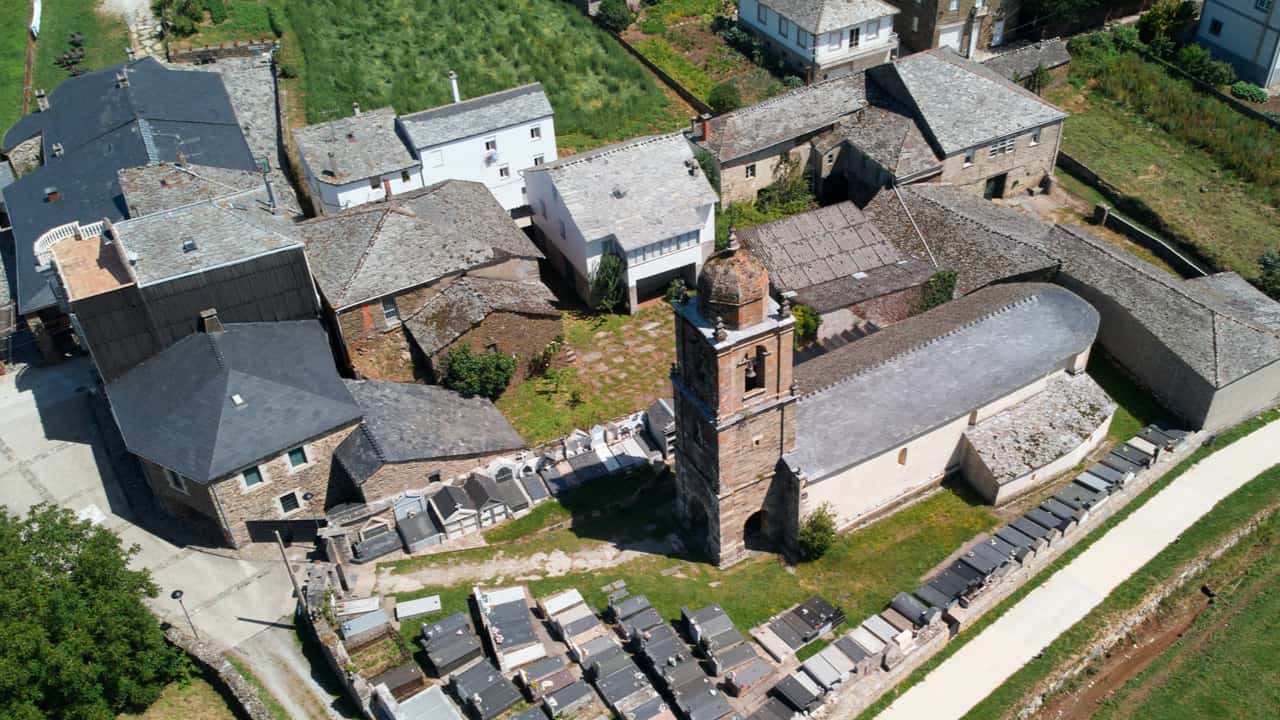
The clear landmark is the Church of Santiago, an 18th century building whose tower carries the town's three castles on its stonework, the same emblem as the coat of arms. It is not a grand cathedral and does not pretend to be. It is the kind of small Romanesque-rooted parish church you find threaded all along the French Way, often written simply as the Camino Frances, the sort that has heard a great many tired prayers and is unbothered by your muddy boots.
For a short stroll with limited time, look for:
- The Church of Santiago and its tower with the three castles emblem
- The main street, where most albergues, bars, and shops cluster within a few minutes' walk
- The old pilgrim stone where, by tradition, walkers once collected limestone to carry toward the kilns near Castañeda, a small ritual of contribution to Santiago de Compostela's cathedral
- Quiet spots at the edge of the village where the chestnut trees give way to pasture, good for a photo when the light comes through after rain
That limestone tradition belongs to the older history of the Jacobean pilgrimage, and it is worth a moment's thought as you pass. Pilgrims walking to the tomb of the apostle Saint James once carried stone this far to feed the lime kilns that helped build the cathedral. You arrive carrying nothing but your own weight and your washing, which is its own kind of progress.
What practical services can you find in Triacastela?
Triacastela punches a little above its size when it comes to pilgrim services, mostly because so many walkers pass through. You will find the basics, though not in abundance, and not at all hours. Treat the table below as a planning sketch rather than a promise, because small-town opening times shift with the season and the owner's mood.
|
Service |
What to expect in Triacastela |
Pilgrim tip |
|
Albergues and lodging |
Several albergues plus pensions and small hotels |
Arrive early in peak months; book ahead if you want a private room |
|
Food and drink |
Restaurants, bars, and cafés along the main street |
Pilgrim dinners often start around 7pm to 8pm; lunch service can end mid afternoon |
|
Water |
Fountains and taps in town |
Fill completely before leaving; refills are scarce on both onward routes |
|
Shops |
Small mini-market and basic supplies |
Buy snacks the night before; do not count on Sunday openings |
|
Pharmacy and ATM |
Basic provision in or near the centre |
Carry some cash; not every bar takes cards reliably |
|
Connectivity |
Mobile signal generally workable |
Download offline maps before you climb out of the valley |
The one service that catches people out is water. In town it is easy. Out on the trail it is not. Both routes toward Sarria run through thin country with long gaps between anywhere that sells you a coffee, so the sensible move is to top up every bottle before you leave and carry more than feels necessary. I have rationed warm water out of a half-empty bottle on a hot Galician morning and resented every sip. Do not be me.
Where should you eat and drink in Triacastela?
What most pilgrims want here is simple and reliable: a menú del peregrino in the evening, an early coffee before the climb, and somewhere to refuel without fuss. Triacastela delivers all three, in the unhurried Galician manner where nobody is in a rush except you.
The pilgrim menu is the backbone of the evening. It is usually three courses with bread and a drink for a fixed price, often somewhere around 10 to 15 euros depending on the place, though prices drift and I would rather you check than quote me as gospel. Expect hearty rather than refined. This is walking food: soup, a meat or fish main, something sweet, and wine that does its job without applying for awards.
For the next morning, the practical points are these:
- Find out the night before what time your bar opens, because an early start beats the heat and the crowds
- If you mean to leave before the first café fires up its coffee machine, buy breakfast supplies in advance
- Pack out water, snacks, a piece of fruit, and anything salty; services are sparse until you are well along the route
- If you are tackling the shorter, steeper line, fuel properly before the climb rather than hoping for a café that may not appear
Galician cooking earns its reputation along here. If you find caldo gallego, the green broth of greens, potato, and white beans, order it. After a wet day it lands like a small mercy. The region also runs heavily on chestnut in its older recipes, a reminder that the chestnut trees crowding the lanes were once food as much as scenery.
Where can you sleep in Triacastela: albergues, hostels, and hotels?
For such a small village, Triacastela offers a decent spread of places to sleep, which is one reason it works so well as a staging post. The range runs from municipal and private albergues with dormitory bunks through to private rooms in pensions and a few small hotels.
Dormitory beds in an albergue or hostel are the cheap, sociable, slightly chaotic option, typically in the region of 10 to 15 euros for a bunk, shared bathrooms, and the familiar dawn chorus of zips and headtorches. Private rooms in a pension or small hotel cost more, perhaps 35 to 60 euros depending on season and standard, and buy you a door that closes and, sometimes, a bathroom of your own. Treat those figures as rough guidance rather than a fixed tariff.
A few things American walkers tend to ask about, answered plainly:
- Private rooms exist here, so you are not forced into a dorm if dorms are not your thing
- In the busy months, beds fill through the afternoon; arriving by early afternoon is the safest play
- Check-in windows can be narrow, and some places lock the doors at night, so do not roll in at midnight expecting a welcome
- If you walk as a group or want private bathrooms, reserve ahead rather than gambling on the day
The rule of thumb is honest and dull: in spring and autumn you can often wing it, in high summer you should not. The Camino after Sarria gets busier, and Triacastela is the last quiet-ish night before that shift, so an easy bed here is worth a little planning.
Which route from Triacastela to Sarria: via Samos or the northern route?
This is the real decision of Triacastela, and you should make it the night before rather than at a fork in the dark. Leaving town, the Camino Francés splits into two distinct ways to Sarria, and they offer genuinely different days.
The longer way runs south through Samos, home to one of the oldest and largest monasteries in the Western world. It adds distance but trades it for calm, river company, and the great Benedictine pile of the Monastery of Samos sitting in its hollow like something dreamed up for the purpose. The shorter way climbs north over higher ground by San Xil, steeper underfoot but quicker on the clock, threading small hamlets and chestnut woods.
|
Feature |
Via Samos (southern) |
Via San Xil (northern) |
|
Character |
Longer, quieter, river valley |
Shorter, steeper early climb |
|
Headline sight |
Monastery of Samos |
Higher ground, chestnut woods, hamlets |
|
Roughly suits |
Those wanting tranquillity and history |
Strong walkers on a tighter schedule |
|
Main demand |
More kilometres on the legs |
A demanding ascent out of the valley |
|
Shared warning |
Food and water scarce between points |
Food and water scarce between points |
Choose by what you value tomorrow. If you want a slow, reflective day and do not mind extra kilometres, take Samos and give yourself time to stand in the cool of the monastery church. If you are tired of crowds, short on days, or simply happier getting the walking done, the northern San Xil variant is your friend, steep start and all. Heat and rain tip the balance too: the higher route is exposed, the Samos route keeps more company with shade and water.
Whichever you pick, the warning is the same and it is not optional. Both lines run thin on services. Leave Triacastela watered and fed.
How does the via Samos stage break down for walkers?
The Samos route loosely strings together a sequence of small places that serve mainly as wayfinding rather than rest stops. After leaving town you drop toward the valley and pass hamlets such as San Cristovo do Real, Renche, and Lastres before the path leads you in toward the monastery and the village around it. Beyond Samos the way continues through small settlements like Teiguín, Gorolfe, and Sivil, picking up toward Sarria.
What to keep in mind on this stage:
- Most intermediate villages have little or nothing open, so do not bank on them for food
- Sunday closures can leave you walking past shuttered bars all morning
- An early start gives you cooler walking and a better chance of services later being awake by the time you reach them
- The yellow arrows are reliable here, but a downloaded map saves stress where the way braids through farmland
What is the walk from Triacastela to Sarria like, and how long does it take?
The honest answer is that it depends on your route and your pace. The Samos line is the longer of the two and will take most walkers the better part of a full morning into early afternoon; the northern San Xil variant is shorter but front-loads a real climb. Both deliver you to Sarria in a single day's walk without heroics.
Terrain is classic eastern Galicia. You move through rolling countryside, sunken green lanes, oak and chestnut woods, with the steeper effort concentrated near the start on the northern route. The ground holds water, so after rain expect mud, slick stone, and the particular Galician fog that turns a familiar lane into something out of a story. In high summer the open stretches bake, which is one more vote for an early departure.
On navigation, a few grounded points:
- Yellow arrows and the official waymarks carry you the whole way; trust them and double-check at junctions where two routes diverge
- People tend to break wherever a bar appears rather than where they planned to, because bars are not where you want them
- Do not rely on frequent cafés; the gaps between them are the whole reason for the water warning
- A kilometer marker count down toward Santiago de Compostela begins to feel meaningful around here, and the famous 100 kilometers stone waits a little further on near Sarria
There is a particular pleasure to this section that is hard to name. It is the last stretch of the Camino Francés that still feels like the quieter days behind you, before the character of the walk changes. Savour it. The path is about to get a lot more crowded.
What changes after Sarria, and why does the Camino feel different?
Sarria is where the Camino Francés quietly becomes a different walk. The reason is simple arithmetic. To earn the Compostela, the certificate of completion issued in Santiago, a pilgrim must walk at least the final 100 kilometers, and Sarria sits just past that line. So Sarria is where thousands of new walkers begin each year, fresh-legged and loud and lovely, and the trail fills up.
This is not a complaint, though tired long-distance walkers sometimes make it sound like one. The newcomers are pilgrims too, every bit as much as someone who started in the Pyrenees. But the feel shifts, and it is worth knowing before it surprises you.
What changes in practice:
- More people on the path, a more social and sometimes noisier atmosphere, larger groups
- More services, more cafés, more places to stamp your credencial, which is the upside of the crowds
- More competition for beds, especially in the popular stages toward Santiago
- A faster turnover of faces; the Camino family you built over weeks gives way to a busier, looser crowd
If you value quiet days, the answer is the same one Triacastela already taught you. Start early, before the new starters are laced up, and consider booking ahead through the final stretch. The walk into Santiago is wonderful regardless. It is just no longer a secret, and Sarria is where that becomes obvious.
Triacastela on the Camino Francés: a practical recap
Strip away the history and the chestnut woods and the rain, and Triacastela does one job supremely well. It is the last good, calm staging post before the Camino changes character at Sarria, a place to eat, sleep, and choose your road. Decide your route the night before, fill your water, and walk out early.
For wider planning, it helps to see where this fits in the bigger picture of the route. Our complete guide to the Camino Francés pilgrimage sets out the full path from the Pyrenees to Santiago de Compostela, while the descent into this valley begins on the high ground covered in the guide to O Cebreiro and the climb into Galicia. Once you are past Triacastela, the next pages of the story open up in Sarria and the start of the final stage. If the food has caught your interest, the round-up of the most delicious Galician dishes is a happy detour, and anyone still sorting paperwork should read where to get a pilgrim passport for the Camino before they set out.
FAQ: What pilgrims ask most about Triacastela
Is Triacastela a good place to stay the night before walking to Sarria?
Yes. Triacastela has solid pilgrim services and a good spread of lodging, from albergue dorm beds to private rooms, which makes it a natural staging point. It also sits right at the fork where the Camino splits toward Sarria, so it is the logical place to rest, resupply, and decide your route before either the Samos or the northern path.
Do I need to carry extra water and food when leaving Triacastela?
Yes, and this is the single most repeated piece of advice for this stage. Both the Samos route and the northern San Xil variant run through quiet country with long gaps between open bars and reliable taps. Fill every bottle in town and pack snacks the night before, because waiting until you need water out on the trail is leaving it too late.
Which route from Triacastela is better, Samos or the northern route?
It depends on what you want from the day. The route via Samos is longer and quieter and rewards you with the great Monastery of Samos and easier, shadier walking. The northern route by San Xil is shorter but starts with a steep climb, which suits stronger walkers or anyone on a tight schedule. Neither is wrong; pick by your legs, your time, and the weather.
How crowded will the Camino be after Sarria?
Noticeably busier. Sarria is just past the 100 kilometers mark needed for the Compostela, so it is where large numbers of pilgrims begin their walk to Santiago each year. Expect more people, more cafés, and stronger competition for beds, especially in summer. Starting early and booking ahead helps if you prefer quieter walking.
Can I find private rooms rather than dorms in Triacastela?
Yes. Alongside the albergues with dormitory bunks, Triacastela has pensions and small hotels offering private rooms, and a few albergues keep a limited number of private rooms too. If you want a door that closes or a private bathroom, especially in the busy months, reserve ahead rather than relying on availability when you arrive.


