What Are You Hoping to Find on the Camino de Santiago, and What If It's Not What You Expect?
Here's the thing nobody tells you before you walk the Camino de Santiago: the most significant thing you find might not be what you went looking for. You pack your boots. You tape your heels. You memorise the elevation profile of the Pyrenees crossing and worry about whether your rain jacket is waterproof enough. You think about blisters, about solitude, about whether you'll have the stamina to walk five hundred miles. You don't think, particularly, about falling in love.
Leslie Gilmour didn't. When he set out on the Camino Francés, he was a solo traveller with low social expectations. Not antisocial, just not seeking anything beyond the walk itself. He wanted the quiet. The simplicity. The change of pace. He certainly wasn't looking for a soulmate.
But pilgrimage has a way of rearranging your plans. The Camino's social rhythm, its communal meals and shared dormitories and long hours of walking with strangers who stop being strangers somewhere around day three, creates conditions that would be almost impossible to replicate in ordinary life. Walls come down. Self-consciousness fades. You become, somehow, more yourself than you've been in years.
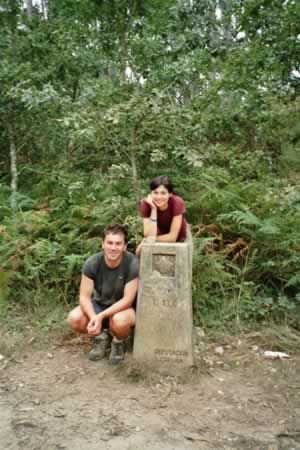
For Leslie, that meant meeting Anna at a communal albergue dinner, walking together through the final stages to Santiago de Compostela, and arriving hand in hand. Twelve years later, they have a child. This is the story of how that happened, and what the Camino taught both of them about patience, flexibility, and the kind of love that outlasts the trail.
What Is It About the Camino de Santiago That Makes Chance Encounters So Common?
Most long-distance walks are solitary by design. The Appalachian Trail is vast. The Pacific Crest Trail spreads hikers thin. But the Camino de Santiago operates differently. Over 400,000 pilgrims received a Compostela certificate in 2024, according to the Oficina del Peregrino, and while they don't all walk the same route or start on the same day, the effect is a steady, companionable flow of people moving in the same direction, at roughly the same pace, toward the same town called Santiago.
You keep crossing paths with the same faces. The woman with the red bandana who left the albergue twenty minutes before you. The retired teacher from Burgos who always stops for a second coffee. The couple from Seoul who somehow manage to look elegant despite the dust. The Camino's daily cadence, similar start times, limited albergue options, shared cafés and rest stops, means you see the same people again and again without ever arranging to.
This is where the magic happens, if we're allowed to call it that. The trail creates a kind of social permission that doesn't exist in everyday life:
- Shared effort breaks barriers. When you've both just climbed the same hill in the same rain, conversation starts easily.
- No job titles, no curated personas. Nobody asks what you do for a living on the Camino. They ask how your feet are.
- Communal spaces encourage connection. Albergues, pilgrim dinners, laundry lines, the bench outside the pharmacy where everyone waits for blister plasters: these are natural gathering points.
- Repeated encounters build trust. You don't just meet someone once. You see them in Pamplona, again in Burgos, again on the Meseta. Each meeting deepens the familiarity.
- The "Camino family" forms organically. Small groups coalesce without anyone deciding it. You walk together. You eat together. You look out for each other.
Being alone on the Camino doesn't mean being isolated. Many pilgrims walk solo precisely because it makes them more approachable, more open to the kind of spontaneous connection that rigid travel plans prevent. You're free to fall into step with someone for an hour, share your water, and then walk in different directions at the next fork. Or not.
How Did Leslie Go From Walking Alone to Feeling Fully Part of the Camino Community?
The first few days are the strangest. You're adjusting to the weight of the pack, the rhythm of your stride, the odd reality that your only job today is to walk. Leslie described his early mindset as observational. He watched the trail community form around him, noticed the small interactions, the way fellow pilgrims would nod and say "Buen Camino" as they passed, the way someone always seemed to have ibuprofen when you needed it.
He wasn't trying to be social. He didn't need to be. The Camino did the work.
|
Day on the Trail |
What Typically Happens Socially |
|
Days 1 to 3 |
Polite greetings, brief exchanges at rest stops, sizing up your fellow pilgrims from a distance |
|
Days 4 to 7 |
Recognising faces, first proper conversations over shared meals, early bonds forming |
|
Days 8 to 14 |
Walking companions emerge, inside jokes develop, sharing stories becomes natural |
|
Days 14 onward |
Deep trust, vulnerability, the Camino family is real and you're in it |
The surprising relief, Leslie found, was letting go of self-consciousness. No performance required. No LinkedIn profile walking beside you. Just simpler priorities: food, rest, feet, weather. When your concerns shrink to that scale, something loosens. Small talk turns meaningful quickly when you're walking for hours with nothing to distract from the conversation, or from the silence between conversations. And the silence matters too. Walking beside someone without speaking and feeling comfortable doing so is its own kind of intimacy.
Where Do Camino Love Stories Actually Begin, and How Did Leslie Meet Anna?
If you imagine love on the Camino starting with a dramatic encounter on a misty mountain pass, the reality is more like this: a long table, a shared meal, tired legs, and someone who makes you laugh when you didn't expect to.
Leslie met Anna at a communal albergue dinner. The kind where you sit elbow to elbow with people you didn't choose, eating whatever the hospitalero made, passing bread and wine and conversation in three languages. He noticed her across the table. She was funny. She was honest. She didn't seem to be performing for anyone. That was enough to spark curiosity.
Communal meals are a catalyst for connection along the Camino because they combine vulnerability and warmth in a way that restaurants never quite manage:
- Everyone is equally tired, equally grateful, equally uncertain about tomorrow.
- The food is simple and shared. Passing a dish to someone is a small act of care.
- Conversation flows without agenda. Nobody is networking. Nobody is on a date. The pressure is zero.
- Sangria helps, occasionally.
Love stories from the Camino tend to start in these unremarkable moments. Not grand gestures. A shared laugh. A question asked with genuine interest. The courage to sit next to someone and say nothing important, which is itself quite brave.
What Made the Connection Deepen Over Days Instead of Feeling Like a Vacation Fling?
This is the part that separates Camino love from a holiday romance. You can't hide on the Camino. Not for long. You walk together for hours, and in those hours, you run out of small talk and arrive at the real stuff. You learn how someone handles discomfort, whether they get snappy when they're hungry, whether they wait for you when your blister is screaming, whether they share their last piece of chocolate without making it a performance.
Leslie and Anna started walking together, not by arrangement, but by gravitational pull. They'd find each other at breakfast and dinner. They'd fall into step on the trail. And over days, the connection deepened through a series of small, unglamorous acts of care:
- Checking in each morning. Did they still want to walk together? The question was asked honestly, with room for either answer.
- Waiting at the top of a hill. Not because you have to, but because you want to.
- Sharing supplies: tape for a blister, a spare pair of dry socks, half a bocadillo.
- Being honest about fatigue, frustration, and the moments when the Camino felt less like a pilgrimage and more like a slog.
Real compatibility reveals itself through discomfort, not through comfort. Rain, exhaustion, a wrong turn that adds three kilometres, the decision about whether to push on or stop early: these are the tests. And they're far more revealing than any first date in a nice restaurant.
How Did They Become Inseparable, and What Changed in the Final Days to Santiago?
There's a moment on any Camino route when you stop being "two pilgrims who walk near each other" and become "us." Leslie described it as a shift he couldn't pinpoint to a specific day. One morning, they just were. Inseparable. Walking the same rhythm, sharing the same silences, finishing each other's observations about the landscape.
The final ten days to Santiago together were, in Leslie's words, the most emotionally concentrated period of his life. Not because anything dramatic happened, but because everything was heightened by the knowledge that the walk was ending:
- Shared rituals anchored the days. Morning starts in the dark, the first café con leche at whatever bar opened earliest, end-of-day reflections sitting outside the albergue with their boots off.
- The approach to Santiago carried a strange mix of emotions. Excitement and grief, tangled together. The Camino was nearly over. The bubble, that precious, unrepeatable bubble, was about to pop.
- They walked the last kilometres hand in hand. Into the cathedral square. Into the sound of bagpipes. Into the question that every pilgrim faces at the finish: now what?
The highs and lows of those final days, the elation of seeing the cathedral spires, the quiet sadness of saying goodbye to the trail itself, are part of what bonds Camino couples so tightly. You've shared something that most people back home will never fully understand. That shared understanding becomes a foundation.
What Does Holding Onto the Camino Look Like After You Go Home Together?
The Camino bubble is real, and it bursts. You fly home. You return to your job, your flat, your inbox, the dull percussion of routine. The person you fell in love with on a trail in Spain is now someone you text across time zones. The question that hangs in the air is honest and uncomfortable: was this real, or was it the Camino?
For Leslie and Anna, the transition from pilgrimage romance to real life required the same qualities the Camino had taught them. Patience. Flexibility. A willingness to keep showing up even when the scenery was less beautiful.
|
Camino Phase |
Real-Life Equivalent |
|
Walking through rain and discomfort together |
Navigating long distance, different schedules, the logistics of merging two lives |
|
Sharing a dormitory with thirty snoring strangers |
Learning to live together with all the mundane friction that involves |
|
Trusting the yellow arrows when the path seems wrong |
Trusting the relationship when certainty is absent |
|
Arriving in Santiago together |
Building a home, a family, a shared future |
They chose to keep building. That's the key word: chose. Every day, actively. Not because the Camino guaranteed it, but because they'd learned, over 500 miles of walking, that love is actions repeated daily, not a feeling that sustains itself. Twelve years later, they have a child. The leap of faith they took on the trail became the foundation of an ordinary, extraordinary life.
What Did the Camino Teach Leslie About Love, Patience, and Personal Change?
When Leslie talks about what the Camino taught him, he doesn't use words like "transformative." He talks about specifics. Learning to wait. Learning to let a conversation develop at walking pace instead of rushing to a point. Learning that flexibility is not weakness but a form of strength.
The Camino de Santiago teaches patience because it forces it. You cannot rush 780 kilometres. You cannot skip the boring bits. You walk through the Meseta's vast, austere flatness, and it teaches you that not every moment needs to be beautiful or dramatic to be meaningful. Some days are just walking. Some days in a relationship are just Tuesday.
- Patience: Letting the relationship unfold at its own pace, not the pace anxiety demands. Like the Camino itself, love doesn't respond well to forcing the schedule.
- Flexibility: Adapting to each other's needs, moods, and rhythms. Some mornings Anna wanted silence. Some mornings Leslie needed to talk. Neither was wrong.
- Personal change: The Camino stripped away old patterns. The need to control, the fear of vulnerability, the habit of keeping people at a comfortable distance. The journey along the Camino didn't just introduce Leslie to Anna. It introduced him to a version of himself capable of lasting partnership.
- Self-discovery: Before you can love someone well, you need a working relationship with yourself. The Camino's long, quiet hours of walking create space for that relationship to develop.
Love on the Camino, the lasting kind, isn't about finding love in a romantic, cinematic sense. It's about finding that you're capable of it. That's the real self-discovery. That's what you carry home.
How Can You Stay Open to Connection on the Camino Without Forcing a Romance?
If you're reading this and thinking, "Right, I'm booking my flight to Saint-Jean-Pied-de-Port tomorrow," hold on. The Camino is not a dating app with better scenery. The connections that form on the trail, romantic and otherwise, happen precisely because people aren't trying to make them happen. The moment you walk the Camino with an agenda, you've lost the thing that makes it work.
That said, you can create conditions that make genuine connection more likely:
- Choose community-friendly settings. Stay in albergues with communal dinners rather than private hotels. The shared table is where relationships begin. Some pilgrims book a parador for a treat, which is lovely, but the albergue is where the magic lives.
- Walk your own pace, but be socially available. Say hello. Sit at the shared table. Accept the offer of wine. You don't have to be an extrovert; you just have to be present.
- Keep expectations light. Focus on presence, not outcomes. The pilgrim who finds love on the Camino is usually the one who wasn't looking for it.
- Respect boundaries. Yours and others'. Consent matters on the trail as much as anywhere. Let "no" be easy. Let "not today" be perfectly fine. Emotional pace matters as much as walking pace.
- If you're walking as a couple, give each other space. Walk apart for a morning. Have breakfast and dinner together but let the hours between be your own. The Camino can strengthen a relationship, but only if both people have room to breathe.
The American Pilgrims on the Camino community is a good starting point for US readers wanting to connect with others before or after the walk. Many pilgrims find that the Camino family they build on the trail, friends of every nationality and background, becomes one of the most enduring gifts of the experience, whether or not romance is part of it.
FAQ: Common Questions About Finding Love on the Camino de Santiago
Is it normal to meet someone and feel close quickly on the Camino?
Yes, and there's a good reason for it. Shared physical challenge, long hours of conversation, stripped-down routines, and communal living compress the timeline of intimacy. Many pilgrims report feeling closer to their Camino companions after two weeks than to colleagues they've known for years. The important thing is to recognise that "Camino intensity" is real but not always the same as long-term compatibility. Give the connection time to breathe after the walk ends before making life-altering decisions.
Where do people most often connect on the Camino, on the trail or at night?
Both, but the communal spaces after walking tend to be where deeper connections form. Albergues, shared dinners, café stops in the evening, rest days spent exploring a town together. On the trail itself, conversations develop beautifully because there's no pressure to maintain eye contact and nowhere else either of you needs to be. Repeated encounters over multiple days build familiarity and trust that single meetings cannot.
Can Camino relationships actually last once you return to the United States?
They can, but it requires honesty and effort. Long distance is hard. The transition from Camino simplicity to real-life complexity is jarring. What helps: open communication, concrete plans to reunite, and a willingness to accept that your partner outside the Camino bubble will have bad days, boring days, and days when the romance of the trail feels very far away. Not every Camino romance is meant to continue, and that's okay. Some connections are complete in themselves.
Is it better to walk the Camino alone if you're open to meeting someone?
Walking solo does make you more approachable. You're more likely to start conversations, join group dinners, and fall into step with strangers. But walking with a friend doesn't prevent connection either; it just changes the dynamic. For anxious or introverted walkers worried about being alone, know this: the Camino is one of the few places in the world where being alone in a crowd feels safe and natural. You will be welcomed. You just have to show up.
How do you keep a Camino connection healthy and respectful?
The same way you keep any connection healthy. Respect pacing. Don't assume shared walking means shared everything. Let people have space when they need it. Be honest about your feelings without pressuring someone to reciprocate. On a pilgrimage where emotions run high and vulnerability is openly discussed, it's especially important to check in rather than assume. Ask. Listen. And if someone wants to go their separate ways, let them go with grace.
Want More Camino Stories Like This, or Ready to Start Your Own?
Have you experienced a chance encounter on the Camino? Did you fall in love, with another person, with the walk itself, with a version of yourself you didn't know existed? Share your story in the comments below.
- Subscribe to the newsletter for Camino reflections, planning guides, and personal essays from pilgrims who've walked the trail.
- Read next: "Walking the Camino Alone: What It's Really Like," "What Albergue Life Is Really Like," or "How the Camino Changes You After You Return Home."
The Camino de Santiago doesn't promise you anything. Not love, not clarity, not even good weather. But it does promise this: if you walk honestly, with your eyes open and your heart not entirely closed, something will happen that you didn't plan. Whether that something is a person, a realisation, or simply the quiet knowledge that you're stronger than you thought, it will be worth the blisters.
Buen Camino.




Leave a Reply