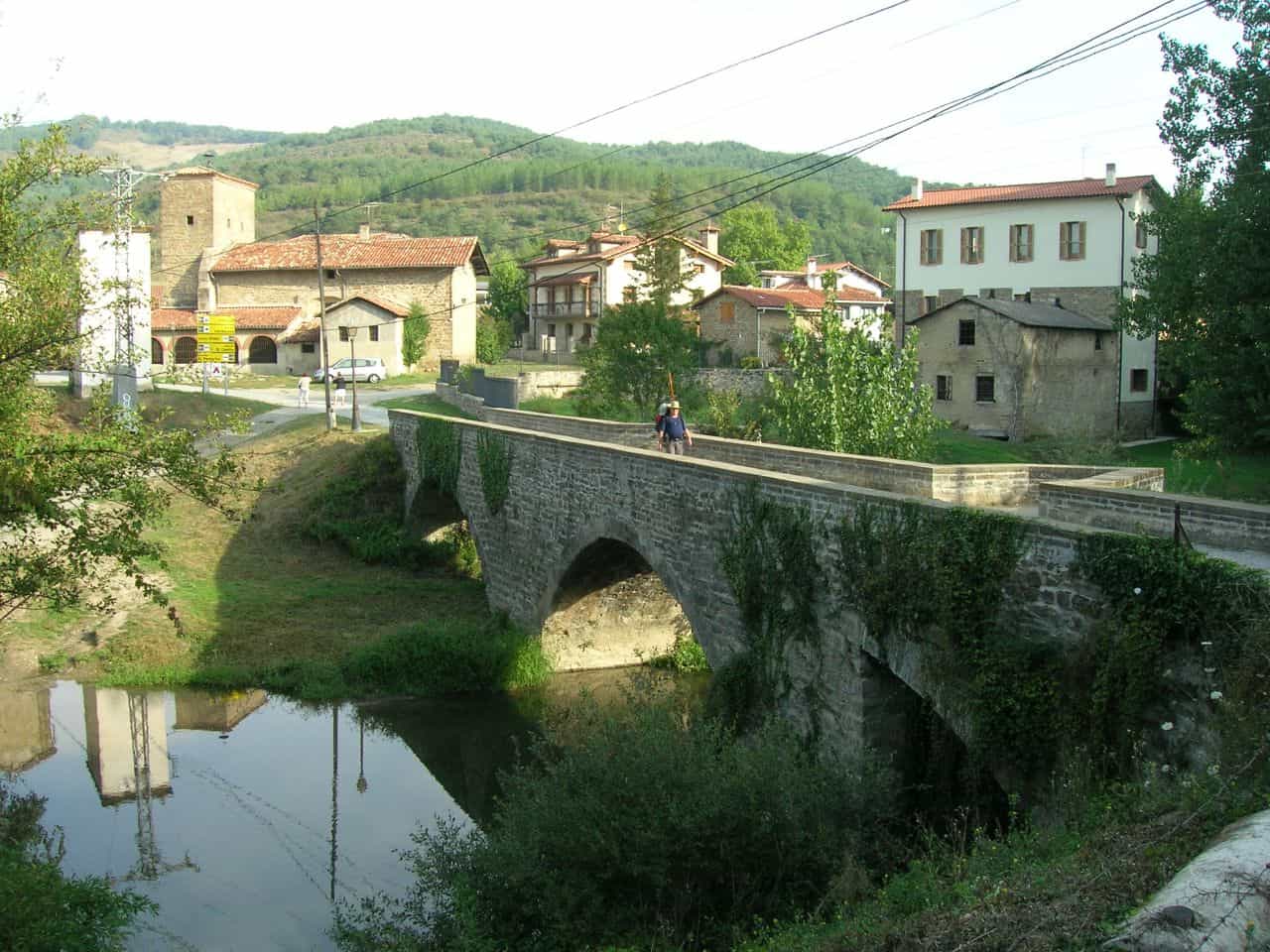
The morning I left Larrasoaña, a cat was sitting on the medieval bridge like it owned the whole valley. It probably did. I stood there for a minute, boots still damp, pack not quite right on my shoulders, and watched the River Arga slide underneath in that unhurried way rivers have when they know exactly where they’re going. I didn’t, not really. But the yellow arrows did, and that was enough.
This is a guide to Stage 3 of the Camino Francés, covering the 16.5 km walk from Larrasoaña to Pamplona. It’s one of the shorter days on the French Way, and that’s entirely the point. You arrive in one of Spain’s most compelling cities with enough energy to actually enjoy it.
What Is Stage 3 from Larrasoaña to Pamplona on the Camino Francés?
Stage 3 covers approximately 16.5 km from the small pilgrim village of Larrasoaña to the city of Pamplona, following the course of the River Arga through a series of quiet Navarran villages before the landscape gradually turns urban. According to the Oficina del Peregrino, this section of the Camino de Santiago falls within the early Navarran stages that begin after crossing the Pyrenees from Saint Jean Pied de Port.
The character of the walk is gentle. After the drama of the Pyrenees on Day 1 and the descent through Zubiri, this stage feels like the Camino exhaling. The terrain is mostly moderate, the path follows the river, and the villages you pass through are small enough that you can hear birdsong between them. Then Pamplona appears, gradually, through suburbs and parks, until you’re standing inside the old city walls wondering how you got from a medieval bridge to a pintxos bar in four hours.
|
Stage Detail |
Information |
|
Start |
Larrasoaña |
|
End |
Pamplona (city centre) |
|
Distance |
~16.5 km |
|
Typical Walking Time |
3.5 to 5 hours |
|
Difficulty |
Easy to moderate |
|
Key Feature |
River Arga valley, village stops, city finish |
This stage is ideal for first-time pilgrims still finding their rhythm, anyone recovering from the Pyrenees crossing, or walkers who simply want time to explore Pamplona properly. If you pushed hard from Saint-Jean-Pied-de-Port or Roncesvalles, your body will thank you for the shorter day.
How Long Does It Take to Walk from Larrasoaña to Pamplona, and How Difficult Is It?
Most pilgrims complete this stage in 3.5 to 5 hours, depending on pace and how long they linger in the villages along the route. If you’re walking steadily at around 4.5 km per hour, you could theoretically finish in under four hours. But the Camino has a way of slowing you down, and that’s not a complaint.
The elevation profile is forgiving. You’re not climbing anything serious. The path descends gently along the Arga valley before flattening out as you approach Pamplona. The Gronze guide notes some mild undulation through the villages, but nothing that will trouble anyone who survived the Pyrenees two days earlier.
Surface types vary more than you might expect on a short stage:
- Riverside paths: Packed earth and gravel along the Arga, pleasant underfoot but sometimes muddy after rain
- Village lanes: Cobblestone and tarmac through Zuriain, Zabaldika, and smaller settlements
- Urban walking: Paved sidewalks, road crossings, and park paths as you enter Pamplona’s outskirts
- The final approach: Mostly flat, through the Universidad de Navarra area and into the old town
A few practical tips for making it easier. Start by 7:30 or 8:00 in spring and autumn to avoid the midday heat, which can be surprisingly fierce in Navarra even in May. Trekking poles are helpful on the riverside sections, less so once you hit pavement. And do something about your feet before you leave Larrasoaña. By day 3, your blisters have opinions, and they get louder on hard surfaces.
What Is the Route Like and Where Do You Pass (River Arga, Villages, and Landmarks)?
The route follows the River Arga for much of the morning, threading through a landscape that feels more like a nature walk than a pilgrimage, at least until the suburbs appear. The Arga is your companion for kilometres, and the sound of it becomes background music you don’t notice until it stops.
Here’s a micro-itinerary to help you plan your stops:
|
Point |
Distance from Larrasoaña |
What to Expect |
|
Larrasoaña (start) |
0 km |
Medieval bridges, quiet village, early morning start |
|
Akerreta |
~2 km |
Tiny hamlet, no services, beautiful riverside path |
|
Zuriain |
~4 km |
Small village, seasonal café/bar, good first break |
|
Irotz |
~7 km |
Brief stop, medieval bridge over the Arga |
|
Zabaldika |
~9 km |
Romanesque church, albergue, peaceful midway point |
|
Arre / Villava |
~12 km |
Trinidad de Arre monastery, start of urban approach |
|
Burlada |
~14 km |
Suburban walking, services increasing |
|
Pamplona (old town) |
~16.5 km |
City walls, cathedral, full services, accommodation |
Waymarking is reliable for most of this stage. Yellow arrows and scallop shell markers guide you through the villages and along the river without much trouble. Where attention is needed is the urban approach. Once you reach Arre and Villava, the arrows can be harder to spot among street signs and traffic. Keep your eyes open, follow other pilgrims if you see them, and don’t panic if you lose the trail briefly. Pamplona is not a city you can accidentally miss.
What changes as you near the city of Pamplona is the atmosphere. The birdsong gives way to traffic noise. Dirt paths become pavements. You cross busy roads. It’s not unpleasant, just different. And then you enter through the old city walls, and suddenly you’re in a place Hemingway wrote about, where the streets have weight and the plazas open up like rooms in a very old house.
What Should You See in Larrasoaña Before You Leave?
Larrasoaña is easy to hurry through, especially early in the morning when you’re focused on the day ahead. But this medieval town has been receiving pilgrims since the 11th century, and it rewards a few minutes of attention.
- The medieval “bandit’s bridge” (Puente de los Bandidos): A stone bridge just outside the village, so named because bandits historically preyed on pilgrims crossing it. The name is more dramatic than the bridge itself, which is modest and lovely. Stand on it for a moment. The Arga runs underneath, and you can see the path curving ahead.
- The 11th-century Augustinian monastery: Little remains of the original structure, but the site is documented in medieval pilgrim records. What you can see today is fragments of its history woven into the village’s layout, a reminder that this place existed for people like you, walking this same route a thousand years ago.
- The 13th-century Church of San Nicolás (St. Nicholas): A Romanesque church dedicated to the patron saint of pilgrims. It’s small, often locked outside of service times, but the exterior alone tells you something about how long this path has been walked.
Where Should You Stop for Food, Water, and Breaks Between Larrasoaña and Pamplona?
Sixteen and a half kilometres doesn’t sound like it needs strategic planning, and it doesn’t, really. But three things can catch you out: seasonal closures, Spanish opening times, and the fact that your body might want to sit down more often than your mind thinks it should on day 3.
Carry at least a litre of water from Larrasoaña. The villages along the route are small, and bars or cafés in places like Zuriain can be closed outside peak season. Having water and a handful of nuts in your pack means you never need to worry about it.
- Zuriain (~4 km): A tiny village where a café or bar may be open, particularly in spring and autumn pilgrim season. Good for a quick coffee stop if it’s operating. Don’t count on it being open in winter.
- Zabaldika (~9 km): A stronger bet for a pause. There’s a small albergue here, and the Romanesque church makes it worth stopping even without food. This is roughly the halfway mark and a natural place to sit and regroup.
- Arre (~12 km): The Trinidad de Arre monastery complex marks the transition into the urban approach. You’re more likely to find a bar or café open here, and the bridge over the Arga at this point is worth a photograph.
- Villava/Burlada (~13-14 km): Once you hit these suburbs, services become plentiful. Bakeries, bars, supermarkets. The pilgrim scarcity economy is over.
A note on Spanish opening times, which confound everyone at first. Many bars open early for coffee (7:00 or 8:00), close mid-morning, then reopen for lunch around 13:00. If you’re walking between 10:00 and 12:30, you may find places shut. Plan accordingly. And restrooms are almost always in bars and cafés. Buying a coffee earns you the right to use the facilities, which is a transaction that works for everyone.
What Are the Must-See Churches and Romanesque Sites on This Stage?
You won’t find anything as grand as Burgos Cathedral on this stretch, but that’s not really the point. The sacred architecture along the Camino Frances between Larrasoaña and Pamplona is small, old, and quietly powerful.
- Zabaldika’s Romanesque Church (Iglesia de San Esteban): This is the standout. A simple, 12th-century church with clean Romanesque lines, a barrel-vaulted nave, and the kind of silence that makes you want to sit for a while. Look for the carved capitals and the way light enters through the narrow windows. The Xacobeo official guide notes Zabaldika as a notable cultural stop on the Navarran section of the French Way.
- Trinidad de Arre: The Trinitarian monastery in Arre dates to the medieval period and sits at a beautiful bridge crossing. It has functioned as a pilgrim hospital and refuge for centuries. The building you see today is more recent, but the site’s connection to the pilgrimage runs deep.
- Wayside crosses and markers: Between the villages, keep your eyes open for stone crosses, small shrines, and Camino markers that are easy to walk past if you’re focused on the path ahead. They’re minor in scale but part of the texture of this route, little punctuation marks in a very long sentence that ends in Santiago de Compostela.
When visiting churches along the Camino, enter quietly, leave a small donation if a box is provided, and check whether photography is welcome. Many of these sites are maintained by local volunteers or tiny parishes, and a euro or two in the collection box goes further than you’d think.
Where Should You Stay in Pamplona After Stage 3 (and What Area Is Best for Pilgrims)?
Arriving in Pamplona by midday or early afternoon is one of the quiet luxuries of this shorter stage. You have time to find accommodation without that slightly panicked sprint that happens when you arrive at an albergue at 16:00 and every bed is taken.
|
Accommodation Type |
Typical Cost (2024/25) |
Best For |
|
Municipal albergue |
8 to 12 euros per night |
Budget pilgrims, communal experience |
|
Private albergue |
12 to 20 euros per night |
Slightly more comfort, smaller rooms |
|
Pension / hostel |
25 to 50 euros per night |
Privacy, better sleep before a city day |
|
Hotel / casa rural |
50 to 100+ euros per night |
Recovery, couples, those wanting a proper rest |
For location, consider two priorities. If you want to explore the old town, stay centrally, near the Plaza del Castillo or the cathedral area. The lively atmosphere, pintxos bars, and Hemingway-adjacent history are all within walking distance. If you want an early, quiet start the next morning, look at accommodation near the Camino’s exit route through the Ciudadela park, which avoids backtracking through the city centre.
Booking ahead is wise during peak pilgrim season (May through September) and essential during Semana Santa or the San Fermín festival in July, when Pamplona’s accommodation fills completely. The Pamplona city tourism site lists accommodation options and can help with planning. Outside peak months, you can usually find a bed on arrival, but the peace of mind of a booking is worth the two minutes it takes.
What Should You Do in Pamplona with the Extra Time (Sightseeing Plan for Pilgrims)?
Here’s the thing about arriving in a city with energy to spare: you remember it differently. Instead of collapsing on a bunk and staring at the ceiling, you get to wander. Pamplona, known as Iruña in Basque, is a city that rewards wandering.
A simple half-day plan after arrival:
- First hour: Check in, shower, sort your laundry. This is sacred time. Do not skip it.
- Afternoon (15:00 to 18:00): Walk the old town. The Plaza del Castillo is the natural centre, ringed by cafés. From there, find the city walls and walk a section of the ramparts for spectacular views over the river valley you just walked through. Visit the Cathedral of Santa María la Real if it’s open; the Gothic cloister is one of the finest in Spain.
- Evening (19:00 onwards): Pamplona’s pintxos culture is serious. The bars along Calle Estafeta and Calle San Nicolás serve small plates that are both cheap and genuinely excellent. Order a glass of Rioja, point at something on the bar, and eat. Repeat until content.
For pilgrims interested in the running of the bulls and San Fermín history, the route of the encierro (bull run) is marked on the streets, and you can walk it at a pace considerably more relaxed than the participants manage in July. The Hemingway connection is everywhere. He made this city famous by writing about it in The Sun Also Rises, and Pamplona has been gracefully living with that fame ever since. There’s a bust of him near the bullring if you want to pay your respects.
Practical city tips for pilgrims:
- Pharmacies in the old town carry blister plasters (Compeed), anti-chafing cream, and basic medical supplies. Stock up here; the next city this well-supplied is Puente la Reina or possibly not until Burgos, depending on your needs.
- Supermarkets near the centre (look for Eroski or BM) are good for restocking trail snacks.
- Pamplona is safe for solo walkers, including solo female pilgrims. The old town is well-lit and busy in the evenings. Use normal city awareness, particularly with luggage and valuables.
How Do You Get to Larrasoaña and How Do You Navigate Onward from Pamplona?
Most pilgrims walking the full Camino Francés will arrive in Larrasoaña on foot the previous evening, having walked from Zubiri or Roncesvalles. If you’re starting your pilgrimage from Pamplona and want to walk this stage in reverse order or connect to Larrasoaña first, local buses run from Pamplona to villages in the Arga valley, though schedules can be limited. A taxi from Pamplona to Larrasoaña costs roughly 25 to 35 euros, depending on the time and company. The Navarra bus service website has current schedules for regional routes.
For context, the full route from Saint Jean Pied de Port to Pamplona is typically covered in three stages totalling around 75 km. Many pilgrims cross the Pyrenees on Day 1 (either via the Napoleon Route in good weather or the Valcarlos alternative), walk to Zubiri or Larrasoaña on day 2, and reach Pamplona on day 3. The entire Camino Frances from Saint-Jean-Pied-de-Port to Santiago de Compostela is approximately 780 km.
Leaving Pamplona the next morning, the route continues through the Ciudadela park and the University campus before heading toward Cizur Menor. The section from Larrasoaña to Cizur (if you include the next morning’s start) follows a logical rhythm: river valley into city, city out to high ground. The itinerary of the Camino from Pamplona onward takes you across the Sierra del Perdón, with its famous wind turbine ridge and spectacular views, before descending to Puente la Reina.
- Next stage: Pamplona to Puente la Reina (~24 km), involving the climb over the Sierra del Perdón
- Rest day option: Pamplona has enough to fill a rest day comfortably, with parks, museums, and excellent food
- Medical help: If you need medical attention, the Hospital de Navarra and several clinics are in the city centre. Spain’s public healthcare system is excellent, and pharmacists can advise on common pilgrim ailments.
One more thing. If you’re planning your broader Camino itinerary, know that a map of the Camino showing elevation profiles for each stage is available from several sources, including the official Galician Camino website and apps like Buen Camino. Having a sense of what’s ahead, from the Meseta’s wide open spaces to the green closeness of Galicia, helps you pace not just your walking but your expectations. The Camino doesn’t end when you reach Finisterre, or even Santiago. But it starts, step by step, on mornings like this one.
FAQ: What Do Pilgrims Ask About the Larrasoaña to Pamplona Stage?
Is Larrasoaña to Pamplona really only 16.5 km, and why is it shorter?
Yes, this stage is commonly listed at around 16.5 km, making it one of the shorter days on the Camino Francés. The shorter distance is partly a natural consequence of how the stages divide between Saint Jean Pied de Port and Pamplona, and partly intentional: arriving early in Pamplona gives pilgrims time to explore the city, recover from the Pyrenees, and handle practical tasks like restocking supplies or getting blister care. Most guidebooks, including those referenced on the Oficina del Peregrino website, treat this as a built-in recovery and sightseeing day.
Are there enough cafés and services between Larrasoaña and Pamplona?
Services are limited in the first half of the stage. Zuriain and Zabaldika may have a café or bar open during pilgrim season (roughly April through October), but don’t rely on it. Carry water and snacks from Larrasoaña. Once you reach Arre and the Pamplona suburbs, services become abundant. The best villages to aim for a break are Zuriain (quick coffee if open) and Zabaldika (church visit, possible rest at the albergue).
Is the walk into Pamplona confusing or unpleasant because it’s urban?
The final 4 to 5 km through Villava and Burlada into Pamplona are urban, with sidewalks, traffic, and road crossings. It’s not the most scenic part of the day, but it’s manageable. Follow the yellow arrows carefully; they can be less obvious among city signage. The reward for patience is entering through the old city walls, which feels like a proper arrival. The busier environment also means more services, so you can grab a coffee or use a restroom easily.
What are the top historical sights in Larrasoaña worth seeing before walking?
Three things are worth a few minutes: the medieval Puente de los Bandidos (bandit’s bridge) just outside the village, the site of the 11th-century Augustinian monastery (mostly fragments now, but historically significant as a pilgrim stopping point), and the 13th-century Church of San Nicolás, dedicated to the patron saint of pilgrims. None requires a long visit, but together they give you a sense of how deep the pilgrim history runs in this small village.
Should I stay in Pamplona or push beyond it?
For most pilgrims, staying in Pamplona is the right call. The city has excellent accommodation at every budget, outstanding food, genuine historical interest, and enough to fill an afternoon and evening comfortably. Very fast walkers or those on tight schedules sometimes push through to Cizur Menor (about 5 km further), but they miss what makes this stage special. The Camino is long. Pamplona is worth your time.
Ready to Plan Your Stage 3 Day (Larrasoaña to Pamplona)?
This stage doesn’t ask much of your legs, and it gives a lot in return. A morning along the river, a few quiet villages, a Romanesque church if you stop, and then Pamplona opening up ahead of you like a promise kept. Here’s a simple planning checklist to carry in your head:
- Start time: Leave Larrasoaña by 7:30 or 8:00 to arrive comfortably by early afternoon
- Water plan: Carry at least 1 litre from Larrasoaña; refill in Arre or Villava
- One café stop target: Zuriain for coffee (if open) or Zabaldika for the church and a rest
- Pamplona afternoon shortlist: Plaza del Castillo, city walls walk, cathedral cloister, Calle Estafeta pintxos crawl
- Booking: Reserve accommodation in peak season; check availability for albergues or a pension near the old town
If you’re building your Camino itinerary stage by stage, the next section after Pamplona takes you over the Sierra del Perdón to Puente la Reina, roughly 24 km with a memorable ridge crossing. But that’s tomorrow’s problem. Today, you walk along the river, you arrive in a city that has welcomed pilgrims for a thousand years, and you eat pintxos until you can’t quite manage another one. Then you manage one more. That’s the Camino. It’s simpler than you think, and it’s enough.


