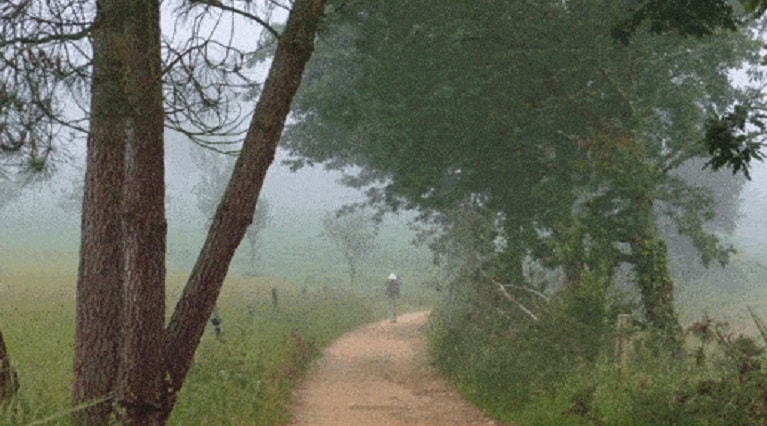
What are you really looking for when you start the Camino?
Here is what nobody tells you before you walk the Camino de Santiago. The logistics are the easy part. You can spend weeks comparing hiking boots, calculating how many euros per day to budget, and debating whether to start your first camino from Saint-Jean-Pied-de-Port or Sarria. All of that is solvable. The harder question, the one that tends to land somewhere around day three when your feet are throbbing and you are staring at a ceiling in an albergue dormitory at 5:47 a.m., is this: what am I actually doing here?
The Camino can be spiritual, physical, social, quietly devastating, or gently boring, sometimes all of those things before lunch. And that can change daily. The pilgrim who left home seeking clarity might find, by the meseta, that the silence just amplifies the noise in their own head. The one who came for fitness might unexpectedly weep at the Cruz de Ferro. None of this is predictable, and none of it is wrong.
This post offers three essential questions to return to when motivation, relationships, or meaning feel blurry on the trail. They are not clever. They will not solve your life. But they work as a compass when the walking gets hard and you have forgotten why you are putting one foot in front of the other. I first tested them walking from Sarria to Santiago de Compostela, the last 100 km of the Camino Francés. It is a condensed but surprisingly intense stretch, and these questions kept surfacing whether I wanted them to or not.
- Where am I going? (about direction, both physical and internal)
- Where have I been? (about memory, baggage, and letting go)
- Who am I when no one needs me to perform? (about identity, stripped down)
Why do the middle days of the Camino feel harder than the beginning or the finish?
Most pilgrims walking the Camino Frances describe a pattern. The first few days carry a buzz of novelty. Everything is photogenic: the Pyrenees, the first stamp in your pilgrim’s credential, the first “Buen Camino” from a stranger. Then comes the messy middle. Somewhere between Pamplona and Galicia, the excitement fades and something less comfortable takes its place. The final days closer to Santiago bring renewed purpose, a destination in sight, the pull of the cathedral of Santiago de Compostela on the horizon. But those middle days? They are where the real camino pilgrimage tends to happen, and they are rough.
Here are the mid-Camino stressors that prospective pilgrims rarely anticipate:
- Routine fatigue and mental noise. Once novelty fades, you are left with your own thoughts for six or seven hours a day. That is a lot of thinking for a species accustomed to scrolling.
- Comparison with fellow pilgrims. Their pace, their gear, their apparent spiritual composure. The person who seems to float up hills while you wheeze. The one who brought exactly the right backpack.
- Pressure to feel transformed on schedule. You have read the books. You have seen the films. By now, surely, you should be having a revelation? But you are mostly thinking about whether there is a café in the next village.
If this sounds familiar, or if it sounds like something you might encounter, take note: difficulty does not mean you are doing it wrong. In fact, among people who walk the Camino regularly, the consensus is that discomfort in the middle is not a sign of failure. It is often the point where the pilgrimage begins to do its quieter, less photogenic work.
How do you handle walking with someone whose pace or priorities clash with yours?
I did not expect the hardest part of my camino to be another person. I had anticipated blisters (I got them), rain in Galicia (constant), and sore shoulders from my backpack (yes). What I had not prepared for was the quiet tension of walking with a companion whose rhythm was fundamentally different from mine.
They wanted to get miles done. I wanted to stop at every church doorway and small chapel. They listened to music or podcasts. I wanted birdsong and the sound of walking poles tapping stone. Neither of us was wrong, but by the second day we were both pretending to be fine while quietly simmering about photo stops.
If you are planning to do the camino with a friend, partner, or family member, these tensions are common and predictable:
|
Tension |
What it looks like on the trail |
|
Fast vs. slow pace |
One person always waiting at the next village, the other always feeling rushed |
|
Social camino vs. quiet camino |
One wants to chat with every fellow pilgrim at dinner; the other wants to journal alone |
|
Schedule-focused vs. feeling-led |
One books albergues in advance; the other wants to see where the day takes them |
|
The “should we separate?” question |
Guilt, relief, and awkwardness all mixed together |
Rather than letting these tensions harden into resentment, try asking yourself three reflection prompts each morning:
- What do I need today: companionship, solitude, or flexibility?
- What expectations did I bring into this relationship, and are they fair on the trail?
- What boundary would make this day kinder for both of us?
Walking apart but staying connected is a healthy option. You can agree to meet at the next town for lunch, or simply at the albergue that evening. Some of the strongest camino friendships I have seen were between people who had the courage to say, “I love you, and I need to walk alone today.” Permission to separate is not betrayal. It is kindness wearing sensible shoes.
Where am I going, and what am I chasing right now?
This is the first of the three big questions, and it has more layers than it appears.
On the surface, you know where you are going. Santiago de Compostela in Galicia, where the remains of Saint James the Apostle are said to rest beneath the cathedral. Or perhaps today’s destination is smaller: the next town, the next café, the next flat stretch after a punishing climb. You walk each day toward something tangible, and the yellow arrows keep you honest.
But the question underneath is different. What are you really walking toward? Peace? Healing? Proof that you can do something hard? Permission to rest? Forgiveness?
This question becomes especially useful in the hard moments:
- When you are tempted to rush through a section just to tick off the kilometers, ask: where am I actually going?
- When you catch yourself comparing your camino route to someone else’s, ask: what am I chasing that is not mine?
- When others’ goals start steering your day (their pace, their schedule, their albergue preference), ask: is this still my pilgrimage?
Two small exercises you can do while walking, no guidebook required:
- Name your “today intention” in one sentence. Not a goal. An intention. “Today I want to notice one thing that surprises me.” “Today I want to walk without checking the time.”
- Identify what you are trying to control, and what you can release. You can control your pace. You cannot control whether the next albergue has a bed. You can control your response to a blister. You cannot control the weather in Galicia (nobody can).
Where have I been, and what am I carrying that I do not need anymore?
The second essential question. And it tends to arrive uninvited, usually during the long, quiet stretches when there is nothing to look at but fields and sky and whatever your mind decides to dredge up.
Something about the repetition of walking, step after step, kilometer after kilometer, seems to shake loose old memories. The silence that many pilgrims crave at the start of their camino becomes, by the middle days, a kind of echo chamber. Old stories resurface. Regrets. Grief. Anger at someone you thought you had forgiven years ago. An unresolved conversation that plays on loop.
On the traditional camino, pilgrims have always spoken about carrying things to the Cruz de Ferro to leave behind, a small stone representing a burden. But the emotional version of this is less tidy. You cannot just set down shame or perfectionism on a pile of rocks and walk away clean. What you can do is notice what you are carrying and ask whether it still serves you.
Emotional “carrying” on the camino can look like:
- The urge to be “fine” at all times, even when your body is screaming and your spirit is flat
- The need to be right, especially during companion conflict (this one cost me a friendship for about 48 hours)
- Shame, perfectionism, people-pleasing, all the habits that feel like identity but are really just armour
Reflection prompts for prospective pilgrims, or for anyone currently on the trail reading this on their phone at an albergue in Porto or Roncesvalles:
- What am I replaying in my mind, and what is it costing me?
- What would it mean to forgive (someone else, or myself) just one notch more than I have managed so far?
A gentle grounding here: you do not have to solve your whole life on the Camino de Santiago. You really do not. You can simply notice what surfaces, soften around it, and keep walking. That is enough. That has always been enough.
Who am I when no one needs me to perform?
The third question, and in some ways the strangest. Because the camino strips away so many of the markers we use to define ourselves. Your job title does not matter on the trail. Your social media presence is irrelevant. Nobody cares how much your house is worth or what car you drive. You are a pilgrim with a backpack, walking boots, and whatever version of yourself shows up when everything else falls away.
This question unfolds differently depending on how you walk:
|
Walking style |
What it reveals about identity |
|
Walking solo |
How you handle loneliness, decision-making, and the absence of external validation |
|
Walking socially |
How you adapt, whether you lead or follow, and what you hide in company |
|
Walking in silence |
What fills the space when you stop talking; whether you find it peaceful or unbearable |
|
Walking through discomfort |
What version of you shows up when you are tired, hungry, or lost |
Whether your camino is a religious pilgrimage to the remains of Saint James or a personal challenge with no spiritual framework at all, there is something about walking across northern Spain that forces a reckoning with the question of who you actually are. Not who you perform as. Not who your family needs you to be. Just you, with blisters and a half-eaten bocadillo, standing in the square in front of the cathedral wondering what comes next.
Practical self-checks to revisit daily, perhaps while lacing up your hiking boots or waiting for the albergue doors to open:
- Am I walking to prove something, or to meet myself honestly?
- What version of me shows up when I am tired? (This is information, not judgement.)
- What do I want to practice today: patience, courage, trust, or openness?
What moments become the best parts of the Camino, and how can you notice them while they are happening?
When pilgrims who have reached Santiago look back, the moments they talk about are rarely the big milestones. They are not usually the arrival at the Plaza del Obradoiro, though that is moving. They are smaller, odder, more specific. A stranger in a village bar near the meseta who insisted on buying everyone coffee. A dog that walked alongside you for three kilometers and then turned back at an invisible boundary only it could see. The sound of church bells at dusk in a town whose name you cannot quite remember, somewhere between Sarria and Santiago de Compostela.
The difficulty is that these moments do not announce themselves. They do not come with a soundtrack. You have to be paying attention, which is hard when your feet hurt and you are worried about whether to take a rest day or push on.
Two simple noticing practices that cost nothing and take almost no time:
- “One good thing” at day’s end. Not toxic positivity, just attention. What was one moment today that felt genuinely good? Name it specifically. “The bread at that café in the village after the hill” is better than “I felt grateful.”
- A quick journal voice note. Thirty seconds on your phone: what surprised me today? You will be glad you have these when you are home and the camino feels like a dream you half-remember.
Arriving in Santiago does not erase the difficult middle days. It integrates them. The frustration, the companion tension, the boredom, the blister you named Gerald because you spent so long together, all of it becomes part of the story. The best parts of the Camino are not separate from the hard parts. They are woven through them.
What do you take home after Santiago, and how do you carry it into real life?
You arrive in Santiago de Compostela. You stand in the square in front of the cathedral. If you walked at least the last 100 km on foot (or 200 km by bicycle), you can collect your Compostela from the Pilgrim’s Office in Santiago. Some pilgrims continue to the towns of Finisterre or Muxía, where the land ends and the Atlantic begins. But eventually, you go home.
And that is when the real work starts.
The contrast can be brutal. On the camino, your day to day life was simple: walk, eat, sleep, repeat. Back home, the notifications return. The obligations. The noise. The pace of everything feels wrong, too fast, too cluttered, too many decisions that have nothing to do with which yellow arrow to follow.
Ways to keep the camino’s lessons alive without romanticising the past:
- A daily walk ritual. Even 10 to 20 minutes. Not exercise. Walking. The kind where you notice things.
- One boundary or value you recommit to. Maybe it is the permission to walk at your own pace in life, not just on the trail. Maybe it is the knowledge that you can tolerate living out of a backpack, that you need less than you think.
- Stay connected to the camino community, gently. Fellow pilgrims you meet along the way often remain friends for years. But resist the urge to live in the past. The camino was not your real life on pause. It was your real life, simplified.
The three questions (where am I going, where have I been, who am I) do not expire at the end of your camino. They work just as well in a supermarket queue, or at a desk on a grey Tuesday, or in the middle of a difficult conversation at home. They are a long-term compass, not a one-time breakthrough. The Camino de Santiago gives you the space to hear them clearly. The rest is up to you.
FAQs about reflective walking on the Camino de Santiago
Is the Camino de Santiago only for religious pilgrims?
No. The camino has deep roots as a Christian pilgrimage to the remains of Saint James the Apostle, and many pilgrims still walk for religious reasons. But according to statistics from the Pilgrim’s Office, a significant number of modern camino pilgrims cite spiritual, cultural, or personal motivations rather than strictly religious ones. Your “why” can be simple, a desire for fresh air and time to think, and still be entirely valid.
Do I have to walk alone to have a meaningful Camino?
Not at all. Meaning can deepen through community or solitude, and most pilgrims experience both during a single camino. Walking solo gives you space for reflection; walking with others offers companionship, perspective, and the occasional shared bottle of wine at sunset. The middle path, walking your own pace while keeping relationships intact, is often the wisest.
What if I do not feel transformed, or I feel frustrated most days?
This is more common than the guidebook stories suggest. Frustration, boredom, and doubt are not failures. They are features of the messy middle, the phase where real change tends to germinate quietly. If you are struggling, return to the three questions rather than chasing a specific emotion. Sometimes the most honest camino moment is sitting outside an albergue thinking, “I am not sure what I feel right now.” That counts.
How do I handle conflict with a companion without ruining the trip?
Focus on reflection and boundaries. Name your needs clearly and kindly. Allow separation when necessary, whether that means walking apart for a morning or taking different camino routes for a day or two. You can love someone and still need different rhythms on the trail. The strongest camino companionships tend to be the ones where both people have permission to walk alone.
How can I keep the inner calm I find on the Camino after I return home?
Choose one tiny practice and protect it. A daily walk without your phone. A journaling prompt once a week. A screen-free hour on Sundays. Revisit the three questions (where am I going, where have I been, who am I) monthly as a check-in. The calm you found on the camino is not location-dependent. It lives in the attention you give to ordinary moments, the same attention the trail taught you to pay.
Ready to walk your Camino with more intention?
If you are planning your first camino, or returning to the trail after time away, consider printing the three questions and tucking them into your backpack. They weigh nothing. They take up no space. And on the days when the walking is hard, when your feet are sore and the next town feels impossibly far, they can remind you why you chose to begin their journey in the first place.
Which of the three questions feels hardest for you right now, and why? Whether you are still in the planning stages, choosing your route, or already somewhere along the camino, I would genuinely like to hear. The questions that unsettle us most are usually the ones worth sitting with longest. Buen camino.




Leave a Reply