I made my first real mistake on the Camino de Santiago before I had walked a single step. I spent the best part of a year being afraid of getting it wrong. Wrong boots, wrong month, wrong route, wrong everything. I read forums until two in the morning and bought a second backpack because the first one was, apparently, the wrong shade of competent.
Here is the thing nobody told me clearly enough, so I will tell you. The biggest mistake on the Camino is being so frightened of mistakes that you nearly do not go. Almost everything else is recoverable. A heavy pack can be posted home. A blister can be taped. A miserable day in the rain becomes, with surprising speed, the story you tell over wine in Burgos. So treat this article less as a list of rules and more as a friend leaning across the table saying: relax, you will get most of this slightly wrong, and you will be absolutely fine.
What follows are the common mistakes I watched pilgrims make, made myself, or wished I had been warned about. None of them will ruin your walk. Avoiding them just makes the first few days kinder.
Why is the fear of mistakes the biggest mistake of all?
Most first-time pilgrims I met, especially those flying in from the United States with a fortnight of precious holiday on the line, carried two things in equal measure: excitement and dread. The dread was rarely about the walking. It was about doing the Camino de Santiago properly, as though there were an exam at the cathedral and someone would mark your technique.
There is no correct way to be a pilgrim. The word pilgrim covers the devout and the curious, the grieving and the simply bored of their desk. You qualify the moment you walk the Camino, however slowly. That is the entire entry requirement.
So I would gently invite you to reframe the whole enterprise. Keep your expectations low and your curiosity high. Not low as in pessimistic, but low as in unfixed. The pilgrims who arrive with a rigid idea of their transformation tend to spend the walk chasing a feeling instead of noticing the one they are actually having. The ones who treat each day as an experiment, walk, watch what happens, adjust tomorrow, seem to come home changed in the small, durable ways that actually last: more patient in queues, quicker to talk to strangers, oddly content with less.
Think of every wrong turn as feedback rather than failure. That single mental swap is worth more than any piece of gear.
How do you avoid overplanning without feeling unprepared?
The opposite trap to fear is control. I have watched people plan every night's bed, every kilometre, every coffee stop, three months in advance, then spend the actual Camino furious that Spain refused to cooperate with the spreadsheet.
You do need a plan. You do not need a script. The skill is building a loose, tentative itinerary that holds the few things that genuinely cannot move and leaves everything else soft.
I find it helps to sort your decisions into two honest piles before you go:
- Non-negotiables: your arrival date, your starting town, a realistic budget range, any medication you must carry, and the date you have to be home.
- Everything else: which albergue, how far each day, rest days, detours, who you walk with, where you eat. Leave these to the road.
The question of whether to book ahead is where most planning anxiety lives, so let me be plain about it. On a first Camino, in the quieter months, on a popular route like the Camino Francés, you can usually walk into a town in the afternoon and find a bed without booking. Pre-booking everything in advance locks you into someone else's pace and robs you of the spontaneous half-day you might want when your knees say stop.
There are sensible exceptions. Book ahead when you are walking in peak summer, when you have limited mobility, when you are on a tight timeline that cannot absorb a full albergue, or when you are reaching a town with a famous festival on. Otherwise, hold your nerve and keep it flexible.
What packing mistakes make the Camino harder than it needs to be?
If there is one mistake almost every pilgrim makes, it is the backpack. We pack our fears, not our needs. The "just in case" jumper. The third pair of trousers. The full-size bottle of conditioner for hair that, by week two, you will be washing in a sink with hand soap and not caring.
Pack weight is a multiplier. A bag that feels reasonable in your hallway becomes a small, sullen companion by the top of a hill, and over the long distances of a full route it punishes your feet long before it punishes your back. Heavy packs are quietly responsible for a great many blisters and tired joints. The old guidance you will hear repeated on every route is to keep your loaded pack at or under roughly ten per cent of your body weight, which for many people lands somewhere near ten kg. It is a guideline, not a law, but it is a good one.
Here is the test I eventually learned to apply to every item before it went in: if I would not use it at least weekly, or if it could not do two jobs, it stayed at home. A merino top works as a base layer and an evening shirt. A buff is a hat, a scarf, and an eye mask. A "just in case" gadget is usually just weight in a clever disguise.
The things pilgrims consistently carry too much of:
- Spare clothes. You wash as you go; two sets is plenty, three if you are nervous.
- Toiletries. Decant into tiny bottles; shops along the way sell more.
- Water. More on this below, because it deserves its own quiet word.
- Books. One slim paperback, or your phone. The Camino is not short of reading time and is very short of spare grams.
If you want a fuller, item-by-item breakdown to test your own kit against, our Camino de Santiago packing list is the document I wish I had read before my first walk rather than after.
What is a sensible packing approach if you are flying from the United States?
Flying in adds two small wrinkles. The first is baggage. A loaded backpack often sits near airline cabin limits, so weigh it at home and decide early whether it travels as carry-on or checked luggage, especially if you are carrying trekking poles, which usually cannot come in the cabin. The second is the temptation to bring everything because you cannot pop home for it. Resist this. Spain has pharmacies, outdoor shops and supermarkets. Almost anything you forget, you can buy in Pamplona or the next decent-sized town.
One thing worth doing before you leave: load your pack to full weight and walk a few hours with it at home. A pack that feels fine empty in a shop feels very different at ten kg on a long-distance day. Better to learn that on a training walk than on a mountain.
How fast should you walk, and why does keeping up with others backfire?
I want to be careful here because this is the mistake that nearly broke me, and I see it break others.
You will, very early on, fall in with someone faster. They will be lovely. You will not want to lose them, so you will walk at someone else's pace, and your body will say nothing for a day, then quietly file for divorce. Trying to match another pilgrim's rhythm is one of the most reliable routes to exhaustion and injury on the whole Camino.
The first few days are when people go too fast, partly from adrenaline, partly from the fear of being slow. The classic error is to start like it is a race: long stages, no breaks, a kind of grim productivity that has no place on a pilgrimage. Many pilgrims who flame out in the first week did not lack fitness. They lacked patience.
Walk your own Camino. Set your own start time, your own breaks, your own daily distance. Build up gradually, with shorter stages at the beginning, and let your legs find the longer days when they are ready. The people you walk past today you will very likely share a kitchen with tonight; the Camino has a way of reuniting everyone at the bar.
Watch for the red flags that you are pushing too hard:
- Pain that does not ease after the first warm-up half hour.
- Blisters that keep worsening rather than settling.
- Dreading the morning instead of being curious about it.
- Sleep that does not refresh you, even in a comfortable bed.
How do you build rest into the walk without feeling behind?
Rest days are not a confession of weakness. They are part of how people finish strong. A day off in León or Burgos, spent washing clothes, eating slowly, sitting in a square doing gloriously little, can be the thing that carries you through the next week.
The mental trick is to stop measuring yourself against an imaginary schedule. Consistency beats heroics. Nobody at Santiago de Compostela asks how fast you came. If you would like the fuller case for stopping, our piece on taking rest days on the Camino makes it better than I can in a paragraph.
What footwear and clothing mistakes cause the most pain?
Feet are where the Camino is won or lost. The single most common footwear mistake is wearing new shoes at the start. Boots or trail shoes need breaking in over weeks of real walking, not a hopeful jog round the block the night before your flight.
Two principles serve most pilgrims well. First, break your footwear in properly at home, on the kind of ground and the kind of distances you will actually face. Second, carry a backup you can genuinely walk in. Not a fashion sandal, but a second pair, often lightweight trainers, that could get you through a stage if your main hiking boots betray you. A pair of simple camp shoes for the evening is a small luxury your feet will thank you for.
Blisters are not inevitable, whatever the war stories suggest. Most come from heat, friction and damp, and most can be headed off. Watch for hotspots, the little warm patches that announce trouble, and tape them early rather than waiting for the skin to break. A decent sock system, often a thin liner under a cushioned sock, sorts out a surprising amount. If you want the detail, our guide to blister prevention on the Camino de Santiago covers the foot care routine I now follow without thinking.
Clothing mistakes are usually about vanity or cotton, sometimes both. Cotton t-shirts hold sweat and rain and chafe when wet; quick-drying fabrics are kinder. Dress for variable conditions in layers you can add and shed, and choose comfort and fast-dry over looking right. Nobody on the Camino is judging your outfit. They are all wearing the same three things you are.
How do weather and navigation catch first-timers off guard?
The Camino weather has a sense of humour. A single day can offer a cold, dim morning, a hot afternoon, and a sudden squall over the Pyrenees mountains that arrives with no manners at all. People who pack for one kind of weather get caught by the other.
You do not need elaborate kit. You need a minimal, reliable rain plan: a waterproof shell or a poncho, a cover or a liner to keep the inside of your pack dry, and clothes that dry overnight. A poncho has the advantage of covering you and your backpack at once, which is why you see so many of them on the trail. For heat, walk early, take shade breaks, and keep your salts up on long, exposed stretches like the Meseta.
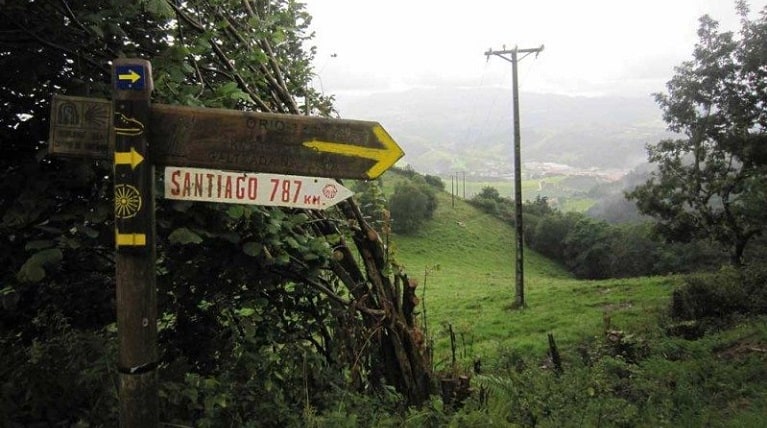
On navigation, the Camino Francés is generally well marked with yellow arrows and scallop shells, and a great deal of the time you simply follow the person in front. But waymarking thins out in cities, in fog, and where roadworks have rearranged things, so do not walk entirely unprepared. A simple, layered approach works:
- A Camino app with offline maps for the route you are walking.
- A guidebook or a few printed pages for the stages where signal is poor.
- A portable charger, because navigation that dies at sixty per cent battery is not navigation.
How do you avoid bed races, accommodation stress, and burnout?
There is a peculiar madness that infects some pilgrims about beds. They wake at five, pack by torchlight, and march off in the dark not to walk but to win, racing the next person to the last bunk in the next albergue. It turns a pilgrimage into a commute.
Albergues are the simple pilgrim hostels that give the Camino its communal heart: dormitory beds, shared kitchens, a stamp for your pilgrim passport, and a price that is gentle on the budget. Municipal albergues are cheaper and busier; private ones cost a little more and sometimes let you book ahead. If you have never stayed in one, our overview of albergues on the Camino de Santiago explains what to expect before you are standing in a dorm at nine at night wondering where to put your boots.
Here is a rough decision framework for the accommodation question, the one I wish someone had drawn for me:
|
Your situation |
Sensible approach |
|
First Camino, quieter season, flexible schedule |
Walk and wing it; book only if a town looks full |
|
Peak summer or a festival town |
Book a night or two ahead for the busy spots |
|
Tight timeline with no room to lose a day |
Pre-book the critical stages, stay loose elsewhere |
|
Walking as a group of four or more |
Book ahead; large groups are harder to place last-minute |
|
Weekends near cities |
Reserve early; locals and tourists compete for beds too |
Whichever you choose, decide each afternoon honestly whether to stop early or push on, and let your body cast the deciding vote. A few small habits make shared sleeping far kinder: earplugs, packing the noisy gear the night before, respecting lights-out, and choosing a quieter private room on the nights you genuinely need to sleep. Protect your joy, not just your mileage. Burnout on the Camino is rarely about distance; it is about forgetting why you came.
What social and cultural mistakes can you sidestep?
Most cultural mistakes on the Camino are small, accidental, and instantly forgivable. The fear of committing one should not make you stiff or silent. Still, a little awareness smooths the way.
In the albergue, the etiquette is mostly common sense worn thin by tiredness: keep noise down after lights-out, do not rustle plastic bags at dawn for twenty minutes, share the laundry line and the kitchen, and clean up after yourself in the shared areas. With locals, a few basic words go a long way. You do not need to speak Spanish fluently, but "hola", "gracias", "por favor", and the lovely "buen camino" that pilgrims and villagers alike call to one another will carry you far. Buen Camino is less a phrase than a small blessing passed hand to hand down the trail.
Respect the route itself, too. Carry your rubbish out, stay on the path through farmland, and remember that the towns along the way are people's homes, not a theme park laid on for pilgrims. If you do put a foot wrong, and you will, the repair is simple: apologise, adjust, move on. Nobody expects perfection. They expect kindness, which is a much lower bar and a much nicer one.
How do you make room for the real Camino instead of chasing a perfect one?
The last mistake is the saddest, and it has nothing to do with gear. It is forgetting to be there. Pilgrims who fix their eyes on the outcome, the distance, the finishing photo, the transformation they were promised, often miss the Camino that is actually happening around them: the old man who walks you to the right turning, the storm that drives four strangers under one café awning, the way a bowl of soup at the end of a wet day tastes like something close to grace.
This is where keeping expectations low pays off most. Hold your outcomes loosely. You may not get fitter on the schedule you imagined, finish in the time you planned, or feel the lightning-bolt revelation the films promised. What you get instead is usually quieter and better. The Camino changes most people not by grand epiphany but by accumulation, day after day of walking until the noise in your head finally goes quiet enough to hear the things underneath it.
A few small practices help you stay in it:
- Ask yourself one honest question at the end of each day, then let it go.
- Leave a few unstructured hours each week with nothing booked and nowhere to be.
- Take photographs, but do not live behind the lens; some moments are better remembered than recorded.
Walking the Camino de Santiago is, in the end, a long lesson in how little you actually need and how much you can be given. The mistakes are part of it. Every pilgrim makes them, on the Camino Francés and the Camino del Norte and every quieter route besides. The ones who enjoy it most are not the ones who avoided every error. They are the ones who stopped being afraid of getting it wrong and started paying attention to what was going right.
FAQs: Easy Camino Mistakes and Quick Fixes
What is the biggest first-time Camino mistake?
Over-fearing mistakes, and letting that fear delay or sour the trip. Almost everything on the Camino is fixable as you go, so treat each wrong turn as feedback rather than failure. The pilgrims who relax and stay curious tend to have the better walk.
Should I book all my albergues in advance?
Usually not. On a first Camino in the quieter months you can often walk in and find a bed without booking, which keeps your pace flexible. Pre-book only for peak summer, festival towns, tight timelines, larger groups, or weekends near cities where beds fill fast.
How many miles or kilometres should I walk each day?
Start conservatively and build up. Shorter stages in the first few days let your feet and joints adapt, and walking at your own pace rather than copying a faster companion is the single best way to avoid injury. Most pilgrims settle into a comfortable daily distance within a week.
What is the number one packing mistake?
Carrying too much weight. A useful rule is to leave behind anything you would not use at least weekly or that cannot do two jobs, and to keep your loaded backpack near ten per cent of your body weight. You can buy almost anything you forget in shops along the way.
Do I really need a Camino app or guidebook?
Yes, at least one reliable navigation tool plus a simple offline backup. The Camino Francés is well waymarked with yellow arrows, but markings thin out in cities and bad weather, so an app with offline maps, a few printed pages, and a charged power bank will keep you on the route.




Leave a Reply