The morning I left Le Puy-en-Velay, my pack was too heavy and I knew it. Everyone's pack is too heavy on the first day. That's practically a law of pilgrimage. I stood outside the cathedral in the half-dark, fumbling with straps, watching my breath curl upward past the statue of the Virgin, and thought: seven hundred and thirty kilometres of this, then. To Saint-Jean-Pied-de-Port. Then across the Pyrenees and onward through Spain to Santiago de Compostela. But that was all impossibly far away. The only thing that mattered was the first yellow arrow.
What followed, over roughly five weeks of walking, was one of the most quietly extraordinary experiences of my life. Not because of any single dramatic event, but because the Chemin du Puy strips everything back to essentials: walk, eat, sleep, repeat. And somewhere inside that rhythm, something shifts.
What Is the Le Puy to Saint-Jean-Pied-de-Port Route on the Camino de Santiago (and Why Start Here)?
The Le Puy Camino, formally known as the Via Podiensis and also called Le Chemin du Puy or simply the GR65, is one of the four great French pilgrimage routes feeding into the Camino Francés at Saint-Jean-Pied-de-Port. From there, most pilgrims cross the Pyrenees and continue the Camino de Santiago trail through Spain to Santiago de Compostela. The total walking distance from Le Puy-en-Velay to St Jean Pied de Port is approximately 730 to 750 kilometres, depending on which route variants you take.
This post is for anyone planning or dreaming about walking this route, particularly those coming from the US or UK who want to know what the Le Puy route actually feels like under your boots, not what it looks like in a brochure. This isn't a tour sales page. There's nothing to buy here. Just honest notes from someone who walked it, froze on it, ate exceptionally well along it, and arrived at the other end a slightly different person.
- Big skies and solitude: The Le Puy Camino route passes through some of the emptiest, most beautiful countryside in southern France, including the vast Aubrac plateau.
- Food and wine culture: This is France. The meals are better than on any other Camino route I've walked. That's not a controversial statement.
- A quieter pilgrim community: Fewer walkers than the Camino Francés, which means more silence, more space, and deeper conversations when you do share a table.
- Beautiful villages: Several stops qualify as official "Plus Beaux Villages de France," including Conques, Saint-Côme-d'Olt, and Estaing.
- The rhythm of long-distance walking: By the time you reach St Jean, you are a walker. Your body knows what to do. That physical preparation makes the Pyrenees crossing far more manageable.
What Does the Le Puy to Saint-Jean Stage-by-Stage Itinerary Look Like (in Plain English)?
Most guidebooks break the Le Puy Camino trail into roughly 30 to 33 stages, but you don't have to follow anyone else's schedule. Some people walk faster. Some people take rest days in towns they fall in love with. The Camino doesn't care about your spreadsheet.
That said, here are the anchor towns I'd mark on any planning map, because they tend to shape the journey's emotional arc as much as its logistics:
|
Town |
Approximate Distance from Le Puy |
Why It Matters |
|
Le Puy-en-Velay |
0 km (start) |
Pilgrim blessing at the cathedral. Volcanic landscape. Emotional send-off. |
|
Saint-Privat-d'Allier |
~23 km |
Early reality check; steep terrain, your body learning what this is. |
|
Saugues |
~43 km |
Settling into routine. Good pilgrim services, a proper boulangerie. |
|
Aumont-Aubrac / Nasbinals / Saint-Chély-d'Aubrac |
~90-130 km |
The Aubrac plateau sequence. Exposed, wild, unforgettable. |
|
Espalion / Estaing |
~155-170 km |
Descending into the Lot valley. Warmer air, river towns, rolling hills. |
|
Conques |
~200 km |
Spiritual and cultural centrepiece. Romanesque abbey. Monastery stay possible. |
|
Figeac |
~270 km |
Larger town with amenities. Good rest-day candidate. |
|
Cahors / Moissac |
~350-450 km |
Le Lot river valley. Easier walking, more services, wine country. |
|
Saint-Jean-Pied-de-Port |
~730 km |
Journey's end (and the beginning of the Camino Francés through Spain). |
Typical walking days range from 18 to 28 kilometres, though some stages stretch further. I'd recommend building in at least two or three rest days across the full Le Puy to St Jean walk, especially if you hit bad weather on the Aubrac plateau or your feet start sending you strongly worded messages.
What Is Walking Across the Aubrac Plains Really Like (and How Cold Can It Get)?
I need to tell you about the Aubrac, because it nearly finished me off before the walk had properly started.
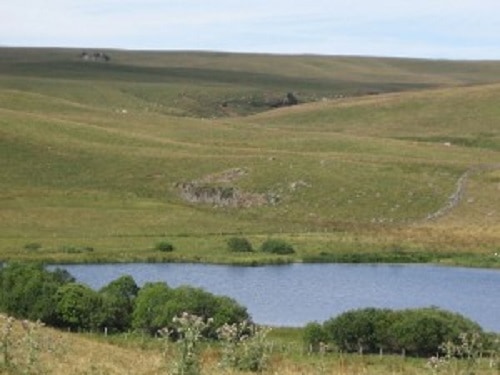
The Aubrac plateau sits at roughly 1,000 to 1,400 metres above sea level. It's a vast, treeless expanse of grassland, granite, and sky. In summer, it's apparently gorgeous: wildflowers, fat cattle, gentle breezes. I walked it in early April. It was not gentle.
The wind came from the north and it didn't let up for three days. I'm talking the kind of wind that makes your waterproof jacket sound like a flag in a gale. The temperature hovered around zero, occasionally dipping below. On the second morning, somewhere between Nasbinals and Saint-Chély-d'Aubrac, I stopped to check my feet and realised my toes had gone completely numb. Not "a bit cold" numb, but white and waxy. I'd read about frostnip; I hadn't expected to experience it on a French hiking route in spring.
I ducked into a buron (a traditional stone shepherd's hut, some now converted into basic shelters) and spent twenty minutes warming my feet against my stomach, which was exactly as uncomfortable and undignified as it sounds. A French pilgrim named Jean-Pierre found me there and, without a word, made me drink hot tea from his thermos. Then he insisted on checking my toes himself. We'd exchanged perhaps forty words over the previous two days. He'd have carried me to the next village if I'd needed it.
What I'd do differently, and what I'd tell anyone planning an early-season crossing:
- Layering system: Merino base layer, fleece mid-layer, windproof shell. Do not rely on a single thick layer.
- Wind protection: A buff for your face and neck. Windproof gloves, not just warm ones. The wind on the Aubrac plateau is relentless.
- Sock strategy: Merino wool socks with a thin liner. Carry a spare dry pair in a waterproof bag at the top of your pack, not buried at the bottom.
- Foot checks: Every 90 minutes in cold conditions, stop and wiggle your toes. If they're numb, deal with it immediately.
- Know when to stop: If visibility drops or the wind becomes dangerous, shorten your stage. There are accommodation options between the main towns.
After the Aubrac, my body adapted. It sounds strange, but those difficult days taught me my sustainable walking rhythm: a steady pace, regular stops, proper food at lunch. By the time I reached Espalion, two days south of the plateau, I felt like a different walker.
How Does the Scenery Change from Winter into Spring Between Le Puy and Saint-Jean?
This was the thing that surprised me most, and I don't think anyone had quite prepared me for it. Walking the Le Puy Camino in early spring means you're literally walking into the season. You start in the tail end of winter and, over weeks and hundreds of kilometres, the world wakes up around you.
Leaving Le Puy-en-Velay, the volcanic landscape was still brown and grey. Frost on the grass each morning. Bare trees. The countryside had that empty, waiting quality of a stage set before the actors arrive.
Then, somewhere south of the Aubrac, daffodils appeared. Just a few at first, in a ditch beside the path. Then whole fields of them, nodding in that slightly idiotic way daffodils have, as if they're agreeing with something you haven't said yet. A week later, the canola fields came in: that absurd, almost aggressive yellow that makes you feel like you've walked into a painting someone over-saturated. By the time I was approaching the foothills of the Pyrenees, apple blossoms lined the route in France, and I was walking in a t-shirt.
- Daylight: At the start, I was finishing stages in near-darkness. By the final weeks, I had light until 8:30 pm.
- Temperatures: From sub-zero on the Aubrac to 18 to 22°C in the Pyrenean foothills.
- Trail conditions: Early muddy and icy sections gave way to dry, firm paths.
- Mood: This is harder to quantify, but I'll say it plainly: the warming of the landscape warmed me. It felt like the earth was keeping pace with something happening inside.
What Are the Biggest Highlights on This Stretch (Including Conques and the Monastery Stay)?
Conques deserves its own paragraph, its own chapter, possibly its own religion.
You approach Conques from above, descending through forest on a path that pilgrims have walked for over a thousand years. Did you know the name Conques comes from the Latin for "shell"? The village appears below you in a fold of the valley: the great Romanesque Abbey Church of Sainte-Foy, the stone houses clustered around it, the whole scene absurdly perfect. I sat on a wall and cried a bit, which I'm only slightly embarrassed about. After the Aubrac, after the cold, after days of pushing through countryside that felt indifferent to my existence, arriving somewhere that had been waiting for pilgrims for a millennium felt like being welcomed home by a place I'd never been.
I stayed with the Premonstratensian community who manage hospitality near the abbey. The accommodation is simple: a shared room, a communal meal, vespers in the church. There are expectations of quiet and respect after a certain hour. During the evening prayer, one of the monks offered a blessing for the pilgrims present. I'm not particularly religious, but when a man in white robes places his hand on your head and asks that you be kept safe on the road ahead, something in your chest responds. You don't have to believe in the theology to feel the kindness.
Beyond Conques, the highlights along the Le Puy route tend to be quieter:
- Morning departures before dawn, the crunch of gravel, the stars still out
- Village fountains where you refill your water and splash your face
- Small Romanesque churches left unlocked, cool and dim inside, a visitors' book with pilgrim entries in six languages
- The evening ritual: boots off, feet inspected, tape applied, journal opened, a glass of something local, and the knowledge that you earned every sip
How Do You Navigate Route Variants and Daily Decisions on the Chemin du Puy?
The GR65 is generally well waymarked with red and white blazes, the standard French long-distance trail markings maintained by the Fédération Française de la Randonnée Pédestre. But "generally well waymarked" doesn't mean "impossible to get lost." I managed it twice, both times leaving towns where the arrows through built-up areas were obscured by roadworks.
Route variants crop up regularly along the Le Puy way. These are alternative paths, sometimes shorter, sometimes longer, often offering a different landscape or avoiding a difficult section. On the Aubrac, for instance, there's a lower variant that avoids the most exposed plateau crossing. I took the high route because I'm stubborn, and I've already told you how that went.
My approach to daily decisions evolved over the weeks:
|
Decision Factor |
Early in the Walk |
Later in the Walk |
|
Weather |
Ignored forecasts, regretted it |
Checked every evening, adjusted plans accordingly |
|
Energy/injury |
Pushed through pain |
Shortened stages when my body asked |
|
Social |
Walked alone, felt noble about it |
Walked with others when the company was good, alone when I needed quiet |
|
Navigation |
Stressed about every junction |
Trusted the waymarking, carried a paper map for backup |
The mindset that served me best: progress over perfection. A wrong turn that adds two kilometres is not a disaster. It's a slightly longer walk through the French countryside. There are worse fates. Treat detours as part of the Camino, because they are.
What Is the Pilgrim Community Like on the Le Puy Route (and Who Will You Meet)?
The Le Puy Camino draws a different crowd than the busier Camino routes through Spain. The route is quieter, more French (naturally), and the pilgrim community feels smaller and more intimate. In peak season (June through September), you might share a gîte d'étape with ten or fifteen others. In shoulder season, sometimes it's just you and a retired Belgian couple and a woman from Toulouse walking through grief.
The motivations people carry are as varied as the walkers themselves:
- Spiritual seeking, traditional and otherwise
- Processing grief or major life transitions
- Retirement celebration (a surprisingly common one among French walkers)
- Simple curiosity: what does it feel like to walk 730 kilometres?
- Training for the Camino Francés, treating the Le Puy to Santiago route as one continuous pilgrimage
Trail friendships form fast. You walk with someone for a day, share a meal, exchange stories about blisters and children and what you did before this. Then one of you walks faster the next morning, and you might not see each other for three days, or ever again. It sounds melancholy, but it's actually liberating. Every encounter is complete in itself.
What American walkers often notice: the pace is unhurried. French pilgrims take lunch seriously, sometimes spending ninety minutes over a proper meal. Trail greetings are warm but not effusive. "Bon Chemin" or "Buen Camino" is all you need. And the evening communal meals at gîtes are where the real connections happen, over wine and cassoulet and someone's terrible French jokes that are somehow funnier because of the language barrier.
What Should You Eat and Drink on the Way (and What Makes French Food and Wine Part of the Camino)?
Let me be direct: the food on the Le Puy Camino is the best on any of the Camino de Santiago routes. This is the unique Camino advantage of starting in France. You are walking through a country that considers a mediocre lunch to be a minor moral failing.
After twenty-five kilometres of walking, a bowl of aligot (that extraordinary Aubrac dish of mashed potato with melted cheese, stretched until it forms long, elastic ribbons) is not just food. It is restoration at a cellular level. A warm tartine with local ham and cornichons at a village café feels like it was invented specifically for the exact degree of hunger you're experiencing.
- Bread: Buy it fresh each morning. A baguette tradition from a proper boulangerie is worth any detour.
- Cheese: Laguiole and Cantal on the Aubrac; Rocamadour further south. Carry a piece wrapped in paper for lunch.
- Wine: Cahors reds in the Lot valley, lighter vin de pays elsewhere. One glass with dinner is recovery. Two glasses is conviviality. Three is a rest-day decision.
- The earned-glass feeling: There is a specific pleasure in drinking a glass of local wine after walking all day that cannot be replicated in any other context. It is modest and enormous at the same time.
Budget-wise, communal gîte meals typically cost 12 to 18 euros for a three-course dinner with wine included. Eating at restaurants in larger towns like Figeac or Cahors will cost more, perhaps 20 to 35 euros for a pilgrim menu. Accommodation along the Le Puy route ranges from around 15 to 25 euros for a gîte d'étape dormitory bed, while private rooms in hotels or chambres d'hôtes run 45 to 90 euros per night. Miam Miam Dodo, the essential guidebook for this route, lists current prices and contact details for most accommodation options.
Are there luggage transportation services available on the Le Puy Camino? Yes. Several companies offer luggage transfer between stages, typically costing 8 to 15 euros per bag per day. This is more common in peak season and on the busier sections. Some purists frown on it. I'd say: carry your own pack if you can, but there's no shame in lightening the load if your body needs it. The pilgrimage is in the walking, not the suffering.
FAQ: Le Puy to Saint-Jean-Pied-de-Port on the Camino de Santiago
How long does it take to walk from Le Puy-en-Velay to Saint-Jean-Pied-de-Port?
Most walkers complete the route in 28 to 35 walking days, plus rest days. A comfortable pace with two or three rest days means roughly five weeks total. Faster walkers can manage it in 25 days, but the Le Puy Camino rewards patience. Weather on the Aubrac plateau and your fitness level in the first week are the biggest variables affecting your timeline.
Is the Le Puy route waymarked and easy to follow without a guide?
The GR65 is marked with red and white blazes maintained by the FFRandonnée, and you don't need a professional guide. Navigation is straightforward on most stages. The tricky moments tend to be town exits (where signs compete with traffic infrastructure), variant junctions (where you must choose between routes), and the Aubrac in fog or low visibility. Carry the Miam Miam Dodo guidebook and a basic map or GPS app as backup.
What is the best time of year to walk this section (especially with Aubrac weather)?
May through September is the main walking season. June offers the best balance of stable weather, long daylight, and manageable crowds. April and early May bring wildflowers and solitude but risk freezing temperatures on the Aubrac plateau, possible snow or ice at higher elevations, and shorter days. July and August are warm but busier, and accommodation in popular stops like Conques can fill up.
Do I need to book accommodation in advance on the Chemin du Puy?
In peak season (June through August), booking one to two days ahead is wise, especially for Conques and smaller villages with limited beds. In shoulder season (April, May, September), you can often walk in and find a bed, though calling ahead by mid-afternoon is courteous and practical. Weekends are busier year-round, as French day-walkers and weekenders use sections of the GR65.
What is special about Conques on the Chemin du Puy?
Conques is a medieval village classified as one of the Plus Beaux Villages de France, centred on the 11th-century Abbey Church of Sainte-Foy with its remarkable Romanesque tympanum. For pilgrims, it's a spiritual and emotional waypoint, roughly 200 kilometres into the walk. The monastery community offers accommodation and communal meals, and the evening pilgrim blessing is a moving experience regardless of your faith. Many walkers describe Conques as the emotional high point of the entire Le Puy to St Jean journey.
What is the difficulty of the Le Puy Camino?
The Le Puy route is a moderate to challenging long-distance walk. It's not technically difficult (no scrambling or ropes), but the distance is significant and the terrain varies from steep volcanic hills near Le Puy-en-Velay to exposed plateau on the Aubrac to rolling hills through the Lot valley. The first week is physically the hardest as your body adjusts. Compared to the Camino Francés, the Le Puy Camino has more elevation change and fewer services between stops, which makes it slightly more demanding.
What is the prettiest Camino de Santiago route?
Beauty is subjective, but the Le Puy route is consistently ranked among the most scenic of all Camino de Santiago routes. The volcanic landscapes around Le Puy-en-Velay, the wild Aubrac plateau, the medieval villages of the Lot valley, and the approach to the Pyrenees offer extraordinary variety. The Camino del Norte along Spain's northern coast is another strong contender. But walking through the French countryside in spring, with canola fields blazing yellow and stone villages appearing around every bend, is hard to beat.
Planning Your Own Le Puy to Saint-Jean Walk
If you're thinking about walking this route, here's what I'd suggest as a starting point. Read the Miam Miam Dodo guide for practical stage planning and current accommodation listings. Check the Oficina del Peregrino website for credencial (pilgrim passport) information if you plan to continue from Saint-Jean-Pied-de-Port to Santiago. And think honestly about when you want to go, because your experience of the Aubrac in April versus June will be fundamentally different.
The next article in this series covers arriving in Saint-Jean-Pied-de-Port and choosing your first Camino Francés stage over the Pyrenees to Roncesvalles. That crossing is its own kind of extraordinary, but if you've already walked the Le Puy way, you'll arrive at the foot of those mountains as a real walker. Your pack will be lighter (you'll have posted things home by then, everyone does). Your feet will know the drill. And you'll have seven hundred kilometres of French countryside, Aubrac wind, Conques stone, and springtime daffodils behind you.
That's not a bad way to start anything.




Leave a Reply