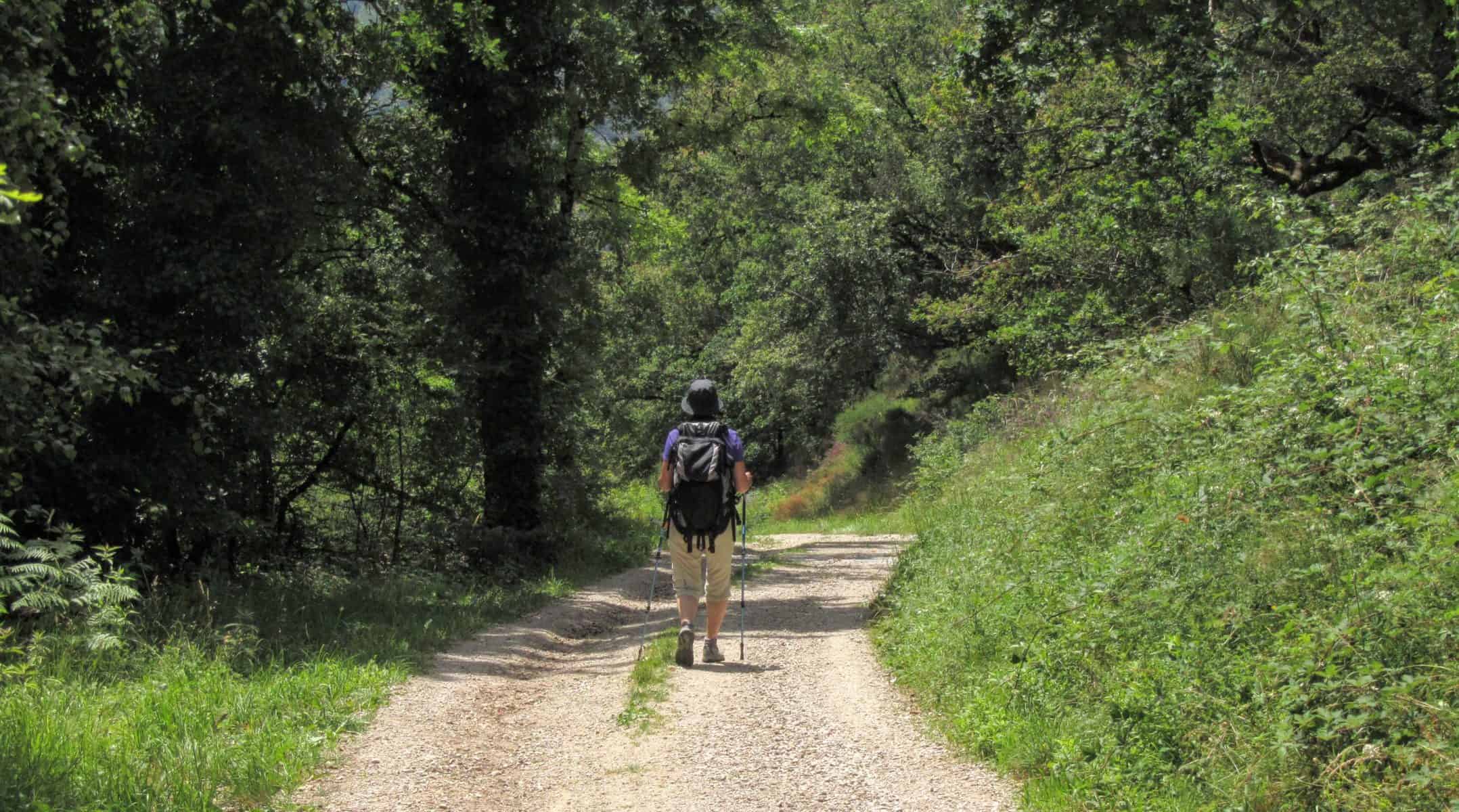
Most people who walk the Camino de Santiago have a tidy answer ready for why they went. A death, a divorce, a milestone birthday, a spiritual itch. Mine is less tidy. In 2004 I walked into Spain with borrowed gear and no real plan to reach the end, and I came back a different person, in ways I am still noticing two decades later. This is not a guidebook. It is one man's account of how a long walk in northern Spain rearranged the furniture in my head.
If you are reading this because you feel stuck, or because some part of your life has stopped fitting you, then we already have something in common. That is roughly where I was standing in 2002, when none of this had happened yet and I had no idea a pilgrimage was waiting for me.
A quick word for readers in the United States who may not know the territory. The Camino de Santiago is a network of old walking routes across Spain, and from neighbouring countries, that all end at the cathedral in Santiago de Compostela in Galicia, where the bones of Saint James are said to rest. The most walked of the walking routes is the Camino Francés, which crosses northern Spain from the French border. Many pilgrims begin on the French side, in a small town called Saint Jean Pied de Port, and that is where my own first steps would eventually fall.
How did I go from an unfulfilling career to the moment that set everything in motion?
In 2002 I was good at a job I had stopped believing in. That is a strange kind of misery, the competent kind. Nobody pities you. You hit your numbers, you get the nod, and on the drive home you feel like a photocopy of a person. The word "unfulfilling" sounds gentle on the page. In practice it felt like Sunday evenings arriving a little earlier each week.
I went to see a counselor, mostly because a friend bullied me into it. I expected tips. Coping strategies. Instead she asked me one plain question that I have never quite shaken: "If you weren't afraid of looking foolish, what would you actually do?" I gave the polished answer first, the sensible one. Then I sat there long enough that the real answer surfaced. I wanted to read books and talk about them. That was it. Not very heroic.
So at an age when most of my peers were buying second houses, I enrolled at university to study English Literature as a mature student. The fear was real. I was older than some of the lecturers. I worried I would be the man at the back who asked obvious questions. But there was relief in it too, a loosening, like setting down a backpack you had been carrying so long you forgot it was optional.
Here is the thing that surprised me, and that I have since heard echoed by other people who walked and changed direction: the change began before any walking did. The Camino did not start in Spain. It started in a counselor's office with a question I could not un-hear.
How did a chance connection at university introduce me to the Camino de Santiago?
I met Dara in a seminar on Romantic poetry. He was another mature student, older even than me, with the unhurried manner of a man who had decided he had nothing left to prove. We fell into the habit of coffee after class. One grey afternoon he mentioned, almost in passing, that he had walked to Santiago de Compostela the previous summer.
I did not really know what that meant. I had a vague picture of monks and medieval roads, something dusty and Catholic and faintly intimidating. Not for people like me, I thought, the way you do when something feels reserved for the more serious, the more devout, the more capable. Dara did not sell it. He just talked about it the way you talk about a place you loved, with specific small details: a soup he could still taste, a German pilgrim who snored like a tractor, a morning when the fog lifted off a valley as if a curtain had been drawn back.
That is the quiet power of sitting near someone whose life is shaped a little differently from yours. One person's casual story can widen the borders of what you think is possible for you. By the time my coffee was cold, a door I had not known was there had opened a crack. And something Dara said stuck with me, that you tend to find your people on the route without ever trying. The friendships, he reckoned, started before the walking did, the moment you decided to go.
How did I prepare on almost no budget, and what did I take even though I wasn't sure I'd finish?
I had the time, being a student, and almost none of the money, being a student. My preparation was a masterclass in making do. I borrowed a backpack from a friend's brother, a faded thing with a frame that dug into my hips for 800 km without ever once apologising. My hiking boots were my own, bought years earlier for a holiday and barely worn. I begged a sleeping bag, two pairs of merino socks, and a sports bra, the last item lent by a no-nonsense fellow student who informed me it was the single most useful thing she had carried, and she was not joking.
The budget shaped everything, and I came to be grateful for it. When you cannot afford choices, you stop agonising over them. Simplicity was forced on me, and it turned out to be the first lesson rather than a limitation.
Here is what went into the backpack, roughly, when I finally laid it all out on the floor:
- Two changes of clothes, including the now-famous borrowed sports bra (not mine, to be clear)
- A sleeping bag liner and a thin bag, for the albergues
- Blister tape, painkillers, and a small first aid kit I prayed I would not need
- A guidebook with the stages marked, already coming apart at the spine
- Enough cash for food and water, and very little spare for anything else
What I did not pack was certainty. I bought a flight home with a flexible return and told nobody, including myself, that I would walk all the way to Santiago. The honest truth is I half expected to quit in the first week. I told my mother I was "going for a long walk in Spain," which technically was not a lie.
What did I learn about "needing the perfect plan" before I could begin?
For most of my life I had treated readiness as a precondition. I would do the thing once I had the right gear, the right savings, the right moment. The Camino quietly dismantled that belief. I left under-prepared, under-funded, and unsure, and the walk happened anyway. Letting go of the perfect plan was what made room for everything that followed.
I think of it now as practice. A thousand small decisions on the trail, when to stop, where to sleep, whether to push on through the rain, were rehearsals for the bigger decisions waiting for me at home. You learn to choose without full information. You learn that "good enough to start" is usually enough.
What did those first steps from France feel like, and why were they so important?
I arrived in Saint Jean Pied de Port the night before I began, in that strange limbo of a traveler who has come a long way to do something he is not sure he can do. The town was full of pilgrims with proper kit and confident calves. I felt like a fraud with a borrowed backpack.
Then it was morning, and I was walking. The first stage out of Saint Jean Pied de Port climbs hard into the Pyrenees toward Roncesvalles, and there is no easing into it. The pack found my shoulders within an hour. The first real hill found my lungs not long after. Somewhere around the second climb I had my first proper doubt, the cold thought of what if I have made a terrible mistake.
But something else happened on those first steps that I did not expect. I stopped being able to think my way through the problem. There was only the path, the breath, the next yellow arrow painted on a stone. The yellow arrows are how you find the way; they appear on walls, posts, and pavements, and you learn to trust them. Later, back home, I would catch myself looking for "yellow" in ordinary decisions, some small sign pointing onward. On the mountain, though, it was literal. Follow the arrow. Put one foot down. Then the other.
That was the shift, and it came faster than I would have believed. I had spent years planning a life I never quite lived. On the first walk, in the space of a single hard morning, I started simply living one day, then the next.
What rhythm did I fall into on the Camino, and how did it reshape my mind?
By the end of the first few days a rhythm had taken hold, and it was the rhythm that did the work. Wake before light to the sound of zips and whispered Spanish. Walk in the cool morning. Eat bread and cheese and an orange somewhere around mid-morning. Walk again. Arrive, wash socks, find a bed, eat, sleep, repeat. There is nothing dramatic about it written down. Lived, day after day, it scoured something clean.
Simplicity worked on me like medicine. With fewer choices, my values got clearer. I noticed I cared a great deal about a hot shower and a dry pair of socks, and almost nothing about the things that had been quietly running my life back home. The trail has a way of sorting the essential from the noise.
It was not all grace. I want to be honest about that, because the romantic version helps nobody. There were bad days. The meseta, that long flat stretch in the middle, tested me with its heat and its sameness. I had blisters that made me hobble like a much older man. There was a night with bed bugs that I will not describe in detail, except to say I have never packed a backpack so fast in my life. And there was loneliness, real loneliness, the kind that arrives at dusk in a strange town and asks you what on earth you are doing.
The struggles, oddly, were where the lessons lived. A few of the things the long walk taught me, the hard way:
- Patience, because no amount of frustration makes a 25 km day any shorter
- Humility, because everyone limps eventually, and pride does not heal a blister
- Resilience, learned not as a slogan but as a thing your body discovers it can do
- Gratitude, sharp and specific, for a bowl of tuna and pasta cooked by a stranger
And then, against all that, the moments of grace. A farmer who pointed me back to the path when I got lost in a field of maize and waved off my thanks. Live music spilling out of a bar in a plaza I cannot now name. A shared meal in an albergue where six of us, with maybe three languages between us, laughed until late. You cannot manufacture these moments. You can only walk far enough, and stay open enough, to receive them.
How did the people I met on the Camino change the experience, and me?
I set out expecting solitude, and the solitude came, and I needed it. There was time to process things I had been outrunning for years. But the people were the part I did not see coming. You meet the same faces at the same albergues, you walk together for a stretch, you peel apart and find each other again three towns on. Without trying, you assemble something pilgrims call a Camino family.
What undid me, gently, was that none of these people had met the polished version of me. They met a tired man in borrowed kit with a half-formed plan, and they liked him fine. There is a strange freedom in being witnessed without your usual armour. I learned to accept help, which I had always been bad at. When you genuinely need food and water and someone offers, your pride is the first thing to go light, and good riddance to it.
I also learned to give it back, to share tape and directions and the last of the wine. And I learned the small daily grace of "Buen Camino," the words pilgrims wish each other on the route. Two words that mean, more or less, may your journey go well. I cannot think of a kinder thing to say to a stranger.
What happened when I reached "the end," and what did it change after I came home?
I did reach Santiago de Compostela, the man who had not committed to finishing. Walking into the Praza do Obradoiro, the great square below the cathedral, with the towers above me and other pilgrims weeping or laughing or just lying flat on the stones, I felt something I am still careful with the words for. Not triumph exactly. More like being emptied and then quietly refilled.
I went on, as many do, to walk the extra days west to Finisterre, the cape the old world called the end of the world. Standing at the edge of the Atlantic with nowhere left to walk is a fitting place to think about endings and beginnings. It felt less like a finish line and more like a release.
The real test, though, was not the arrival. It was the flight home, and the months after. This is the part the films skip. Coming back is hard. The world is loud and fast and full of choices again, and you carry a quiet that does not quite fit the supermarket. They call it the Camino blues, and it is real. Reintegrating that pilgrim version of yourself into ordinary life takes time.
But the changes held, and they were concrete rather than mystical. Here is roughly how my life looked on either side of that 2004 walk:
|
Area of life |
Before the Camino |
After the Camino |
|
Work and purpose |
Competent but hollow; staying for security |
Willing to choose meaning over the safe option |
|
Decisions |
Driven mostly by fear of looking foolish |
Led more by values, less by what others might think |
|
Discomfort |
Avoided it, planned around it |
Tolerated it; learned it usually passes by the next town |
|
Uncertainty |
Needed a full plan before starting anything |
Comfortable beginning with "good enough to start" |
None of this turned me into a saint. I still procrastinate, still over-pack, still occasionally choose the safe thing. But the long walk gave me a reference point, a place I can return to in my head when life gets noisy. When a decision frightens me, I remember a tired man on a mountain in Spain following a yellow arrow he had to trust, and I find I can take the next step.
What can you take from my 2004 Camino if you're considering a bold shift in direction?
If you are standing where I stood in 2002, I will not pretend I have a formula. The experience is genuinely different for everyone, and anyone who tells you exactly what your pilgrimage will mean is guessing. But there are a few things I would say to a friend, plainly, that hold up across the years.
You do not need perfect timing, perfect gear, or perfect confidence. I had none of the three. The walk took my physical and emotional edges and worked on them anyway. A handful of mindset takeaways, offered not as a how-to but as what I actually learned:
- Start before you feel ready, because you will never feel entirely ready
- Let the day's walk be enough; the whole route is just one day, repeated
- Say yes to the conversation, the meal, the offer of help
- Trust small steps to add up to a change you could not have planned
Your own version of this might be a literal pilgrimage in northern Spain, on the Frances or the quieter routes, or even the Camino Portugués starting near Porto in Portugal. Or it might be the first brave step taken at home, the phone call, the course, the resignation letter, the honest question you have been avoiding. Both count. The Camino taught me that the bold shift is rarely one grand gesture. It is usually a small, frightened decision to begin, followed by another, followed by the willingness to keep going.
I think often about whether I will walk again. There is always a next Camino somewhere in my mind, a next adventure half-planned. Whether or not I ever lace up the boots again, the first one did its work. It is the long walk I keep walking, in a sense, every time I choose the meaningful thing over the merely safe one.
What do people in the U.S. usually ask about walking the Camino to change their life?
Do I need a religious reason to walk the Camino de Santiago?
No. The Camino is a religious pilgrimage in origin, and many walk it for faith, but plenty of pilgrims set out for reflection, grief, a life transition, or simple curiosity. Your reason matters more than any label. I would say I walked it seeking something closer to clarity than to God, and I was made welcome all the same.
What if I'm not sure I can finish the Camino?
Then you are in good company, because I was not sure either. You can begin without committing to the end, and the experience can change you even if you stop early. Many people walk a week or two of a route rather than the whole thing, and come home moved. Starting is the brave part; the finishing tends to sort itself out one day at a time.
Is the Camino de Santiago safe for solo travelers?
It is generally considered safe and welcoming, with a strong pilgrim culture and other walkers rarely far away, even when you set out alone. That said, ordinary travel sense still applies: keep an eye on your belongings, trust your instincts about people and places, and do not walk yourself into a state of exhaustion in the heat. I walked much of it solo and never once felt in danger.
How much does walking the Camino cost if I'm on a tight budget?
Costs vary with how you sleep and eat, but it can be done modestly. Pilgrim albergues are inexpensive dormitory hostels, and a hostel bed plus simple meals keeps the daily spend low. I walked on very little, and the budget became part of the lesson rather than a hardship; spending less made me notice more.
What's the best time of year to walk if I'm traveling from the United States?
Spring and autumn are the popular seasons, balancing decent weather against the worst of the summer heat and crowds. Summer is busiest and hottest; winter is quiet and demanding. Choose based on what you want, whether that is company on the trail or solitude, and on what your body can take. There is no single right answer, only the one that fits your reasons for going.




Leave a Reply