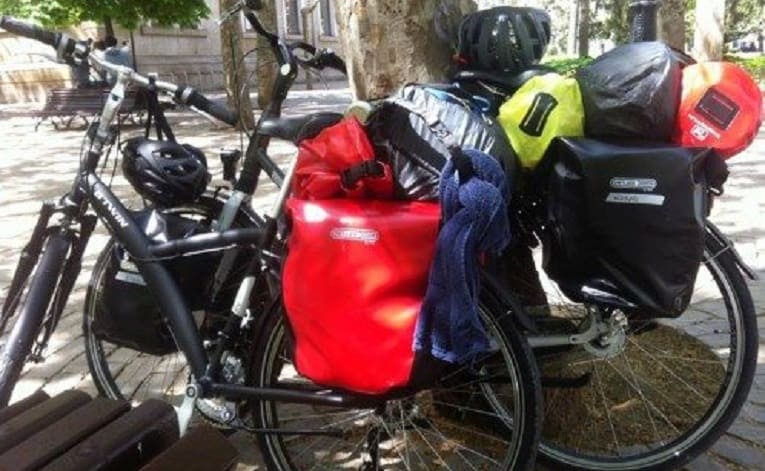
What Is It Like to Cycle the Camino de Santiago to Santiago de Compostela?
Somewhere around kilometre twelve, on a gravel path south of Pamplona, a Dutch woman's bicycle made a sound like a small animal dying. The chain snapped. The derailleur hung at an angle that suggested it had given up on life entirely. She'd been cycling for fifteen minutes.
This is a true story, and it's the reason this article exists. The woman, physically limited and unable to walk the Camino Francés with a backpack, had been inspired by the film The Way to cycle the camino de santiago instead. Her plan was simple: ride from Pamplona to Santiago de Compostela, roughly 740 kilometres of the classic route, with her partner. The reality, as the Camino tends to insist, was more complicated.
This post is for anyone, particularly U.S. readers, planning to cycle the Camino de Santiago by bike. Maybe you're considering it because walking isn't feasible for you, whether due to injury, disability, or the honest acknowledgment that your knees have opinions about stairs. You'll learn about bike choice, helmet and traffic safety, the surfaces you'll actually ride on, dealing with breakdowns, and the kind of flexible, expect-the-unexpected mindset that separates a miserable trip from a pilgrimage.
Why Choose Cycling the Camino Instead of Walking It?
The traditional camino pilgrimage involves walking, often with a pack on your back, for weeks. It's a beautiful thing. It is also, for some people, physically impossible. Bad hips, chronic pain, spinal conditions, post-surgical limitations: the list of reasons someone might not be able to carry a rucksack over the Pyrenees is long, and none of them should disqualify a person from the experience.
Cycling can make the Camino accessible while still feeling genuinely like a pilgrimage. You're still outside, still moving under your own power, still arriving at albergues with aching muscles and a need for soup. The pace is different, yes, but the landscape and the community remain.
- Speed vs. endurance: Cyclists cover more ground per day (typically 60 to 100 km) but face different fatigue patterns, particularly in the hands, neck, and lower back.
- Less foot strain, more technical demand: No blisters, but you'll need to handle mixed surfaces, traffic, and basic bicycle maintenance.
- Emotional expectation: If you've watched The Way and imagined walking into Santiago de Compostela on foot, cycling will feel different. Not lesser, but different. Set that expectation early.
The tradeoff is real. You'll move faster through villages that walkers savour for hours. You'll miss some conversations. But you'll have others, usually at rest stops, where cycling pilgrims tend to cluster and swap stories about gradients and gear ratios with the fervour of theologians debating doctrine.
Can You Earn a Compostela by Cycling to Santiago de Compostela?
Yes. The Oficina del Peregrino (Pilgrim's Office) in Santiago de Compostela issues the official Compostela certificate to cyclists who have ridden at least the last 200 kilometres of any camino route. For walkers, the minimum is 100 km. For cyclists, it's double.
|
Mode of Travel |
Minimum Distance for Compostela |
Common Starting Point (Camino Francés) |
|
Walking |
100 km |
Sarria |
|
Cycling |
200 km |
Ponferrada or León |
|
Horse |
200 km |
Varies |
To document your journey, you'll need a pilgrim credential (also called a pilgrim passport), a folding card where you collect stamps, known as sellos, at albergues, churches, cafés, and municipal offices along the route. You can purchase a credential before departure from confraternities such as the American Pilgrims on the Camino, or pick one up at the pilgrim office in Saint-Jean-Pied-de-Port or Pamplona.
- Collect at least two stamps per day for the final 200 km.
- Don't skip stages by car or bus without noting it honestly; the Pilgrim's Office staff may ask questions.
- Common pitfall for cyclists: covering too much ground and forgetting to stop for stamps. Plan your sello stops as deliberately as your lunch stops.
What Route, Surfaces, and Navigation Should You Expect on the Camino Francés by Bike?
The Camino Francés is the most popular camino route for both walkers and cyclists, and with good reason. It's the best waymarked, has the most accommodation options, and the most reliable infrastructure along the route. Starting from Saint-Jean-Pied-de-Port (or Pamplona, as many cyclists do to avoid the steep Pyrenean crossing on foot-only paths), the cycling route runs roughly 740 to 780 km west through Navarra, La Rioja, Castilla y León, and into Galicia before you arrive in Santiago.
But here's the surface reality check that no glossy camino cycling brochure will give you honestly:
- Dirt and gravel paths: The camino trail itself is often unpaved, ranging from hard-packed earth to loose gravel to rocky singletrack. After rain, sections in Galicia become genuinely muddy.
- Cobblestones: Town entries and historic centres feature cobbles that rattle your teeth and test your grip.
- Paved roads: When the walking path is too narrow or too rough for bicycles, cyclists are diverted onto local roads or, more problematically, the N-roads (national roads).
What Should You Know About Cycling on Roads Without Dedicated Bike Lanes?
The N-roads are the uncomfortable truth of camino cycling. These are national highways carrying lorries, cars, and motorcycles at speeds that feel much faster when you're on a bicycle with panniers. There is often no dedicated cycle lane. The hard shoulder, where it exists, can be narrow and littered with debris.
This is not a reason to abandon the plan. It is a reason to ride defensively and plan intelligently.
- Visibility: Wear bright layers. Use front and rear lights even during daylight. A reflective vest weighs nothing and could save your life.
- Positioning: Ride predictably. Don't weave. Hold a consistent line roughly one metre from the road edge.
- Timing: Avoid N-road sections during rush hours or in poor visibility. Early morning riding is quieter and cooler.
- Riding as a pair: If cycling with a partner, ride single file on busy roads. Agree on hand signals and verbal calls ("car back") before you start.
- GPS alternatives: Apps like Komoot, Mapy.cz, or Gronze often show parallel routes on quieter local roads. Check the night before each stage.
Waymarking along the Camino Francés is excellent for walkers, with yellow arrows and scallop shells painted on walls, trees, and fence posts. Cyclists will follow many of these same markers, but where the cycling route diverges onto roads, GPS becomes essential. Don't rely solely on painted arrows when you're being diverted around a section that's foot-traffic only.
What Kind of Bike Do You Need to Cycle the Camino?
This is where the Dutch woman's story becomes instructive. She started with an old, poorly maintained bicycle. It broke within fifteen minutes. The lesson isn't subtle: invest in a high-quality mountain bike with many gears.
A sturdy mountain bike or hybrid bike is the right choice for the Camino Francés. A road bike, with its narrow tyres and aggressive geometry, is poorly suited to the gravel paths, cobbles, and rough terrain you'll encounter. You want stability, tyre clearance for at least 38mm (ideally 40mm or wider), reliable disc brakes, and a gearing range low enough to get you up steep climbs without destroying your knees.
|
Bike Type |
Francés Suitability |
Key Advantage |
Key Limitation |
|
Mountain bike (hardtail) |
Excellent |
Handles all surfaces; wide gearing |
Heavier; slower on tarmac |
|
Hybrid bike |
Good |
Comfortable geometry; versatile |
Less capable on rough singletrack |
|
Road bike |
Poor |
Fast on paved sections |
Tyre punctures; unstable on gravel |
|
Gravel bike |
Very good |
Drop bars; wide tyres; light |
Gearing may be limited for steep climbs |
For riders with physical limitations, fit matters enormously. A saddle that causes pain after twenty minutes will cause agony after twenty days. Consider an ergonomic saddle, adjustable stem, and bar ends or ergonomic grips. If possible, get a professional bike fit before departure. It costs around 100 to 200 euros and can prevent weeks of unnecessary suffering.
What Happened When the Original Bike Broke, and What Can You Learn From It?
The bike failed within fifteen minutes. Not gradually, not with a polite warning creak. It simply stopped being a functional bicycle. The chain snapped, the derailleur twisted, and the couple stood on a gravel path near Pamplona wondering what to do with a pilgrimage that hadn't really started yet.
What this reveals is straightforward:
- Cheap or old bikes are a false economy. A bicycle that hasn't been serviced is a bicycle waiting to betray you.
- Pre-trip tune-ups are non-negotiable. Have a qualified mechanic inspect the drivetrain, brakes, wheels, and headset before you leave.
- Do a shakedown ride. Ride the actual bike, loaded, for at least 50 km before your departure day. If it's going to break, better it breaks near home.
- Must-check components: chain wear (use a chain checker tool), brake pad thickness, tyre condition, spoke tension, and bolt tightness on racks and accessories.
Should You Bring a Bike From Home or Buy One in Spain?
The couple in this story solved their crisis by walking into a Decathlon store in Pamplona and buying a new bike. This is, it turns out, a perfectly sensible strategy for many cyclists, particularly those flying from the United States.
|
Option |
Pros |
Cons |
|
Fly with your own bike |
Perfect fit; familiar machine |
Airline fees ($75 to $300+); damage risk; boxing/unboxing hassle |
|
Bike rental in Spain |
No transport logistics; return at end |
Fit uncertainty; quality varies; availability limited in smaller towns |
|
Buy in Spain (e.g. Decathlon) |
Quick; affordable (€300 to €800 for a solid bike); easy end-of-trip logistics |
May need adjustment; limited high-end options |
Decathlon stores exist in most major Spanish cities, including Pamplona, Burgos, León, and others along the route. Their B'Twin and Rockrider ranges offer reliable mountain bikes and hybrid bikes at reasonable prices. If you buy in Spain, you can donate or resell the bicycle in Santiago de Compostela at the end of your camino journey, which many cycling pilgrims do.
Before committing to any bike rental or purchase, check: frame size (stand over it; you need clearance), gearing range (at least a 34-tooth rear cassette for climbs), brake type (disc brakes strongly preferred), tyre width (40mm minimum), and whether the frame has rack mounts if you're using panniers.
Do You Need to Wear a Helmet When Cycling the Camino in Spain?
Under Spanish cycling regulations from the DGT (Dirección General de Tráfico), cyclists are required to wear helmets on interurban roads (outside built-up areas). Within cities, helmets are recommended but not mandatory for adults. Since the vast majority of the Camino Francés runs through interurban areas, you should wear a helmet for essentially the entire ride.
- Mixed surfaces and fatigue dramatically increase fall risk, especially in the afternoon.
- A MIPS-equipped helmet offers better rotational impact protection and costs only marginally more.
- Pair your helmet with front and rear lights (even during the day), a reflective vest, and bright clothing layers.
- Total cost for basic visibility kit: roughly €30 to €50. A trivial expense against the risk.
Where Can You Get Bike Repairs on the Camino, and How Should You Prepare for Breakdowns?
Bike shops exist in the larger towns and cities along the Camino Francés: Pamplona, Estella, Logroño, Burgos, León, Ponferrada, and Sarria all have at least one. In smaller villages, you're relying on your own tools, the kindness of fellow pilgrims, or the occasional bar owner who happens to have a wrench and an opinion about your derailleur.
Carry a minimalist repair kit. You're not opening a workshop; you're keeping yourself moving to the next town with a proper bike shop.
- Two inner tubes (matching your tyre size)
- Patch kit and tyre levers
- Mini pump or CO₂ inflator with two cartridges
- Multi-tool with Allen keys (4, 5, 6mm), Phillips and flathead screwdriver bits, and a chain breaker
- Quick link for your chain (match it to your chain speed: 9, 10, 11, or 12-speed)
- Small bottle of chain lube
- Basic first-aid: plasters, antiseptic wipes, ibuprofen
Daily maintenance habits prevent most breakdowns. Each morning, before you clip in: check tyre pressure (squeeze test if you don't have a gauge), spin both wheels to check for rubbing brakes, and give each bolt on your rack and accessories a quarter-turn to ensure nothing has rattled loose. It takes ninety seconds. It can save your day.
What Should You Pack for Cycling the Camino Without Overloading Yourself?
The pilgrim's eternal dilemma applies doubly to cyclists. Every gram you carry, you push uphill. The temptation is to pack for every eventuality, but the Camino Francés passes through enough towns that you can buy most things you've forgotten.
|
Category |
What to Bring |
Notes |
|
Clothing |
2 cycling jerseys/shirts, padded shorts, arm warmers, rain jacket, lightweight fleece, evening clothes (one set) |
Merino wool layers dry faster and smell less |
|
Safety |
Helmet, front/rear lights, reflective vest, cycling gloves |
Gloves prevent nerve compression on long days |
|
Repair kit |
See list above |
Keep in an accessible bag, not buried in a pannier |
|
Documents |
Passport/ID, pilgrim credential, travel insurance details, phone with GPS app, charger/power bank |
Photograph all documents as backup |
|
Storage |
Panniers (rear) or bikepacking bags |
Panniers offer more space; bikepacking bags are more aerodynamic and stable on rough terrain |
If you're planning a mixed itinerary of part walking and part cycling, you'll also need walking shoes (not just cycling shoes), a small cable lock for the bicycle when you walk sections, and a realistic stage plan that accounts for the logistics of switching modes. Some pilgrims arrange luggage transfer services, available along the Camino Francés for around €5 to €8 per stage, to move bags between accommodation on the camino while they ride or walk unburdened.
FAQ: Cycling the Camino de Santiago to Santiago de Compostela
Is the Camino Francés more dirt paths or road biking for cyclists?
It's a genuine mix. Roughly half the cycling route follows unpaved paths (dirt, gravel, some rocky sections) and the other half uses paved roads, including local roads and stretches of busier N-roads. This is precisely why a mountain bike or hybrid bike with wider tyres outperforms a road bike on the Francés. Your daily pace will vary depending on how much of that day's stage is off-road.
How long does it take to bike from Pamplona to Santiago de Compostela?
Most cyclists complete the Pamplona to Santiago de Compostela stretch (roughly 740 km) in 10 to 14 riding days, averaging 55 to 75 km per day. Add rest days, repair delays, and the inevitable afternoon spent in a café in Burgos watching the world go by, and a realistic itinerary is two to three weeks. Fitness, weather, elevation (the climb to O Cebreiro in Galicia is no joke), and whether you choose trail or road alternatives all affect timing significantly.
Are cyclists welcome in albergues (pilgrim hostels)?
Generally, yes, though with caveats. Many albergues along the Camino accept cycling pilgrims, but walkers typically receive priority for beds. Some albergues have dedicated bicycle storage; others will let you lock your bike in a courtyard or garage. Arrive by early afternoon if possible, and always ask about bike storage before assuming it's available. Be considerate of walkers, particularly regarding early morning noise and gear sprawl in shared spaces.
Do e-bikes count for a Compostela?
The Pilgrim's Office in Santiago de Compostela does currently issue the Compostela certificate to e-bike riders who meet the 200 km minimum cycling distance. However, attitudes toward e-bikes vary among traditional pilgrims and some confraternities. If you're relying on an e-bike, confirm current policy with the Oficina del Peregrino before departure, and ensure you have charging access planned for each stage.
Can you do part walk, part bike on the same Camino trip?
Yes, and some pilgrims with physical limitations find this mixed approach ideal. You might cycle the flatter Meseta stages and walk the more intimate sections through Galicia, or vice versa. Keep collecting stamps in your pilgrim credential regardless of mode. The logistical challenge is moving the bicycle when you're walking; luggage transfer services or a folding bike can help, though neither is without compromise. Plan your stages honestly and don't try to do both in one day unless you genuinely enjoy exhaustion.
What Should You Do If You're Considering Cycling the Camino Because You Can't Walk It?
Start by being honest about what your body can and cannot do, then plan around that reality rather than against it. Cycling the Camino de Santiago is not a consolation prize. It's a different expression of the same ancient impulse: to move toward something, under your own effort, one turn of the pedals at a time.
- Get a proper bike fit. If you have physical limitations, this isn't optional. A poorly fitted bicycle will amplify existing problems.
- Choose your gearing generously. More gears, lower ratios. Grinding up a hill in too hard a gear is how injuries happen.
- Do a shakedown ride. Load the bike with everything you plan to carry and ride 50 km. Note every discomfort. Fix it before you leave.
- Plan conservative daily distances. 40 to 50 km per day is perfectly respectable and leaves room for detours, delays, and the spontaneous café stop that turns out to be the best part of your week.
- Carry your safety kit religiously. Helmet, lights, reflective vest, repair essentials, documents.
The Dutch woman whose bike broke on day one? She bought a new bike at Decathlon, adjusted her expectations, and kept going. She and her partner cycled into Santiago de Compostela weeks later, a little battered, significantly fitter, and carrying a story that started with catastrophic mechanical failure and ended at the Cathedral of Santiago. That's the Camino. Not the plan, but what you do when the plan falls apart.
Whether you start from Pamplona, from Sarria to Santiago, or even consider the Portuguese Camino route from Porto to Santiago de Compostela, the bicycle can carry you there. It carried her. The key is to take it seriously enough to prepare well, and lightly enough to enjoy the ride.



Leave a Reply